
How active are children in the UAE, how much time do they spend on screens, and how does that compare with the rest of the world? This page collects the most reliable figures in one place, with every number linked to its source. Journalists, schools and parent bloggers are welcome to use the tables and charts with a credit and a link back.
Short answer: WHO recommends that children aged 5 to 17 average at least 60 minutes of moderate to vigorous activity a day, with vigorous and muscle-strengthening activity on at least three days a week, and less recreational screen time. Children aged 3 to 4 need 180 minutes of activity a day, including 60 minutes at moderate to vigorous intensity.
Table 1. WHO activity, screen and sleep guidelines by age
| Age | Physical activity | Screen time | Sleep |
|---|---|---|---|
| Under 1 | Several active periods a day; 30 minutes tummy time if not yet mobile | Not recommended | 14-17 hrs (0-3 months); 12-16 hrs (4-11 months) |
| 1-2 years | At least 180 minutes at any intensity | None at age 1; up to 1 hour at age 2, less is better | 11-14 hrs |
| 3-4 years | At least 180 minutes, including 60 minutes moderate to vigorous | Up to 1 hour, less is better | 10-13 hrs |
| 5-17 years | Average 60 minutes moderate to vigorous a day; vigorous and strength work 3 days a week | Limit recreational screen time | Not covered in these guidelines |
Sources: WHO guidelines for under-5s (2019) and WHO guidelines on physical activity and sedentary behaviour (2020).
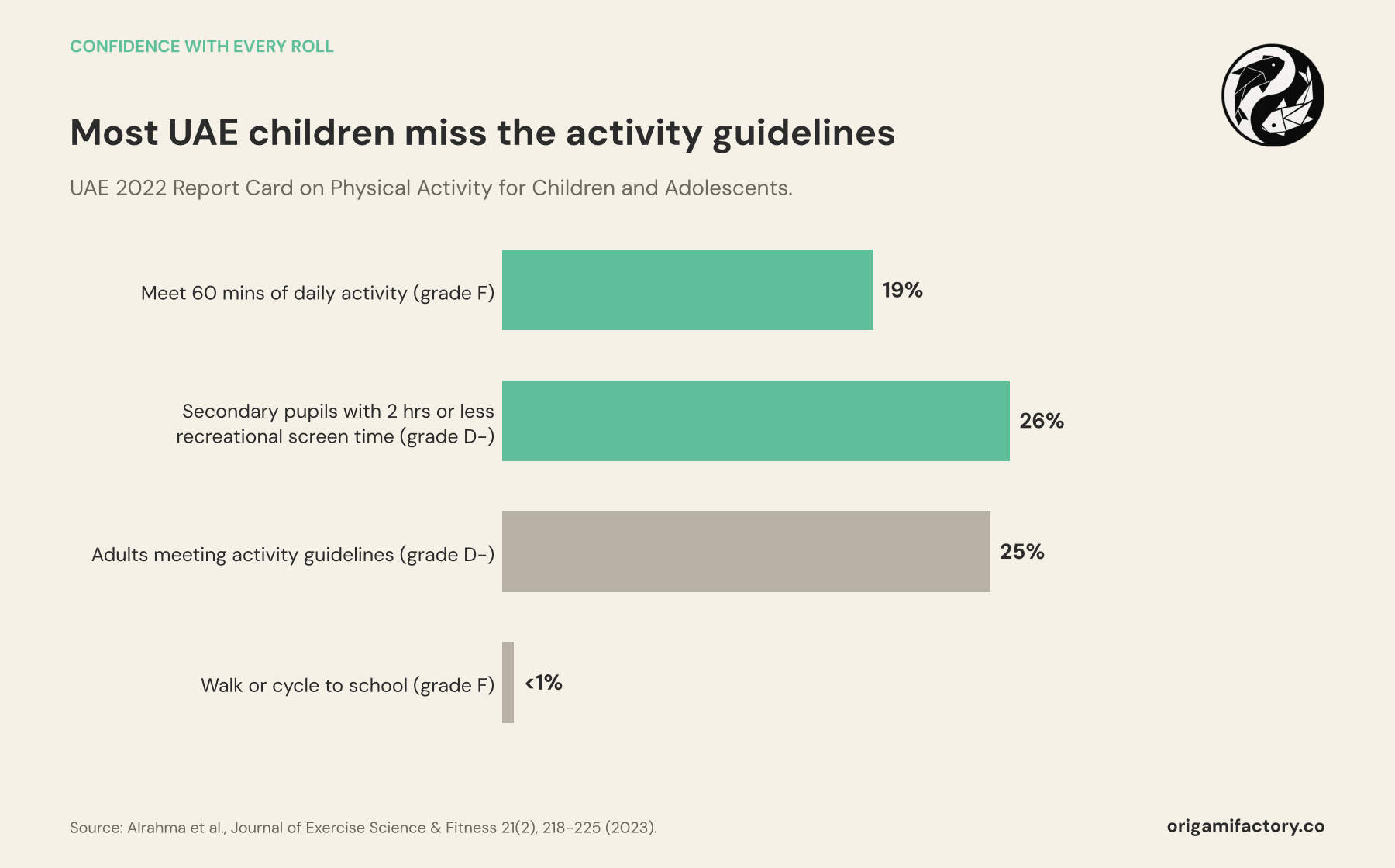
Short answer: Not very. Only 19% of UAE school children meet the 60-minute daily activity guideline, which earned the country an F in its 2022 Report Card on Physical Activity. Fewer than 1% walk or cycle to school. The UAE scored well on school PE (A-) and government investment (B+).
Table 2. UAE 2022 Report Card on Physical Activity for Children and Adolescents
| Indicator | Grade | Key finding |
|---|---|---|
| Overall physical activity | F | 19% meet 60+ minutes a day of moderate to vigorous activity |
| Active transportation | F | Less than 1% walk or cycle to and from school |
| Sedentary behaviour | D- | 26% of secondary pupils keep recreational screens to 2 hours or less |
| Family and peers | D- | About a quarter of adults meet 150 minutes a week of activity |
| School | A- | PE taught by specialists with at least a bachelor’s degree |
| Government | B+ | Significant investment in strategies and facilities |
| Organised sport, active play, fitness, community | INC | Not enough data to grade |
Source: Alrahma et al., Journal of Exercise Science & Fitness, 2023. Honestly, the gap that stands out to me is organised sport: there wasn’t enough UAE data to grade it at all.
Short answer: Four in five adolescents worldwide do not get enough exercise. A WHO-led study of 1.6 million students aged 11 to 17 in 146 countries found 81% were insufficiently active in 2016. Girls were less active than boys in almost every country, and the gap widened in 73% of countries between 2001 and 2016.
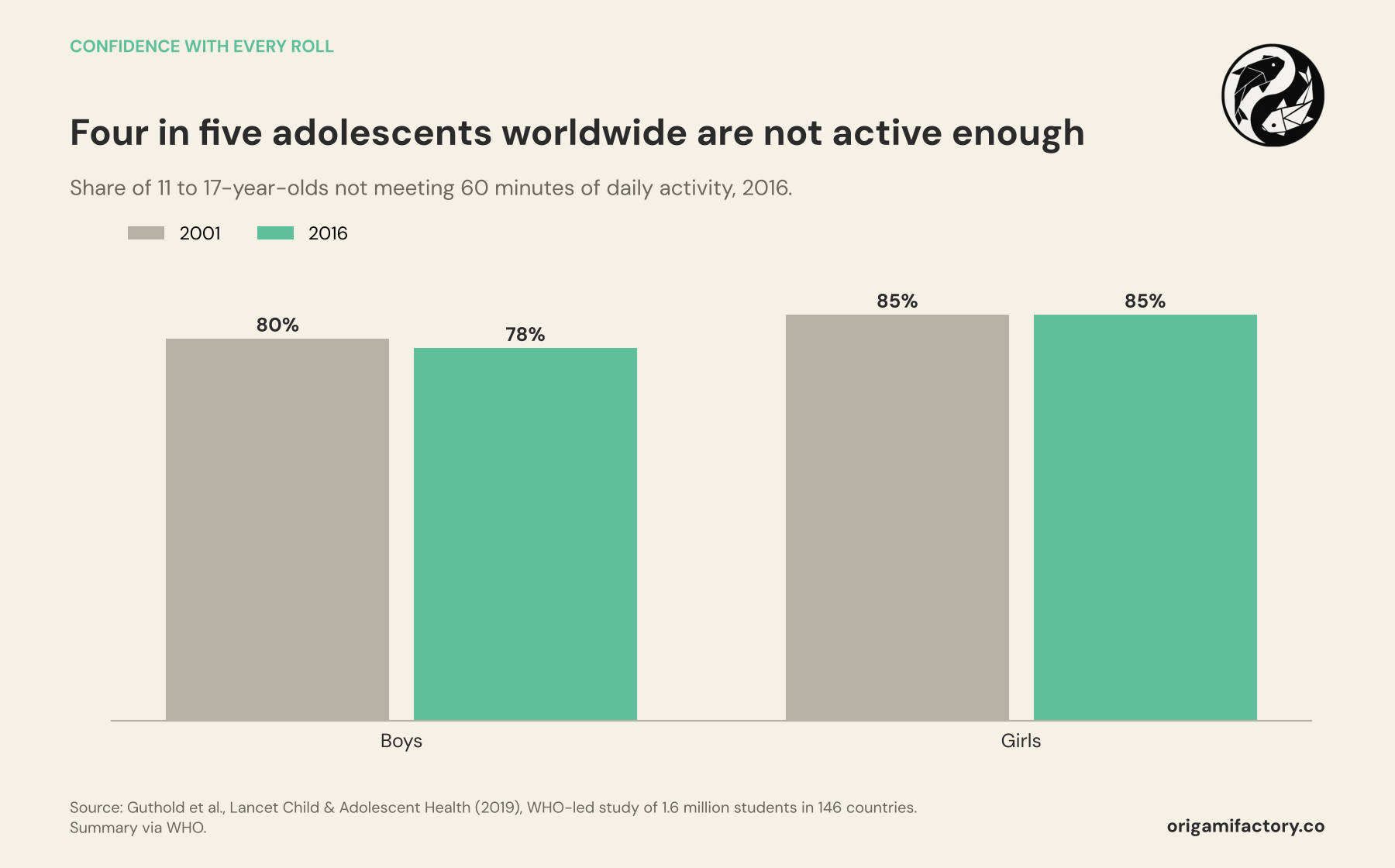
Table 3. Insufficient physical activity among 11 to 17-year-olds, 2016
| Group or country | Share not active enough |
|---|---|
| All adolescents, 146 countries | 81% |
| Girls | 85% |
| Boys | 78% |
| South Korea (highest, both sexes) | 94% |
| Philippines, boys (highest for boys) | 93% |
| Bangladesh (lowest, both sexes) | 66% |
| USA, boys | 64% |
Source: WHO (2019).
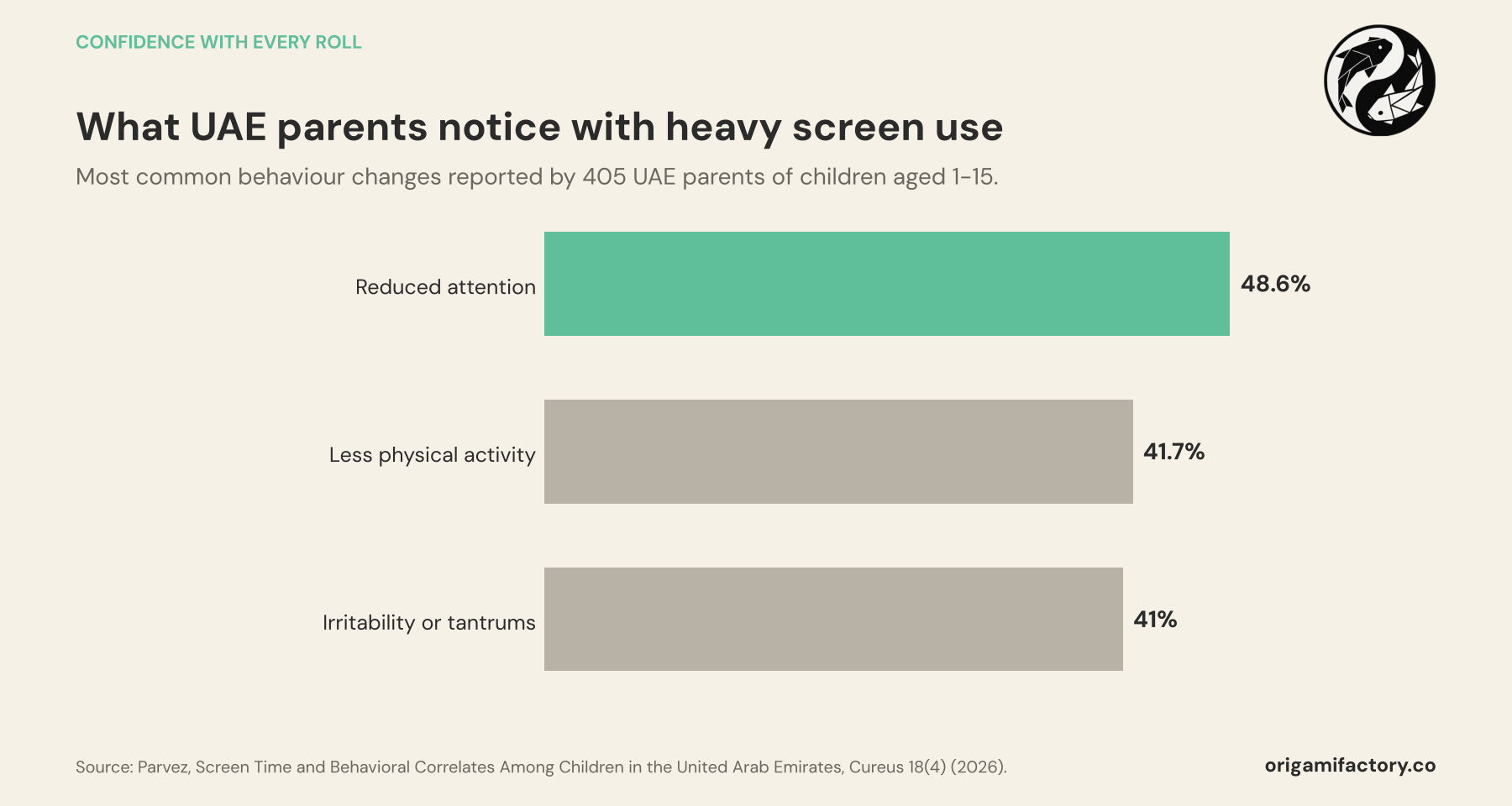
Short answer: More than the guidelines suggest. A 2026 UAE study of 405 parents found children aged 1 to 15 averaged 4.05 hours of screen time a day, rising to 5.05 hours for those aged 11 to 15. A separate 2025 study found 37.7% of UAE children aged 4 to 17 spent more than seven hours a day on screens outside lessons.
Table 4. UAE screen time research
| Study | Sample | Finding |
|---|---|---|
| Parvez, Cureus (2026) | 405 parents, children aged 1-15 | Average 4.05 hours a day (SD 2.34); 5.05 hours for ages 11-15 |
| Parvez (2026) | Same | Each extra hour linked to a 3% higher rate of behavioural symptoms |
| Parvez (2026) | Same | Screens in the bedroom linked to a 30% higher symptom rate |
| University of Sharjah and AUB, Cureus (2025) | 300 children aged 4-17 | 37.7% spent 7+ hours a day on screens outside lessons |
| University of Sharjah and AUB (2025) | Same | 68.8% of those children did no physical activity |
| UAE Report Card (2023) | Secondary pupils | 26% kept recreational screens to 2 hours or less |
Short answer: In the US, tweens aged 8 to 12 averaged 5 hours 33 minutes of screen media a day in 2021, and teens averaged 8 hours 39 minutes, not counting school or homework. Both figures rose about 17% between 2019 and 2021, according to Common Sense Media.
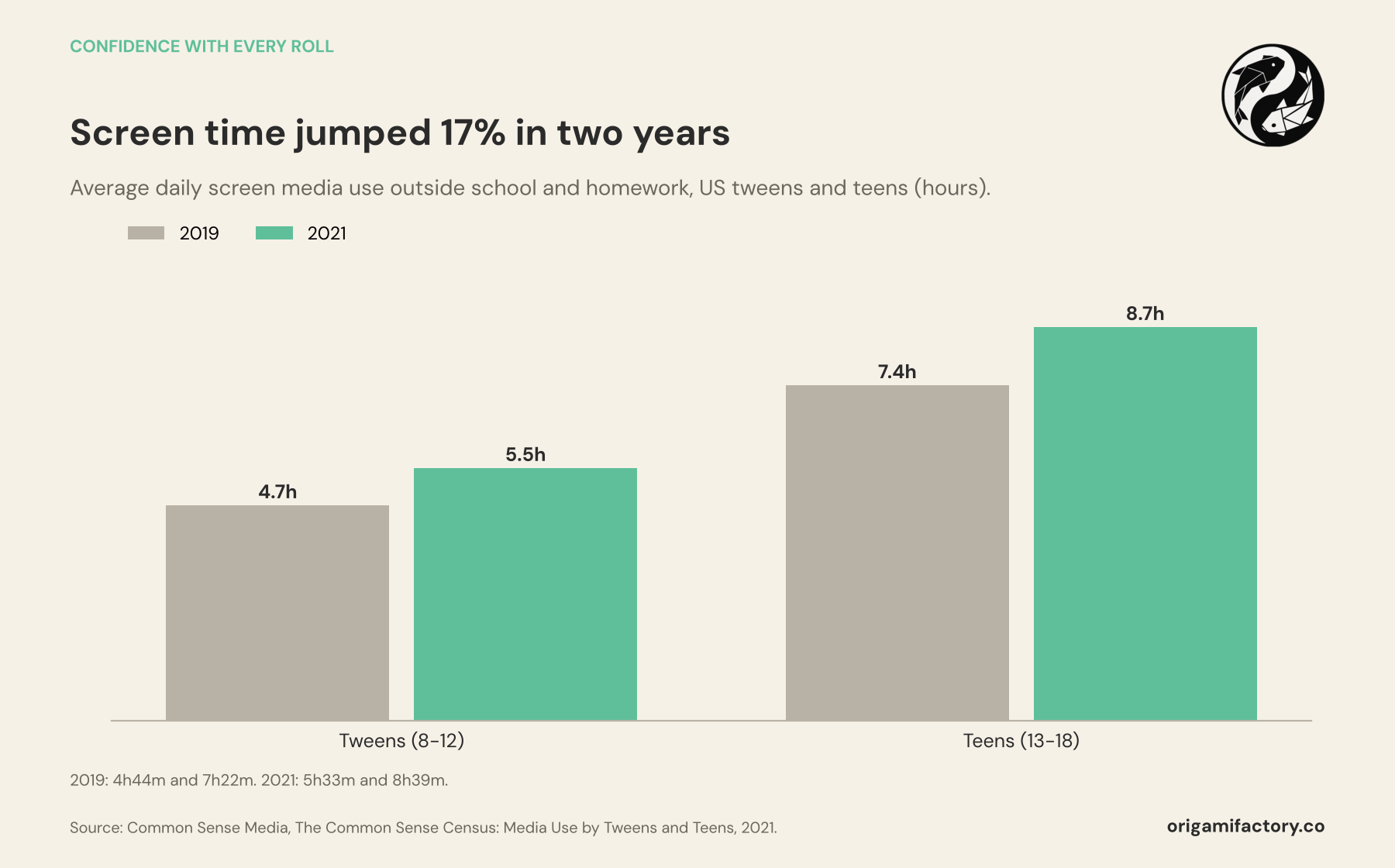
Table 5. Daily screen media use outside school, US (Common Sense Census)
| Group | 2019 | 2021 | Change |
|---|---|---|---|
| Tweens (8-12) | 4h 44m | 5h 33m | +17% |
| Teens (13-18) | 7h 22m | 8h 39m | +17% |
| Tweens who had ever used social media | 31% | 38% | +7 points |
Source: Common Sense Media (2021 census).
Short answer: Yes, according to a systematic review of 30 studies. Children and teenagers who play sport show better self-esteem and social skills and fewer depressive symptoms. Team and group-based sport appears to give more of these benefits than solo exercise, probably because of the social contact.
The catch is keeping children involved. US parents in an Aspen Institute survey said their children spent an average of only 2.86 years in a sport before quitting, often around age 11. The most common reason was that the child lost interest or stopped enjoying it (Project Play; Eime et al., 2013).
19%, according to the UAE 2022 Report Card on Physical Activity for Children and Adolescents.
A 2026 study found an average of 4.05 hours a day for children aged 1 to 15, and 5.05 hours for those aged 11 to 15.
WHO recommends no more than one hour a day for children aged 3 to 4, and says less is better.
Globally, yes. 85% of adolescent girls and 78% of boys are not active enough.
Every figure on this page is available as a spreadsheet, free to use with a credit and a link back: Children’s activity and screen time statistics 2026 (CSV). Each row carries the value, the population it describes, the year and a link to the original source.
The Origami Factory (2026). Children’s Physical Activity and Screen Time Statistics 2026: UAE vs the World. Available at: https://origamifactory.co/research/children-activity-screen-time-uae/
The Origami Factory is a children’s Brazilian Jiu-Jitsu and character development academy at Jumeirah Golf Estates, Dubai, for ages 4 to 17. Classes run indoors all year. Book a trial class or see our programmes.