
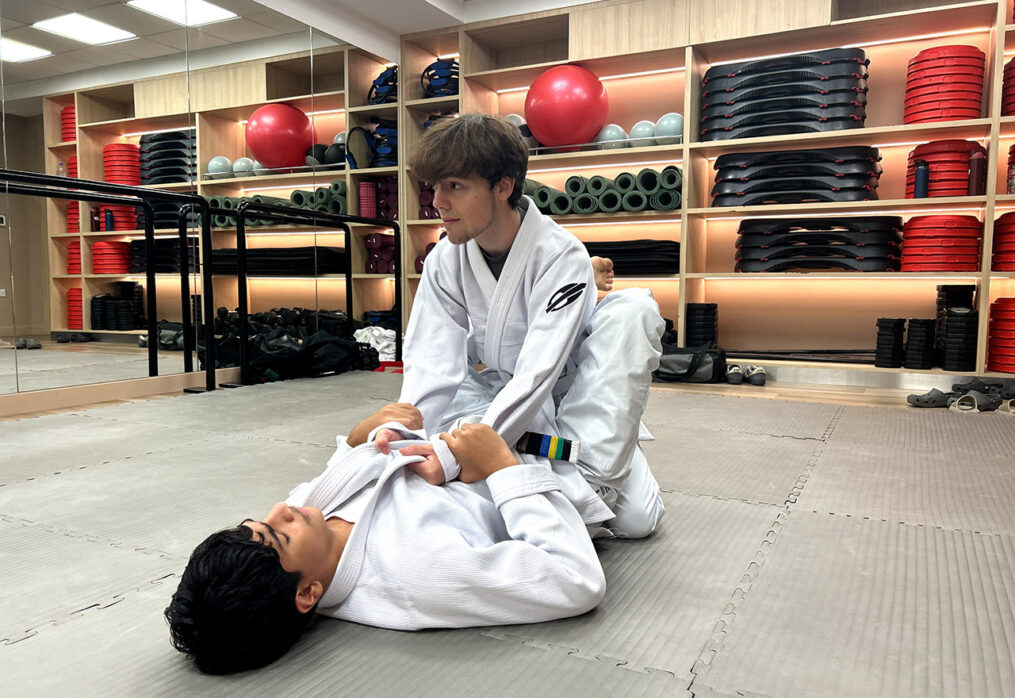

How Physical Activity Changes a Child’s Brain.
You have probably noticed it yourself. After a weekend with no sport, no running around, no mat time, your child seems foggier. Homework takes twice as long. Instructions need repeating three times. Then a week of regular movement goes by and something shifts, they listen the first time, they sit with a task a little longer, they seem, for lack of a better word, sharper. You are not imagining it. The link between physical activity and child brain development is one of the better documented findings in child psychology, and understanding how physical activity benefits child brain development can change the way you think about your child’s whole week, not just their sport.
This article walks through what is actually happening in a child’s brain during and after movement, why parents so often misread the signs, and what you can practically do this week to put physical activity benefits child brain development to work at home. We will also explain where Brazilian Jiu Jitsu fits into this picture, because it is the vehicle we use here at The Origami Factory, though the underlying science applies to any well-structured physical activity.
What “Physical Activity Benefits Child Brain Development” Actually Means
It is easy to hear a phrase like physical activity benefits child brain development and picture something vague, a general sense that exercise is “good for you.” The reality is far more specific. When a child moves, particularly through activity that combines coordination, decision making, and effort, several measurable things happen in the brain at once.
Blood flow to the prefrontal cortex increases. This is the part of the brain responsible for planning, impulse control, and sustained attention, the exact skills parents usually mean when they say a child “cannot focus.” Levels of brain-derived neurotrophic factor, a protein that supports the growth of new neural connections, rise measurably after exercise. And executive function, the umbrella term for working memory, cognitive flexibility, and self-control, shows short-term and long-term improvement with regular movement. This is the mechanism behind physical activity benefits child brain development, and it is not a soft claim. It is one of the more replicated findings in developmental research.
The Science Behind How Movement Shapes a Developing Brain
A 2018 special issue in the journal Biomed Research International, hosted by the National Library of Medicine, pulled together thirteen studies on exactly this question. The editors, led by researcher Zan Gao, summarised findings across early childhood, healthy school-age children, and children with additional needs. In one of the included trials, a four-week coordinated bilateral physical activity programme produced significant increases in processing speed, focused attention, and concentration performance among fifth graders, measured using the D2 Test of Attention. In another, twelve of fifteen reviewed studies found statistically significant effects of structured movement on preschoolers’ language learning, academic achievement, attention, and working memory. None of the studies reviewed found any adverse effect.
That is a fairly blunt way of putting it, but it is accurate. If you are asking whether physical activity benefits child brain development in a way that is measurable rather than anecdotal, the research answer is yes, consistently, across age groups and activity types. What varies is how much, how quickly, and under what conditions, which is exactly what the rest of this article covers.
Why This Gets Missed by So Many Parents
The most common misconception is thinking of physical activity and focus as opposites, something you do instead of “brain work,” or a reward once the real work of homework and reading is done. In practice, the opposite ordering tends to work better. A child who runs, trains, or plays before a task that needs concentration typically performs better on that task than a child who has been sitting still.
The second misconception is assuming any movement will do. Passive movement, being driven somewhere, standing in a queue, does not carry the same cognitive load as movement that requires a child to think while their body works. This is a meaningful distinction, because how physical activity benefits child brain development depends heavily on the type of activity, not just the fact that the child is up and moving. Activities that combine physical coordination with problem solving, reacting to a partner, adjusting position, remembering a sequence, appear to produce stronger cognitive effects than repetitive activity like running laps with no variation.
A third misconception, understandable but worth correcting, is expecting instant results. A single class will not transform a child’s attention span. The way physical activity benefits child brain development is cumulative. It looks more like compound interest than a light switch, small deposits that add up over weeks and months of consistent practice.
A Story From the Mats
We see a version of the same pattern often enough that it is worth describing, even though the details below are a composite rather than one specific child. A seven year old, one of our Foxes, joins with a parent explaining that school reports mention “struggles to stay on task” and “easily distracted.” In the first few sessions, this shows up exactly as expected, wandering attention during instructions, needing prompts repeated, difficulty staying with a partner drill.
What tends to change, usually somewhere between week four and week eight, is not that the child becomes a different personality. It is that the specific skill of returning attention after losing it gets practised, over and over, in a context where it has an immediate and physical consequence. Lose focus during a drill and the technique falls apart straight away. There is no delay between distraction and feedback the way there often is at a school desk. That immediacy is a large part of why physical activity benefits child brain development in ways that are sometimes hard to replicate in a classroom setting, and it is one of the reasons coaches watch closely for this shift in the first six to eight weeks.

Practical Ways to Build This Into Your Child’s Week
You do not need to overhaul your family’s schedule to see benefits. A few adjustments, applied consistently, tend to matter more than one dramatic change.
Move before the hard task, not after it. If homework or a task requiring concentration is coming up, twenty minutes of active play or training beforehand tends to help more than using activity as an end-of-day reward. This ordering is a simple, testable example of physical activity benefits child brain development in the middle of an ordinary week, not just in a classroom study. This is a direct, practical way to put physical activity benefits child brain development to use in an ordinary Tuesday evening.
Favour activity with a thinking component. A structured sport, a martial art, a game with rules and reaction, tends to outperform pure repetitive cardio for cognitive effects, though any movement beats none. This is one reason we built our own programmes around problem solving and partner work rather than drills alone, since it is one of the clearest everyday examples of how physical activity benefits child brain development.
Protect consistency over intensity. Two or three regular sessions a week tend to produce steadier gains than one long, intense session followed by a week of nothing. The brain adapts to repeated, moderate challenge more reliably than to occasional bursts, which is really the whole practical case for how physical activity benefits child brain development over a school term rather than a single weekend.
Watch, do not just ask. Children rarely narrate their own cognitive improvement. You are more likely to notice change by watching how they handle a frustrating moment or a multi-step instruction than by asking them directly whether they feel more focused. That quiet, observable shift is often the clearest sign parents get that physical activity benefits child brain development in their own house, not just in a research paper.
How The Origami Factory Applies This
The Origami Factory is a character development programme that happens to use Brazilian Jiu Jitsu as its delivery method. We did not choose BJJ because it is trendy. We chose it because it sits at the intersection of everything the research above describes: physical exertion, real-time problem solving, controlled pressure, and immediate feedback. Every one of those elements is part of why physical activity benefits child brain development so specifically well through this kind of training.
We track this through our 3D Method, Discover, Develop, Demonstrate. In the Discover phase, coaches identify where a child’s attention, confidence, or emotional regulation currently sits. In the Develop phase, training is structured around building those specific capacities, not just belt progress. In the Demonstrate phase, children show the change, often to their own surprise, in situations that matter to them, at school, with friends, at home. Structuring training around these three phases is our practical answer to the question of how physical activity benefits child brain development over a full season, not just after one good class. You can read more about how the 3D Method works and how we track it beyond belts in our piece on how we measure character development.
Our age cohorts matter here too. Penguins, ages four to six, Foxes, seven to nine, Cranes, ten to twelve, and Dragons, thirteen and up, each get training built around how their brains actually develop at that stage, not a one-size approach. A five year old and an eleven year old benefit from movement differently, and coaching them identically wastes the advantage that physical activity benefits child brain development most when it is age-appropriate.
How This Connects to Screen Time and Attention
We write about this a great deal because the two issues are closely linked. Reduced physical activity and increased screen time tend to rise together in a child’s week, and untangling which one is driving attention problems is genuinely difficult. Our article on screen time and your child’s attention span goes into the research on that side in detail, and our piece on how to reduce your child’s screen time without a daily battle gives a practical framework for making the swap.
If your child’s main obstacle is that screens have become the default filler for every spare moment, our article on five alternatives to screen time that give the same buzz is a useful next read, and it is a good practical starting point for how physical activity benefits child brain development when screens are the main competitor for your child’s time. And if you are noticing focus struggles specifically, rather than screen habits generally, why your child can’t focus and how to improve a child’s attention span covers that territory directly. In every case, physical activity benefits child brain development in a way that directly offsets some of what heavy screen use displaces.
Where Confidence and Focus Overlap
It is worth saying plainly, because it is easy to miss, that attention and confidence are not separate projects, and that physical activity benefits child brain development on both fronts at the same time. A child who feels capable in their body tends to concentrate better, and a child who can concentrate tends to feel more capable. Our articles on how jiu jitsu builds confidence in children and whether sport really builds a child’s confidence cover the confidence side of this in more depth, and our piece on how jiu jitsu builds emotional intelligence looks at the regulation piece, which is closely tied to sustained attention. If resilience is more of a concern in your house than focus specifically, how to build resilience in children is a natural next step.
None of these are separate problems requiring separate solutions. They are facets of the same underlying development, and that is precisely why physical activity benefits child brain development across so many fronts at once rather than narrowly improving one isolated skill.
What to Expect If You Try This With Your Child
If you are considering a structured activity specifically because of the cognitive benefits, it helps to know what a realistic timeline looks like. Most families notice small shifts within two to four weeks, slightly better listening, a touch more patience with a frustrating task. The more durable changes, the kind teachers comment on unprompted, tend to appear over two to three months of consistent attendance, which is roughly the timeline most families need before physical activity benefits child brain development in ways that feel obvious rather than subtle.
We explain what that first step actually looks like in our guide to what happens at a kids BJJ trial class in Dubai, and you can see how our full programme structure is laid out on our programmes page. The best way to see whether physical activity benefits child brain development for your specific child is to watch one session and see how they respond, rather than to take our word for it.
Frequently Asked Questions
How quickly does physical activity improve a child’s focus?
Some effects are almost immediate, a single active session can sharpen attention for the following hour or two. The more lasting changes, where physical activity benefits child brain development in ways that show up at school without prompting, generally take six to twelve weeks of consistent practice to become noticeable.
Does the type of physical activity matter, or is any movement helpful?
Type matters more than most parents expect. Activities requiring a child to think while moving, reacting to an opponent, solving a physical puzzle, remembering a sequence, tend to produce stronger cognitive gains than repetitive activity with no decision making involved. This is a core reason physical activity benefits child brain development more through structured sport than through unstructured running around alone.
My child already does a lot of sport but still struggles to focus. Why?
Volume of activity is not the only variable. A child doing several hours of unstructured or purely competitive sport each week may still be missing the specific combination of controlled pressure, feedback, and problem solving that seems to drive the strongest effects. It is also worth checking sleep and screen habits, both of which can offset the benefits of physical activity. In our experience, this is the most common reason a family feels like physical activity benefits child brain development for other people’s children but not their own.
Is Brazilian Jiu Jitsu better than other sports for this specifically?
We are obviously biased, having built our entire programme around it, but the honest answer is that several sports share the key ingredients: physical exertion, real-time decisions, and immediate feedback. BJJ happens to combine all three unusually well within a single session, which is one reason we chose it as the vehicle for how physical activity benefits child brain development at The Origami Factory specifically.
What age should I start if I want to see these cognitive benefits?
Research reviewed in the Biomed Research International special issue found measurable cognitive and motor benefits from structured physical activity in children as young as three to five. Our Penguins cohort, ages four to six, is built around this early window, though children of any age can begin and still see meaningful change, which is part of why we say physical activity benefits child brain development at every stage from preschool through the teenage years, not just in one narrow window.
Can too much physical activity ever backfire?
Overtraining without adequate rest can affect mood and sleep, which indirectly affects attention. For most children in a well-structured, age-appropriate programme, this is rarely the concern. The bigger risk we see is too little consistent movement, not too much, and that is usually where the conversation about physical activity benefits child brain development needs to start.
Movement is not a side note to your child’s development, it is one of the more direct levers you have, and the evidence for how physical activity benefits child brain development only keeps growing the more closely researchers look. If you want to see what a properly structured programme looks like in practice, and how we track the change beyond just physical skill, take a look at our programmes page or book a trial class and watch how your child responds to a single session. It tends to tell you more than any article can.