
Thousands of families move to Dubai every year, and many of them bring children. This page gathers the best available data on how many children are arriving, where they go to school, and what research says about how children cope with a big move. Every number links to its source, and you are welcome to reuse the tables and charts with a credit and link.
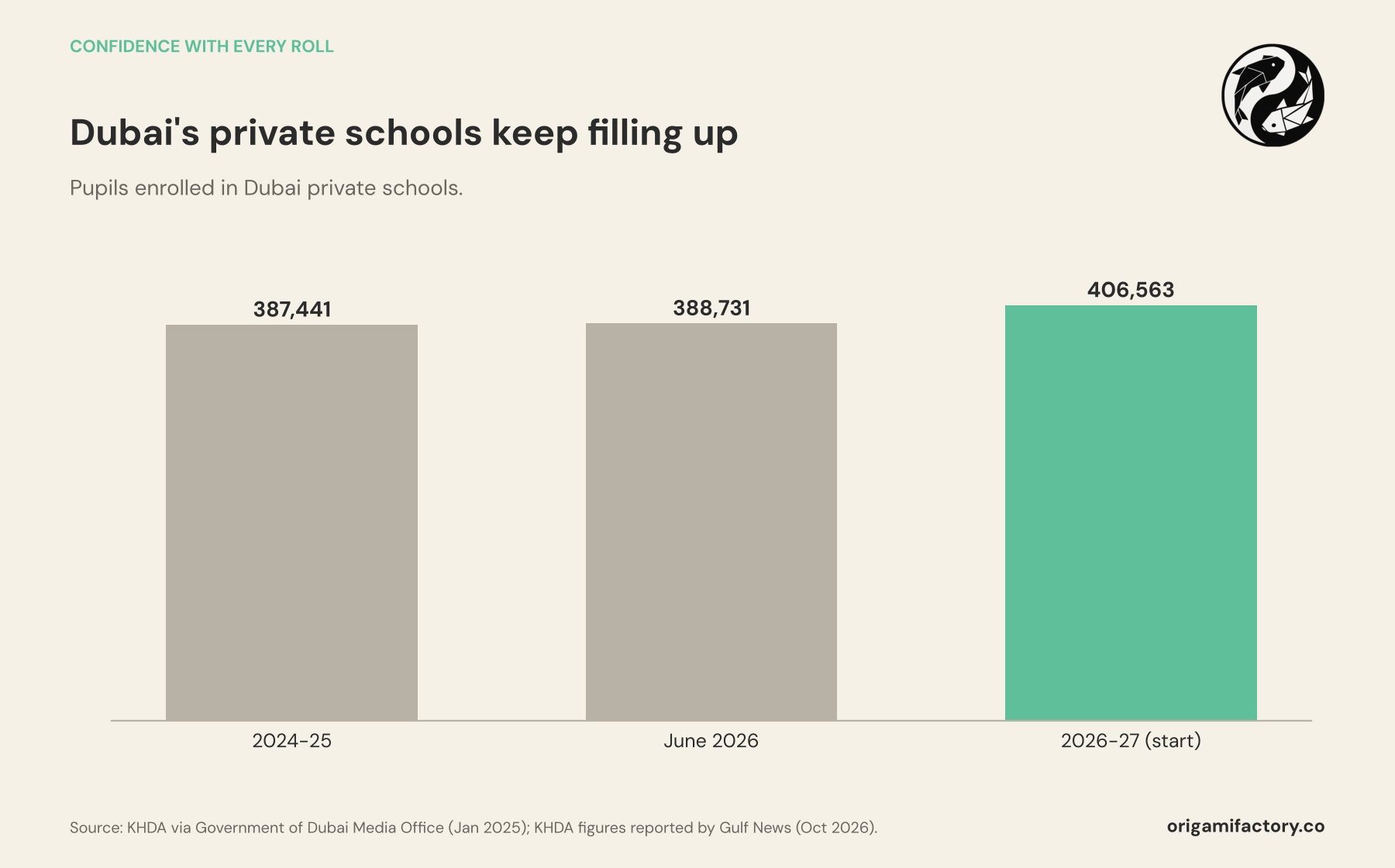
Short answer: There is no official count of children arriving each year, but school data shows the scale. Dubai private schools had 406,563 pupils at the start of 2026-27, up 4.6% in a few months and up from 387,441 in 2024-25. Dubai’s population grew by 332,000 people in 2025 alone.
Table 1. Dubai growth indicators
| Indicator | Figure | Period | Source |
|---|---|---|---|
| Dubai resident population | 4.58 million | End of 2025 | Gulf News |
| Population growth | +332,000 (7.5%) | 2025 | Gulf News |
| Private school pupils | 387,441 | 2024-25 | Media Office |
| Enrolment growth | 6% | 2024-25 | Media Office |
| Private school pupils | 406,563 | Start of 2026-27 | Gulf News |
| Enrolment growth | 4.6% | June 2026 to start of 2026-27 | Gulf News |
| New private education institutions | 26 (17 early childhood centres, 7 schools, 2 higher education institutions) | 2026-27 | Gulf News |
| Private schools | 227 | 2024-25 | Media Office |
| Teachers | 27,284 (+9%) | 2024-25 | Media Office |
Short answer: UK-curriculum schools are the largest group, with 37% of Dubai private school pupils in 2024-25. Indian curricula follow at 26%, then US at 14% and the International Baccalaureate at 7%. Pupils came from 185 nationalities across 17 curricula.
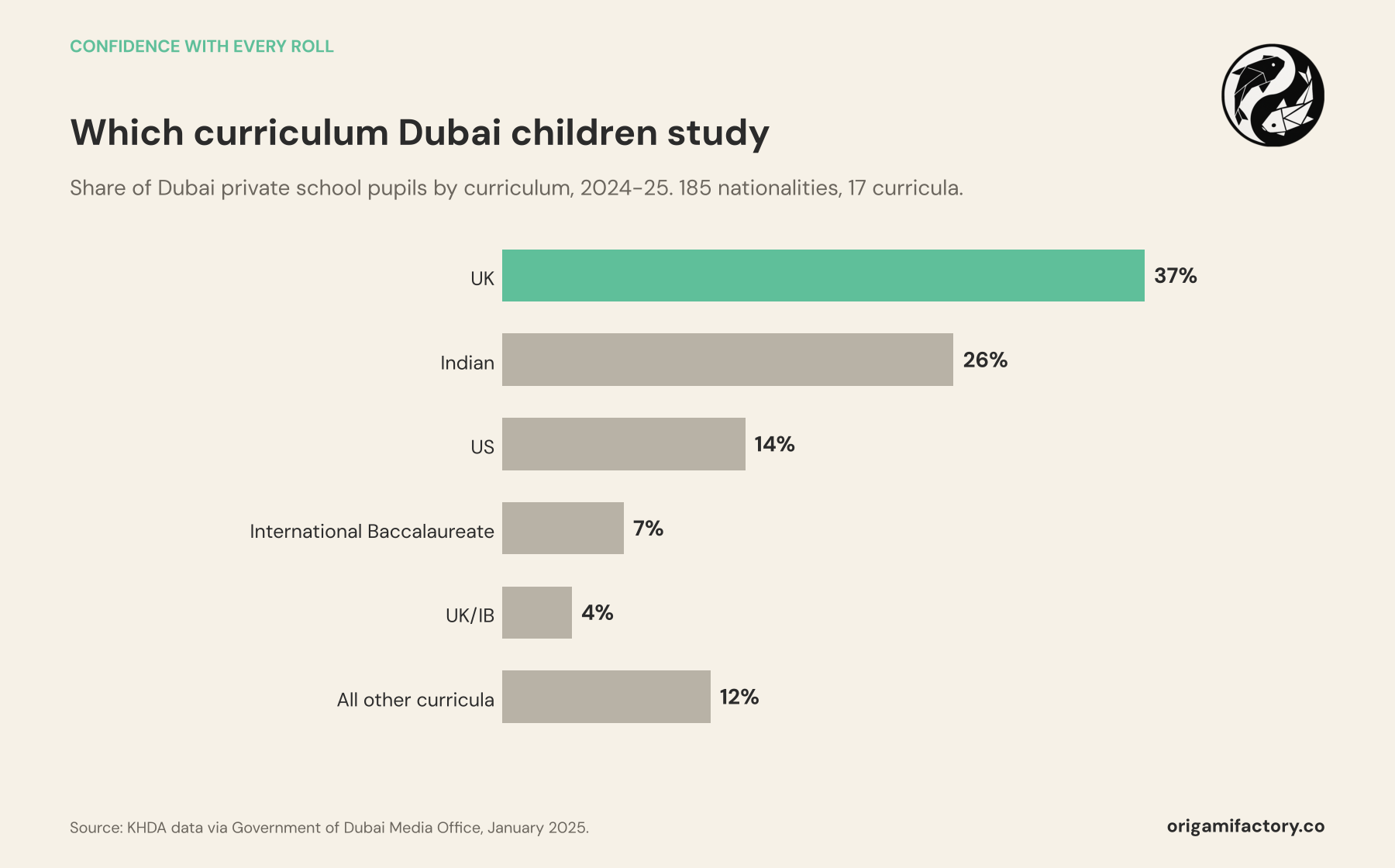
Table 2. Dubai private school pupils by curriculum, 2024-25
| Curriculum | Share of pupils |
|---|---|
| UK | 37% |
| Indian | 26% |
| US | 14% |
| International Baccalaureate | 7% |
| UK/IB | 4% |
| All other curricula (12 more) | 12% |
Source: KHDA data via Government of Dubai Media Office. The ‘all other’ figure is calculated as the remainder.
Short answer: Settling in is the UAE’s weakest area for expats. In InterNations’ Expat Insider 2025, the UAE ranked 7th of 46 destinations overall and 2nd for quality of life, but only 11th for ease of settling in. Around three quarters of expats said they feel welcome.
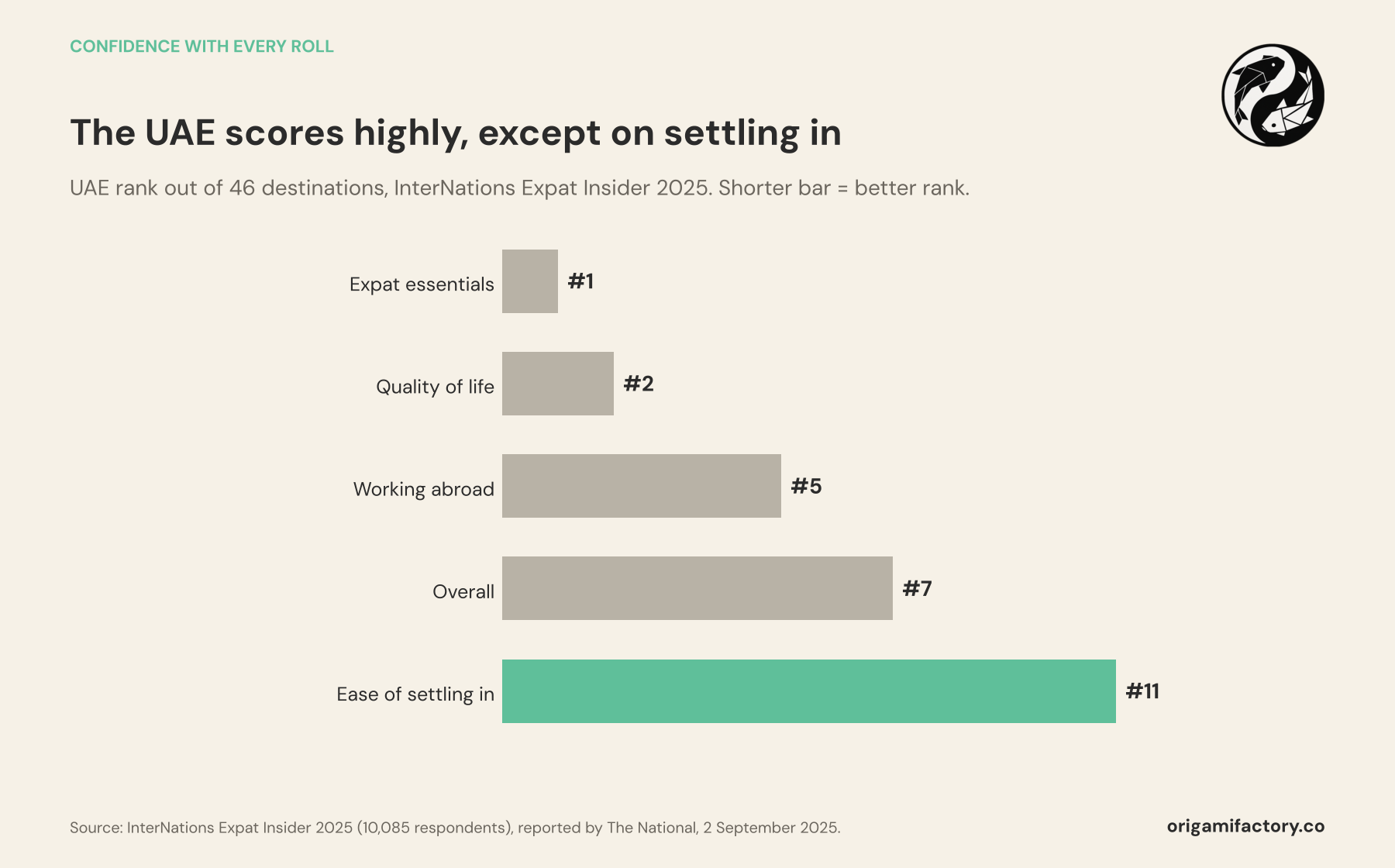
Expat Insider surveys adults, not children. But if parents find settling in the hardest part, it’s reasonable to expect children feel some of that too. We’d love to see a UAE survey that asks children directly.
Short answer: A single move carries less risk than repeated moves. Repeated moves, especially between ages 12 and 14, are linked to worse outcomes. A Danish study of 1.4 million people found risk rose with each additional childhood move, across mental health, substance misuse and violent offending, and across all income levels.
The Danish study looked at moves within Denmark, not international relocation. We include it because it is the largest study of childhood moves and outcomes, but the findings may not transfer directly to expat families.
Short answer: Yes. A 2025 study of grades 4 to 8 in six California districts found midyear school moves lowered English scores by 0.073 standard deviations and maths by 0.083. Summer moves had near-zero effects. Moving to a higher-achieving school could close the gap.
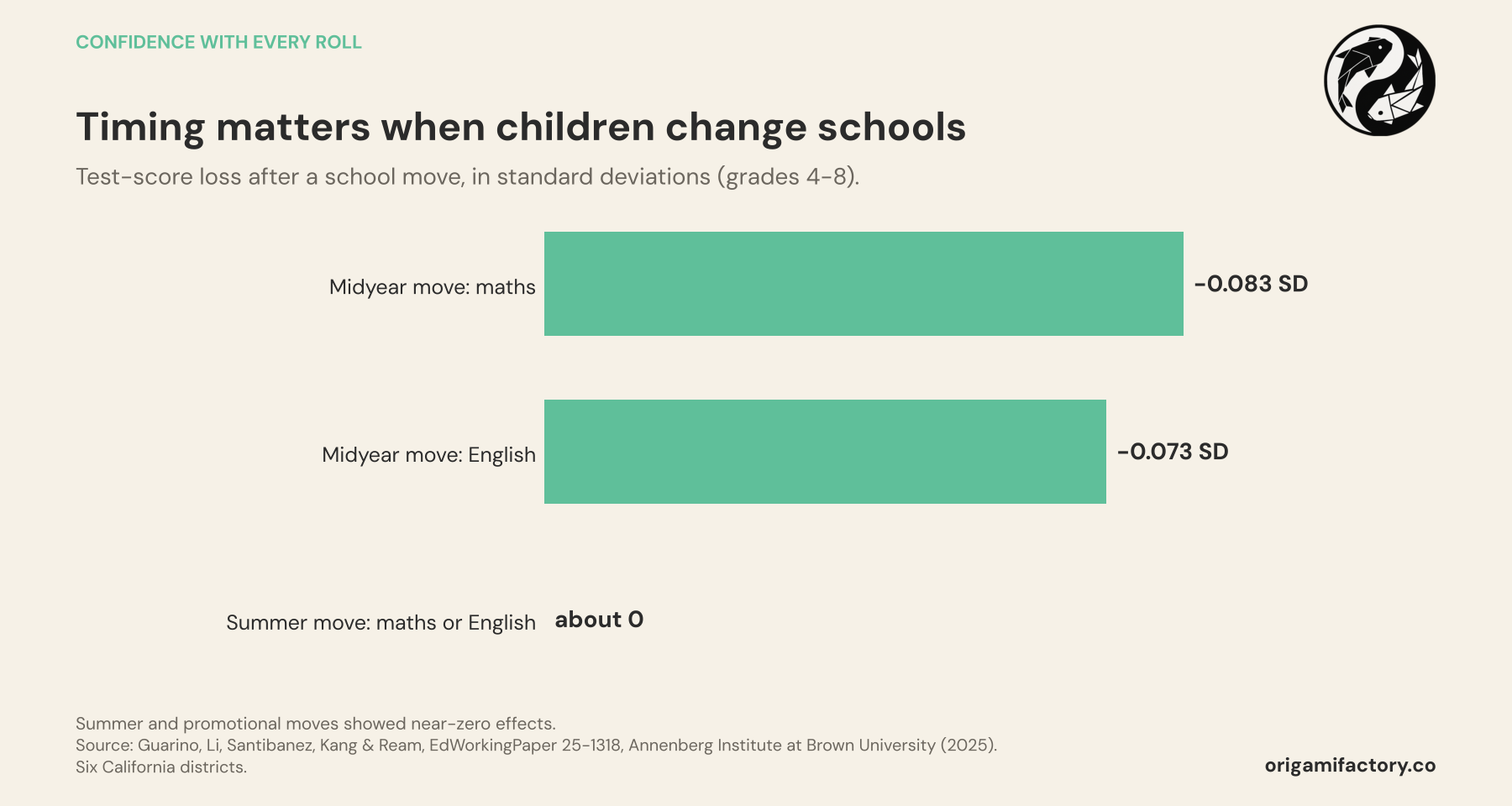
For Dubai families this is practical: if you have a choice, start at the beginning of a school year. Midyear effects were largest for middle schoolers and children learning English (Guarino et al., 2025).
Short answer: Mostly positive, with gaps. In the KHDA Dubai Student Wellbeing Census of 64,686 pupils in grades 6 to 9, 84% reported medium or high happiness at school and 84% were satisfied with life. But only 57% felt highly connected to adults at school, and 23% did not report a medium or high sense of safety.
Table 3. KHDA Dubai Student Wellbeing Census findings
| Measure | Result |
|---|---|
| Medium or high happiness at school | 84% |
| Satisfied with life | 84% |
| Confident about schoolwork | 92% |
| Medium or high optimism about the future | 87% |
| Medium or high sense of safety at school | 77% |
| Highly connected to adults at school | 57% |
| Highly connected to adults at home | 77% |
| Happiness, grade 6 vs grade 9 | 88% vs 78% |
Source: GESS Dubai report on the KHDA census. For more on safety and peer problems, see our childhood bullying statistics.
Short answer: Research points to three things: a close, supportive family, at least one solid friendship, and a regular activity that connects them with peers. Sport participation is linked to better self-esteem, social skills and fewer depressive symptoms, and group activities appear to help more than solo ones.
406,563 at the start of the 2026-27 academic year, according to KHDA figures reported by Gulf News.
The UK curriculum, with 37% of private school pupils in 2024-25.
Not on its own. Research links repeated moves, especially several in one year during early adolescence, with worse outcomes. Family cohesion is the strongest protective factor found in expat studies.
The summer. Midyear moves were linked to lower test scores, while summer moves had near-zero effects.
Every figure on this page is available as a spreadsheet, free to use with a credit and a link back: Expat children in the UAE statistics 2026 (CSV). Each row carries the value, the population it describes, the year and a link to the original source.
The Origami Factory (2026). Expat Children in the UAE: Relocation and Adjustment Statistics 2026. Available at: https://origamifactory.co/research/expat-children-uae/
The Origami Factory is a children’s Brazilian Jiu-Jitsu and character development academy at Jumeirah Golf Estates, Dubai, for ages 4 to 17. Plenty of our families are new to Dubai, and a regular class is often where children make their first friends here. Book a trial class or get in touch.