
Bullying is common, it can be measured, and it can be reduced. This page pulls together the most reliable bullying figures for children in the UAE and compares them with global data. Each number links to the study or official report it came from.
You are free to use any table or chart on this page in an article, report or school newsletter. Please credit The Origami Factory and link back to this page.
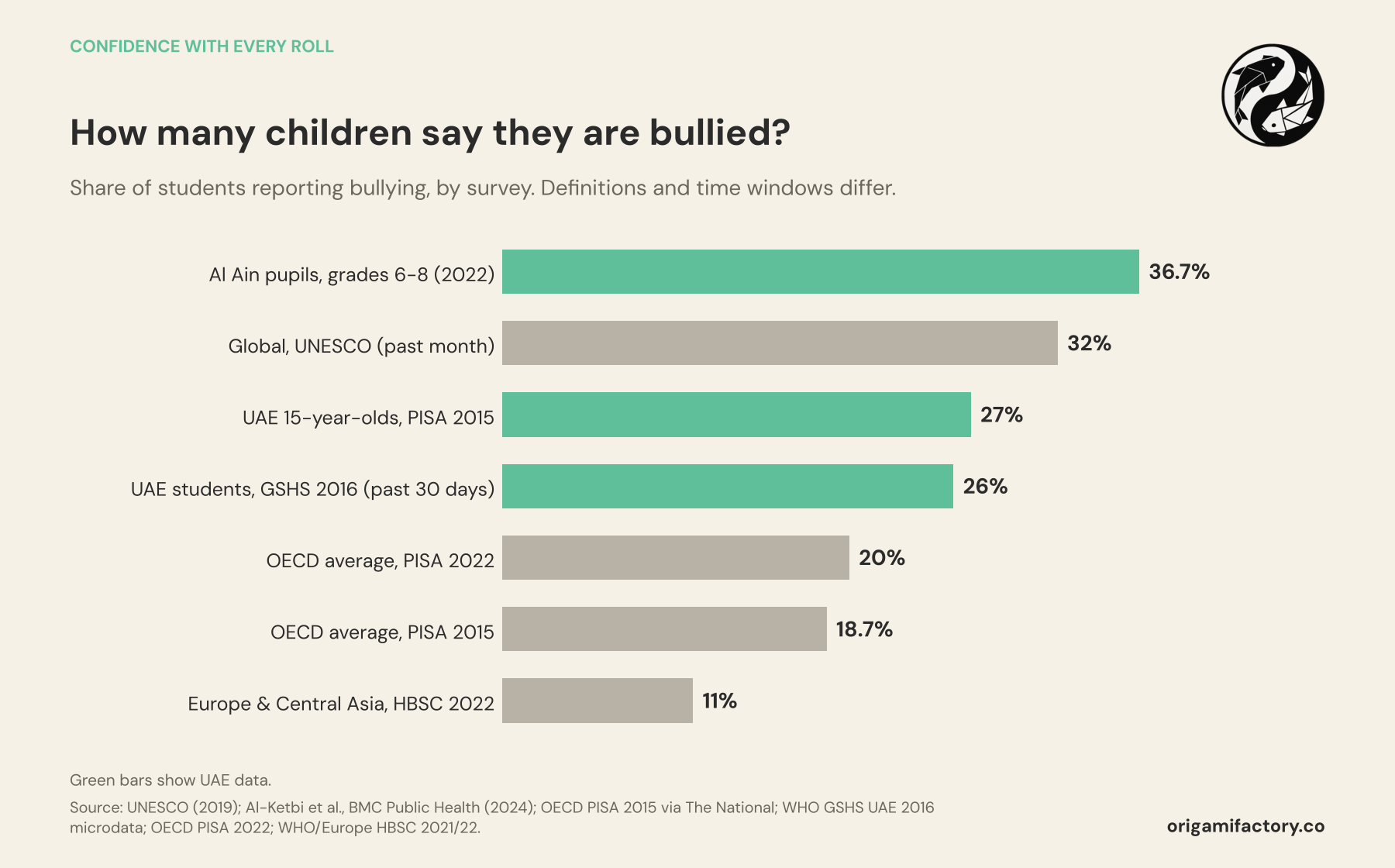
Short answer: Between one in four and one in three UAE schoolchildren report being bullied, depending on the survey. PISA 2015 found 27% of UAE 15-year-olds were bullied at least a few times a month. A 2016 national health survey put the figure at 26% for the past 30 days, and a 2022 Al Ain study found 36.7%.
These surveys ask different questions, about different age groups, over different time periods. So I would not line them up and call one the true number. What they do show, taken together, is a consistent picture: bullying in the UAE sits at or above the international average.
Table 1. Bullying measurements in the UAE
| Survey | Data year | Who was asked | What was measured | Result |
|---|---|---|---|---|
| OECD PISA | 2015 | 15-year-olds, Abu Dhabi and Dubai samples included | Bullied at least a few times a month | 27% |
| OECD PISA | 2015 | 15-year-olds | Frequently bullied | 17.8% |
| WHO Global School-based Student Health Survey | 2016 | UAE school students, national file, 5,515 valid responses | Bullied on 1 or more days in the past 30 days | 26% (unweighted) |
| Al-Ketbi et al., BMC Public Health | 2022 | 723 pupils, grades 6 to 8, Al Ain | Bullying victimisation | 36.7% |
| Al-Ketbi et al. | 2022 | Same sample | Physical bullying (boys vs girls) | 23% vs 13% |
| KHDA Dubai Student Wellbeing Census | Census round reported by GESS | 64,686 private school pupils, grades 6 to 9 | Medium or high sense of safety at school | 77% |
| KHDA School of Hearts pilot | Reported 2018 | 4,391 middle school pupils | Subject of gossip or mean rumours in past 12 months | 59% |
Note on the GSHS figure: the 26% comes from the raw WHO microdata file, which is unweighted. WHO advises that file counts should not be read as population estimates. Treat it as indicative.
Short answer: Roughly one in three children worldwide is bullied in a given month. UNESCO’s 2019 review of 144 countries found 32% of students had been bullied by peers at school at least once in the past month. In PISA 2022, about 20% of 15-year-olds across OECD countries reported bullying at least a few times a month.
Table 2. Global bullying benchmarks
| Source | Coverage | Measure | Result |
|---|---|---|---|
| UNESCO | 144 countries and territories | Bullied by peers at school at least once in past month | 32% |
| OECD PISA 2022 | OECD countries, 15-year-olds | Bullied at least a few times a month | About 20% |
| OECD PISA 2015 | 35 OECD countries | Bullied at least a few times a month | 18.7% |
| WHO/Europe HBSC 2021/22 | 44 countries and regions, 279,000+ children aged 11, 13, 15 | Bullied at school | About 11% |
| WHO/Europe HBSC 2021/22 | Same | Bullied others at school | 6% (boys 8%, girls 5%) |
UNESCO also found that physical bullying is the most common type in most regions, and that a child’s physical appearance is the most common reason given for bullying. Race, nationality or skin colour comes second. That second point matters in a city like Dubai, where private school pupils come from 185 nationalities.
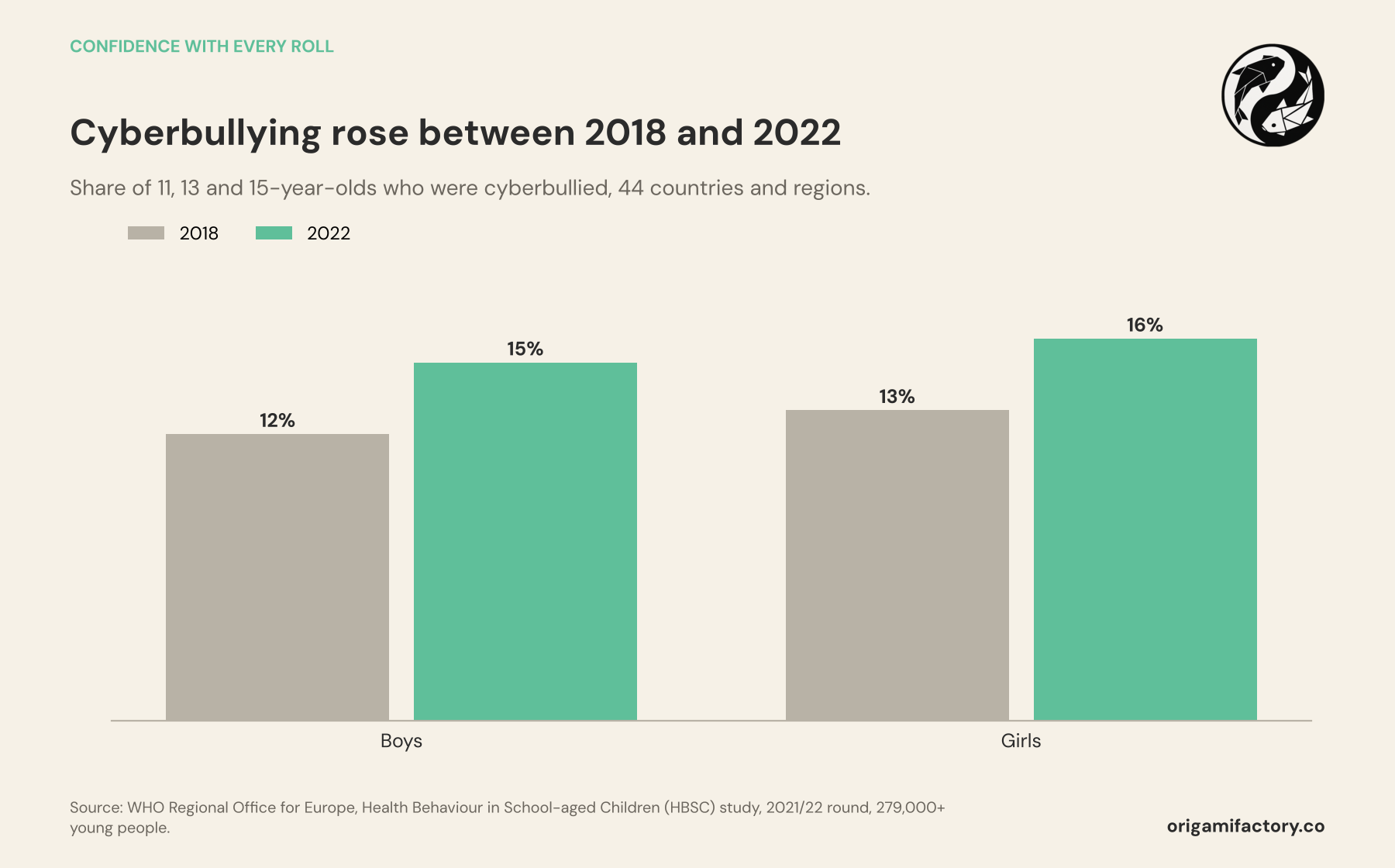
Short answer: Yes. In the WHO/Europe HBSC study, the share of children who were cyberbullied rose from 12% to 15% for boys and from 13% to 16% for girls between 2018 and 2022. Cyberbullying now affects about one in six school-aged children in those 44 countries, more than the 11% bullied face to face at school.
Table 3. Cyberbullying, 2018 vs 2022 (HBSC, ages 11, 13 and 15)
| Measure | Boys 2018 | Boys 2022 | Girls 2018 | Girls 2022 |
|---|---|---|---|---|
| Was cyberbullied | 12% | 15% | 13% | 16% |
| Cyberbullied others | 11% | 14% | 7% | 9% |
UAE data points the same way. The Al Ain study recorded cyberbullying rates of 37% in private schools and 27% in public schools, and cyberbullying was strongly linked with being bullied overall, with adjusted odds ratios of 5.31 and 7.08 (Al-Ketbi et al.).
Short answer: Boys and children in the early secondary years face the highest risk in UAE research. In Al Ain, boys in public schools had 16 times the odds of being bullied compared with girls, and boys in private schools had 4.6 times the odds. Appearance and nationality are the most common reasons for bullying worldwide.
Table 4. Risk factors for being bullied, Al Ain 2022 (adjusted odds ratios)
| School type | Factor | Adjusted odds ratio |
|---|---|---|
| Private | Boy vs girl | 4.57 |
| Public | Boy vs girl | 16.30 |
| Private | Grade 8 vs grade 6 | 7.72 |
| Private | Cyberbullying experience | 5.31 |
| Public | Cyberbullying experience | 7.08 |
Wellbeing also slides as children move up through school. In the KHDA census, the share of Dubai pupils reporting medium or high happiness at school fell from 88% in grade 6 to 78% in grade 9. Boys were less likely than girls to say they felt very safe (74% vs 81%) (GESS Dubai).
Short answer: Bullying affects mood, learning and attendance in the short term, and mental health into adulthood. In Al Ain, 81% of bullied private school pupils reported sadness or distress. A US study that followed 1,420 children into their twenties found victims had four times the rate of anxiety disorders as adults.
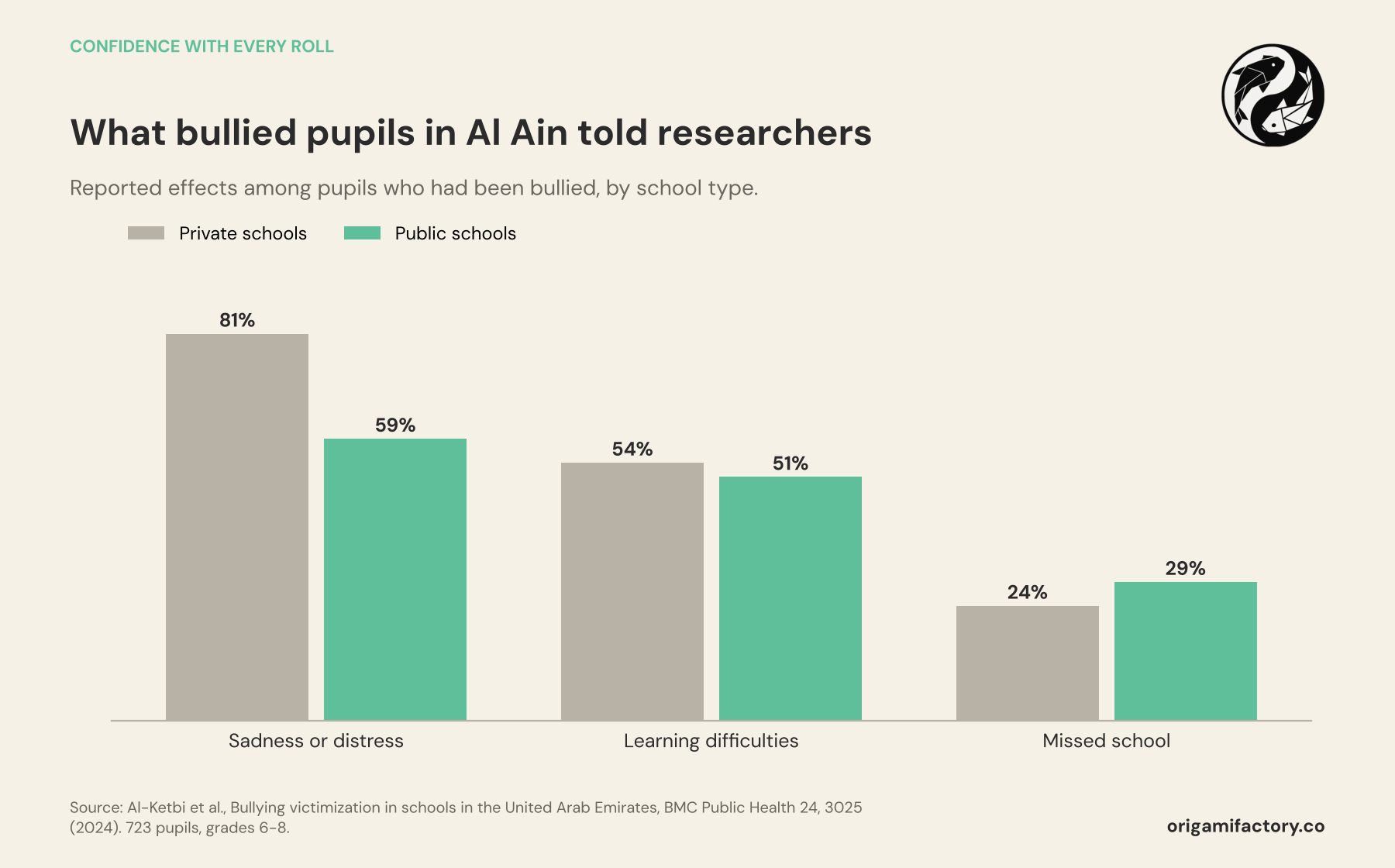
The Great Smoky Mountains Study tracked 1,420 children from age 9 to their mid-twenties. The link between childhood bullying and adult disorders held even after researchers accounted for earlier mental health problems and family hardship (NIMH summary of Copeland et al., 2013).
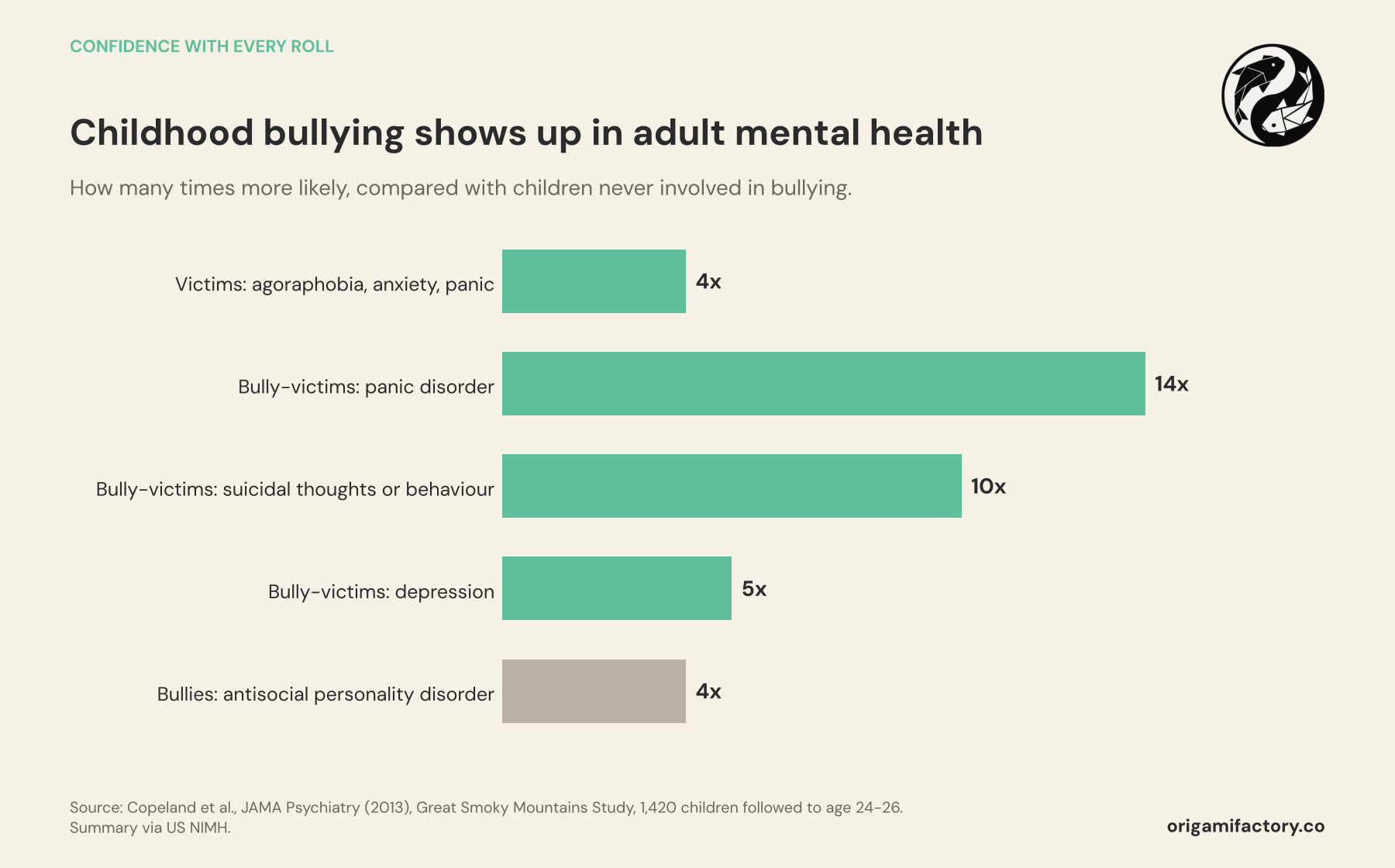
Table 5. Adult outcomes linked to childhood bullying (Copeland et al., 2013)
| Group | Adult outcome | Compared with uninvolved children |
|---|---|---|
| Victims | Agoraphobia, generalised anxiety, panic disorder | 4 times the prevalence |
| Bully-victims | Panic disorder | 14 times the risk |
| Bully-victims | Suicidal thoughts or behaviour | 10 times the risk |
| Bully-victims | Depressive disorders | 5 times the risk |
| Bullies | Antisocial personality disorder | 4 times the risk |
Short answer: Structured school anti-bullying programmes work, though the effect is moderate. A review of 100 evaluations found they cut bullying perpetration by about 19 to 20% and victimisation by about 15 to 16%. Supportive adults and activities that build self-control also help.
Short answer: Write down what happened and when, tell the school in writing, and ask for its anti-bullying policy and a named contact. Then check in with your child every few days. Most cases improve faster when the school and the family act on the same plan.
Between 26% and 37% depending on the survey. PISA 2015 found 27% of UAE 15-year-olds were bullied at least a few times a month, the 2016 GSHS recorded 26% over 30 days, and a 2022 Al Ain study found 36.7% of grade 6 to 8 pupils.
About 32% of students were bullied at least once in the past month, according to UNESCO’s 2019 data from 144 countries and territories.
In the 2022 HBSC study, 15% of children were cyberbullied compared with about 11% bullied at school, so yes, in that sample it was slightly more common.
On average, yes. They reduce bullying perpetration by roughly 19 to 20% and victimisation by 15 to 16%.
The research shows martial arts reduces aggression (effect size 0.65) and internalising symptoms such as anxiety (effect size 0.62). There is less direct evidence on bullying victimisation itself. Read our martial arts research summary for the full picture.
Every figure on this page is available as a spreadsheet, free to use with a credit and a link back: Childhood bullying statistics 2026 (CSV). Each row carries the value, the population it describes, the year and a link to the original source.
The Origami Factory (2026). Childhood Bullying Statistics 2026: UAE and Global Data. Available at: https://origamifactory.co/research/childhood-bullying-uae/
Embedding a chart? Please add this line below it: Source: The Origami Factory, origamifactory.co (with a link to this page).
The Origami Factory is a children’s Brazilian Jiu-Jitsu and character development academy at Jumeirah Golf Estates, Dubai, for ages 4 to 17. Our 3D Method tracks confidence, discipline, focus, resilience and social development. If you’d like to see how your child responds on the mat, book a trial class.