
Martial arts schools make a lot of claims about confidence, focus and discipline. Some of those claims hold up well in research. Some are thinner than you’d expect. This page summarises the controlled studies and meta-analyses on martial arts for children, with effect sizes, sample sizes and links, so you can judge the evidence for yourself.
We run a kids’ Brazilian Jiu-Jitsu academy, so we have an obvious interest here. That’s exactly why we’ve tried to report the limits as clearly as the findings.
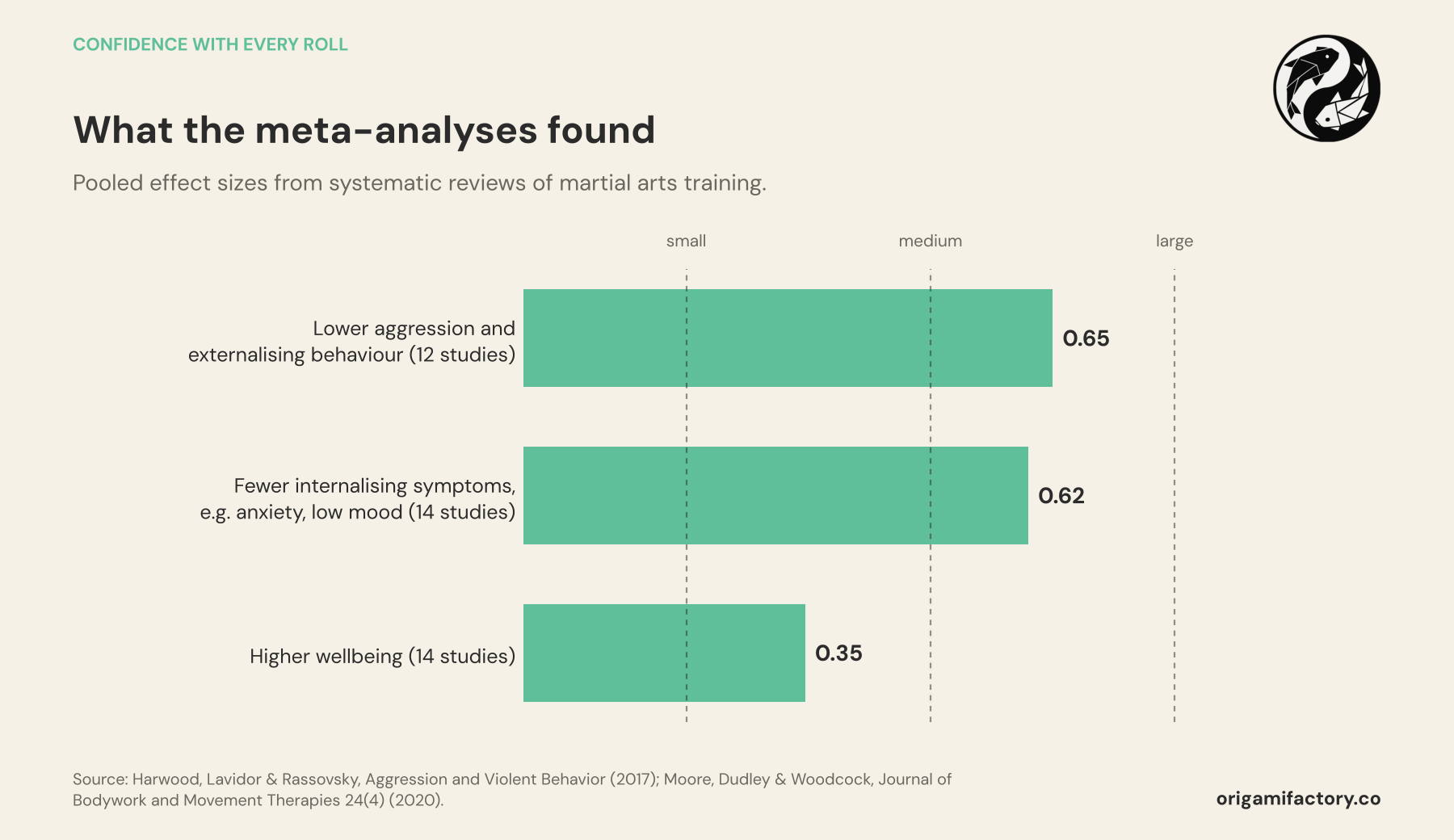
An effect size tells you how big a change is, not only whether it exists. By the usual convention, 0.2 is small, 0.5 is medium and 0.8 is large. A medium effect from a weekly after-school activity is a meaningful result, I think, though not a miracle.
Short answer: No. The evidence points the other way. A 2017 meta-analysis of 12 studies found martial arts training reduced aggression and externalising behaviour in children and teenagers, with a medium effect size of 0.65. Results held regardless of age, gender, training length or whether classes ran in or out of school.
A 2025 meta-analysis of 16 randomised controlled trials reached a similar conclusion. It also found that programmes lasting 12 to 16 weeks, with three or more sessions a week, gave the clearest drop in aggression (Luo et al.).
Short answer: The evidence is promising. A 2020 systematic review and meta-analysis of 14 studies found martial arts training reduced internalising symptoms such as anxiety and low mood (effect size 0.62) and improved wellbeing (effect size 0.35). The studies varied a lot, so the exact size of the benefit is uncertain.
That variation shows up in the statistics: the confidence interval for internalising symptoms runs from 0.006 to 1.23 (Moore, Dudley and Woodcock). In plain terms, the benefit is probably real, but how large it is depends heavily on the programme.
Short answer: Yes, in controlled trials. In a randomised trial of 240 UK primary pupils, an 11-week Taekwondo course led to fewer teacher-rated conduct problems, better attentional control and better executive attention on a computer task. It did not change impulsivity, working memory or prosocial behaviour.
Table 1. Controlled studies on self-control and attention
| Study | Design and sample | Duration | Main result |
|---|---|---|---|
| Ng-Knight et al. (2022), Developmental Psychology | Randomised field experiment, 240 children aged 7-11, UK | 11 weeks, Taekwondo | Fewer conduct problems; better attentional control and executive attention. No change in impulsivity, working memory or prosocial behaviour. |
| Kadri et al. (2019), IJERPH | Controlled trial, adolescents with ADHD | 18 months, Taekwondo | Large improvements in inhibitory control and selective attention (effect sizes 1.26 to 2.90). |
Kadri et al. was a small trial in a specific group, so treat its very large effect sizes with caution.
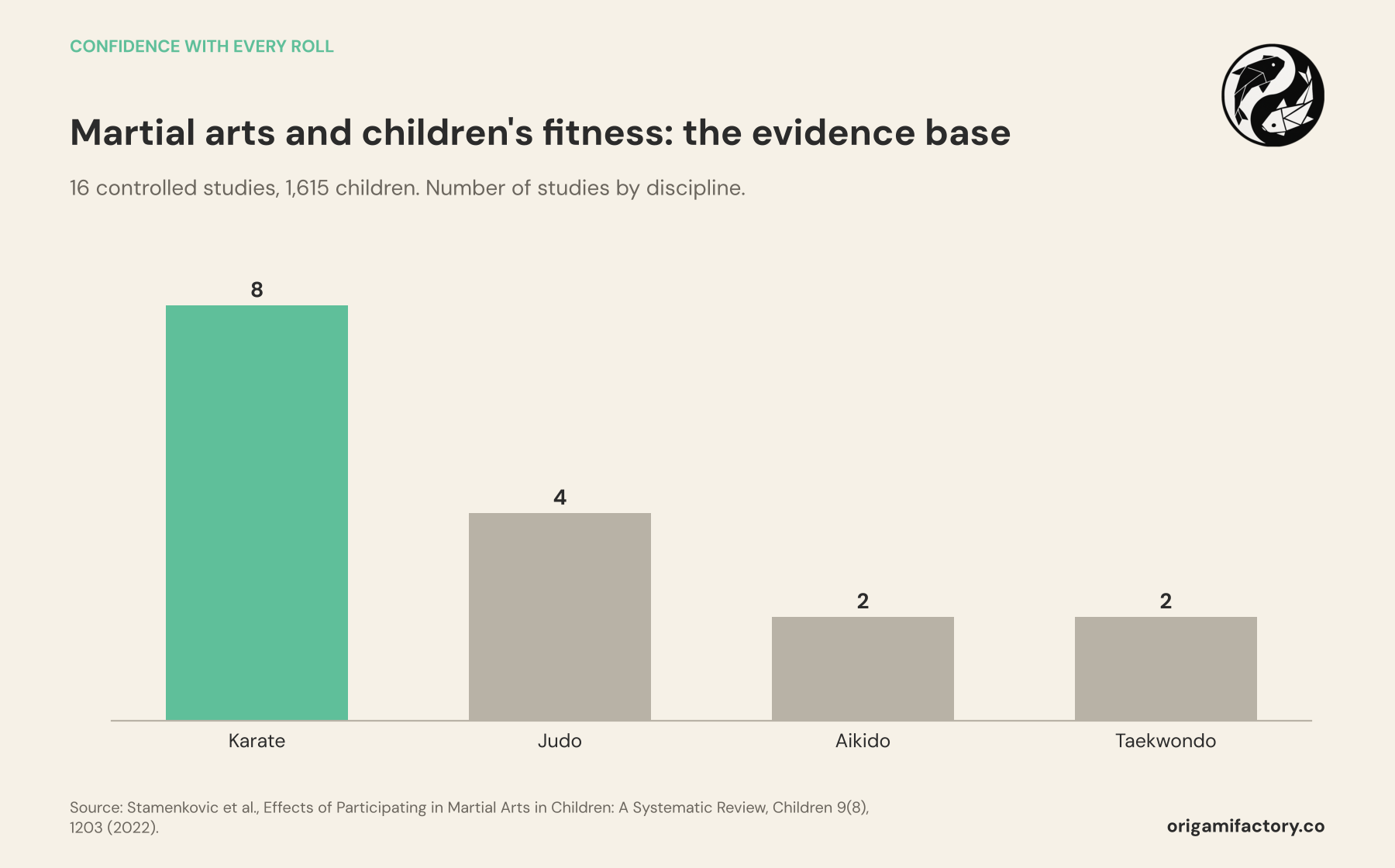
Short answer: Yes. A 2022 systematic review of 16 controlled studies with 1,615 children found martial arts programmes improved cardiorespiratory fitness, speed, agility, strength, flexibility, coordination and balance. Karate was the most studied discipline, followed by judo.
That matters in the UAE, where only 19% of school children meet the 60-minute daily activity guideline (UAE 2022 Report Card). See our physical activity and screen time statistics for more.
Short answer: BJJ has far less research than karate, judo or taekwondo. The most relevant study for UAE families is a 2022 randomised trial of a school-based BJJ programme in Abu Dhabi, published in the International Journal of Sport and Exercise Psychology. Most other evidence comes from martial arts in general. We have listed the citation below so you can read it in full.
We have not summarised this trial’s results here, because we have only verified its citation details, not read the full text. Study: Bueno, Andreato, Silva and Andrade (2022). Effects of a school-based Brazilian jiu-jitsu programme on mental health and classroom behaviour of children from Abu Dhabi: a randomised trial. International Journal of Sport and Exercise Psychology 21(6), 1091-1106 (publisher page).
Table 2. Summary of the evidence
| Outcome | Best evidence | Effect | Strength of evidence |
|---|---|---|---|
| Aggression and externalising behaviour | Meta-analysis, 12 studies (2017); 16 RCTs (2025) | 0.65 (medium) | Good |
| Prosocial behaviour | Meta-analysis, 16 RCTs (2025) | Significant improvement | Moderate |
| Anxiety and low mood | Meta-analysis, 14 studies (2020) | 0.62 (medium, wide range) | Moderate |
| Wellbeing | Meta-analysis, 14 studies (2020) | 0.35 (small) | Moderate |
| Attention and conduct | RCT, 240 children (2022) | Improved attention, fewer conduct problems | Moderate, one large trial |
| Physical fitness | Systematic review, 16 studies, 1,615 children (2022) | Improvements across most measures | Good |
| Being bullied | No direct trials found | Unknown | Weak |
Short answer: Many of the trials here ran for 10 to 16 weeks. The 2025 meta-analysis found the clearest gains in prosocial behaviour from programmes lasting 12 to 16 weeks with sessions of around 46 to 59 minutes. The UK Taekwondo trial saw effects after 11 weeks.
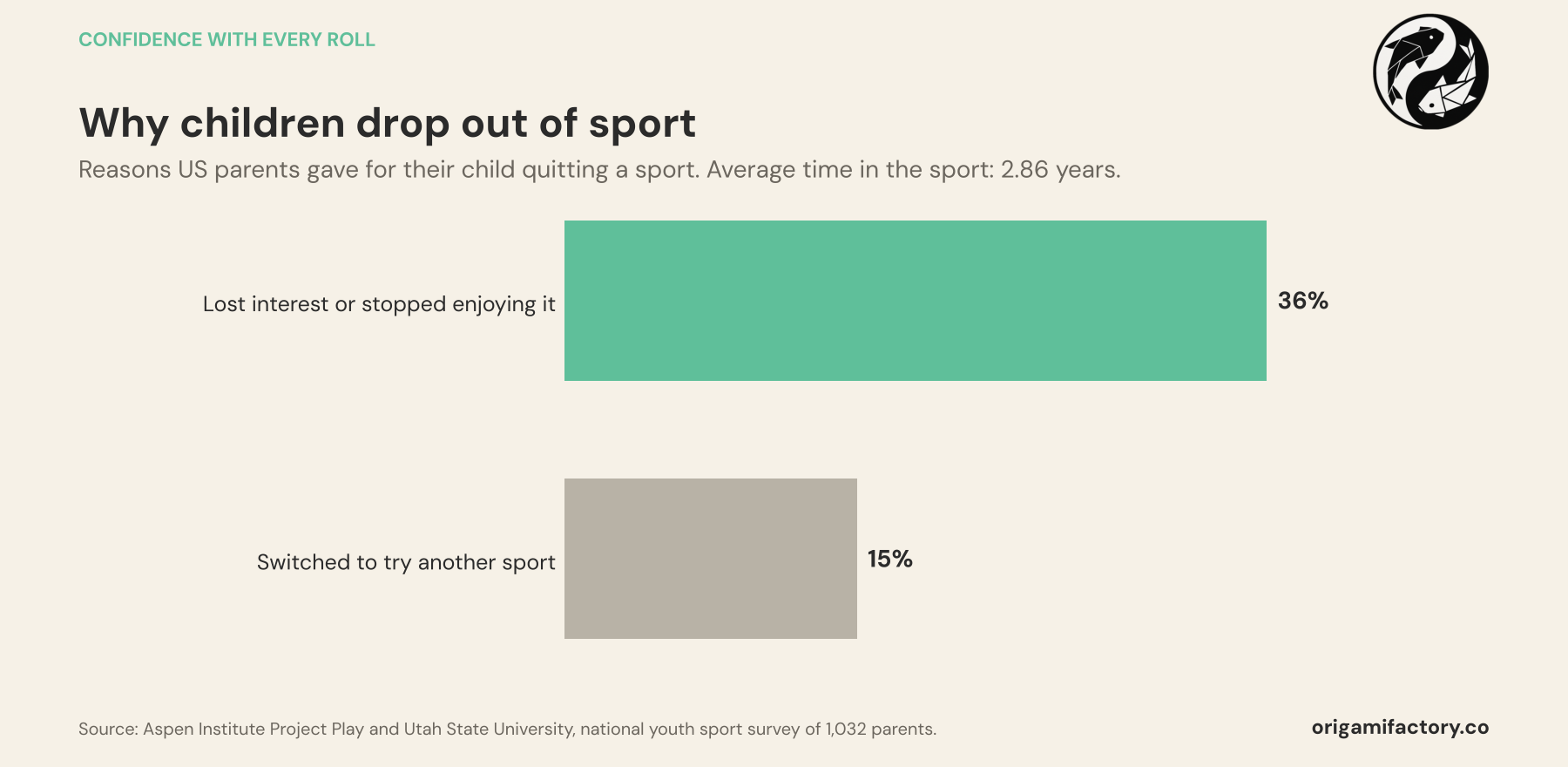
Staying long enough is the hard part. US children quit a sport after an average of 2.86 years, and the most common reason, given 36% of the time, is that they stopped enjoying it (Project Play). So when you choose a club, the fun matters as much as the syllabus.
Early evidence is positive. A small Taekwondo trial in adolescents with ADHD found large gains in attention and inhibitory control, and a larger UK trial found better attention in typical primary pupils. More research is needed.
The studies on this page cover children from preschool age up to 17. Classes for 4 to 6-year-olds should focus on movement, listening and play.
No. Meta-analyses show it reduces aggression, with an average effect size of 0.65.
There isn’t enough head-to-head research to say. Karate and judo have the most studies; BJJ has the fewest. The coach and the class structure probably matter more than the style.
Every figure on this page is available as a spreadsheet, free to use with a credit and a link back: Martial arts for kids research summary 2026 (CSV). Each row carries the value, the population it describes, the year and a link to the original source.
The Origami Factory (2026). Martial Arts for Kids: What the Research Says (2026 Evidence Review). Available at: https://origamifactory.co/research/martial-arts-for-kids-research/
The Origami Factory teaches Brazilian Jiu-Jitsu and character development to children aged 4 to 17 at Jumeirah Golf Estates, Dubai. Our 3D Method (Discover, Develop, Demonstrate) tracks confidence, discipline, focus, resilience and social development across four age groups. Book a trial class.