


10 Signs Of Low Confidence In Children (And What They Are Really Telling You)
 Confidence in children does not always announce itself loudly. A child who is struggling internally does not usually walk up and tell you they feel small, or scared, or not good enough. The signs are quieter, scattered through daily behaviour, and easy to miss if you are not specifically looking for them.
That is part of what makes the signs of low confidence in children so important to recognise. The earlier you spot them, the earlier you can do something about them. Left unaddressed, low confidence has a habit of compounding. A child who feels uncertain at six often feels worse at nine, and worse still at twelve, because the avoidance behaviours that low confidence produces deny them the very experiences they need to build the confidence they lack.
This article walks through ten of the most common signs of low confidence in children, what each one is really telling you, and what you can do about it. None of the signs on their own should cause panic. But if your child shows several of them consistently, it is worth taking the pattern seriously.
Why Recognising the Signs of Low Confidence in Children Matters
Before we get to the specific signs of low confidence in children, it is worth understanding why this matters more than it might seem. Confidence is not just about how a child feels. It shapes what they attempt, what they avoid, who they make friends with, how they handle setbacks, and ultimately how their lives unfold. Children who develop strong confidence in childhood tend to enter adolescence with the internal resources to handle its difficulties. Children who do not, often struggle in ways that look like other problems on the surface, anxiety, withdrawal, behavioural difficulty, but trace back to the same root.
The UK children’s mental health charity YoungMinds notes that low self-esteem in children and young people is closely linked to wider mental health difficulties, and that catching the signs early is one of the most useful things parents can do.
The good news is that confidence is built, not inherited. A child who shows signs of low confidence today is not destined to be that way. They are showing you, through behaviour, where they need support. Read the signs correctly and you have a starting point.
Sign 1: They Refuse to Try New Things
This is one of the most common and most visible signs of low confidence in children. A child who consistently refuses to try anything new, a new activity, a new sport, a new food, a new social situation, is usually not being stubborn or difficult. They are protecting themselves from the possibility of failing in front of others.
What they are really telling you: “I would rather not try than try and fail. The risk of looking stupid is worse than the loss of the experience.” For a child with healthy confidence, the calculation runs the other way: trying is worth it because failing is survivable. For a child without that internal reassurance, the avoidance feels safer.
This sign often shows up clearly when parents try to enrol a child in an activity. Children who quit everything within a few weeks often do so for this reason. Our article on why your child quits everything explores this pattern in more detail.
Sign 2: They Use Negative Self-Talk
“I’m stupid.” “I’m rubbish at this.” “Nobody likes me.” When children say things like this regularly, even in passing, it is worth paying close attention. Casual negative self-talk is one of the more reliable signs of low confidence in children, and it tends to grow louder over time if it is not addressed.
What they are really telling you: this is the soundtrack running in my head. The things they say out loud are usually a fraction of what they say to themselves silently. A child who calls themselves stupid once in front of you is probably saying something similar internally a dozen times a day.
The temptation is to argue back. “Don’t say that, you’re brilliant.” This rarely helps. The child hears the contradiction but does not internalise it. What works better is acknowledging the feeling without agreeing with it: “It sounds like you’re feeling really frustrated right now. Tell me what happened.”
Sign 3: They Avoid Eye Contact or Speak Very Quietly
Posture and voice volume are often overlooked signs of low confidence in children. A child who consistently avoids eye contact with adults, who speaks so quietly you have to ask them to repeat themselves, or who physically shrinks when attention is on them, is communicating something important about how they feel in themselves.
What they are really telling you: I do not feel like I deserve to be heard. I do not want to be noticed because being noticed feels dangerous. The body language of low confidence is unmistakable once you know what to look for.
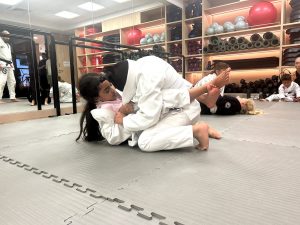
This is one area where structured activity helps quietly and powerfully. Children who train in BJJ learn over time to make eye contact with coaches, to speak clearly in answer to questions, to physically claim their space on the mat. These small adjustments to how they hold themselves transfer into how they move through the rest of their life.
Sign 4: They Cannot Take a Compliment
This is one of the trickier signs of low confidence in children to spot, because it looks like modesty. A child who genuinely struggles to receive a compliment, who deflects, denies it, or visibly squirms when praised, is usually not being humble. They are protecting themselves from a positive statement that does not match how they feel inside.
What they are really telling you: I do not believe what you are saying about me, so I need you to stop saying it. Compliments create an uncomfortable tension between the child’s internal self-image and the external statement. Deflecting resolves the tension.
The way to help is not to compliment more, but to compliment differently. Praise effort and specific behaviour rather than abstract qualities. Instead of “you’re so clever,” try “I noticed how carefully you worked on that.” Specific praise is harder to deflect and easier to absorb. Our article on how to build confidence in a child covers the difference in more depth.
Sign 5: They Are Highly Sensitive to Criticism
A child with healthy confidence can hear correction without falling apart. A child with low confidence often cannot. Tears, anger, defensive shutting down, or sudden withdrawal in response to even mild criticism are among the more telling signs of low confidence in children.
What they are really telling you: I have so little internal evidence of my own value that one critical word from outside is enough to overwhelm it. For a child whose self-worth is fragile, criticism does not register as feedback. It registers as confirmation of what they already secretly believe about themselves.
This is one reason BJJ training, done well, is so useful. Coaches give frequent, kind correction. Over time, children learn that correction is information, not judgement, and they become more able to receive feedback without collapsing under it. We cover the link between training and emotional resilience in our article on how jiu jitsu builds emotional intelligence.
Sign 6: They Compare Themselves Constantly to Others
“She’s so much better at this than me.” “He’s smarter than me.” “Everyone in class can do this except me.” When children comment frequently on how they measure up against peers, they are usually showing one of the deeper signs of low confidence in children.
What they are really telling you: I am constantly measuring myself against others because I have no internal yardstick for whether I am okay. They are looking outward for evidence of their value because they have not yet built any inward.
The trap here is that comparison is endless. There is always someone better, someone faster, someone with more friends. A child who lives by comparison will always find evidence to feel bad about themselves. The way out is not to win the comparison but to step out of it, to develop a sense of self that does not depend on what others are doing.

Sign 7: They Cling to You in Social Situations
Some clinginess is age-appropriate. A young child who does not want to leave you at a party is not necessarily showing low confidence. But a child who consistently refuses to engage socially without you nearby, who needs you to speak for them in front of strangers, or who shows real distress at being separated even in safe and familiar settings, is showing one of the clearer signs of low confidence in children.
What they are really telling you: I do not feel safe in social situations without a familiar adult to anchor me. The world feels overwhelming and I need you as a buffer.
This sign is often connected with broader social difficulty. Our article on how to help a child who struggles socially goes into this in more depth, including the practical steps that help children develop the internal security to function socially without constant adult support.
Sign 8: They Give Up Quickly When Things Get Hard
A child who packs up the puzzle after two failed attempts. A child who says “I can’t do this” before they have really tried. A child who refuses to keep practising a skill they were enthusiastic about a week ago. These are all signs of low confidence in children showing up as low frustration tolerance.
What they are really telling you: I cannot handle the feeling of being not-good-yet. The discomfort of struggling exceeds what I have internal resources to manage.
The strategies that help here are about building tolerance for difficulty in safe contexts. Structured activities where struggle is normal and expected, where every child fails regularly and gets up and tries again, are uniquely good at developing this capacity. Our article on why consistent training helps children behave better at school covers the broader mechanism by which consistent training builds the internal resources to handle difficulty.
Sign 9: They Withdraw From Activities They Used to Enjoy
This is a more concerning sign and it often shows up around adolescence, but it can appear earlier. A child who suddenly loses interest in something they previously loved, dropping a hobby, stopping a sport, walking away from a friendship group, is often experiencing something more significant than a change in taste.
What they are really telling you: something has happened that I cannot explain, and protecting myself feels more important than continuing. Perhaps they have started comparing themselves negatively to others in the activity. Perhaps a small experience has knocked them. Perhaps a sense of inadequacy has crept in that makes the activity feel exposing rather than enjoyable.
The right response is not to force them back to the activity. It is to find out, gently, what changed. Open-ended questions: “I noticed you’ve stopped playing piano. Tell me what’s going on with that.” Listen more than you speak. The answer may not come immediately, but the fact that you have asked carefully matters.
Sign 10: They Apologise Constantly, Even for Things That Are Not Their Fault
A child who says sorry for everything, when they brush past someone in a corridor, when they ask a teacher a question, when something they had no control over goes wrong, is showing one of the quieter but more revealing signs of low confidence in children.
What they are really telling you: I assume I have done something wrong because I think of myself as the kind of person who is usually wrong. The apology is automatic. It is not a response to anything specific. It is a default position.
The fix here is not to tell them to stop apologising, which usually adds another layer of self-criticism. It is to gently mirror what is happening: “You haven’t done anything wrong. You don’t need to say sorry for that.” Over time, with consistency, children begin to notice their own pattern and adjust it.
What All These Signs of Low Confidence in Children Have in Common
Read through the ten signs above and a pattern emerges. They are all, in different ways, expressions of the same underlying belief: I am not enough. The specific behaviours vary, but the message running underneath is consistent. A child with low confidence is operating on the working assumption that they are smaller, weaker, less worthy, less capable than the people around them. Every behaviour is a strategy to protect themselves from having that belief confirmed in public.
This is why telling a child they are brilliant rarely works. The brilliant statement bounces off the belief that they are not. What changes the belief is not words. It is experience. Specifically, the accumulated experience of doing difficult things and discovering, slowly, that they can. Real confidence in children is built through evidence, not reassurance.
What Actually Helps
If your child shows several of the signs of low confidence in children we have covered, you are probably wondering what to do next. The good news is that the approaches that genuinely work are clear and consistent across the research.
Build mastery through structured challenge
A child who has experienced what mastery feels like, the feeling of being genuinely good at something through their own effort, carries that experience as proof of their own capability. Structured activities that offer real, earned progression are particularly good at this. BJJ is one example. Our 3D method is built specifically to give children sequenced experiences of struggle, development, and demonstration, which is the cycle that builds durable confidence.
Praise effort, not outcome
Children praised for their effort, persistence, and process develop stronger confidence than children praised for being talented or clever. This shift in how you speak is one of the most useful single changes you can make at home.
Let them struggle without rescuing
Every time a parent steps in to fix a problem the child could have worked through, the child receives a small message that they were not capable. Over time, these small messages accumulate. Letting children struggle in age-appropriate ways, with you nearby but not intervening, is one of the most underused ways of building confidence.
Find one regular activity that suits them
Consistency matters more than variety. A child who attends one structured activity once or twice a week for a year builds far more confidence than a child who tries six activities for a month each. Our article on building confidence at home covers what you can do day to day alongside whatever structured activity you choose.
Consider how their environment is shaping them
Two underrated factors deserve mention. Heavy screen use can erode confidence by giving children constant exposure to curated versions of other people’s lives. Our article on screen time and your child’s attention span covers the broader effects. Bullying, even at low levels, can corrode a child’s confidence rapidly. Our article on how jiu jitsu prevents bullying explores this dynamic.
How BJJ Helps Children Who Show These Signs
We have worked with a lot of children who arrived showing several of the signs of low confidence in children we have described. The ones who train consistently tend to change in ways that surprise their parents. Not because BJJ is magic. Because the activity is specifically structured to give children regular, supported experiences of doing hard things and getting through them.
Our programmes are organised by age. The Penguins for ages 4 to 6 work on the foundations: physical coordination, attention, the basics of cooperating with another child. The Foxes for ages 7 to 9 introduce real technique and the satisfaction of earning small wins. The Cranes for ages 10 to 12 and Dragons for ages 13 and above work at the level where genuine identity-level confidence is built, the kind that carries into adolescence and beyond.
Our article on how jiu jitsu builds confidence in children covers the specific mechanism in detail.
Getting Started
If you recognised your child in several of the signs of low confidence in children above, the most useful thing you can do is take one step. You do not need to fix everything at once. Pick one activity, build the habit, and let the small daily changes accumulate over months.
If BJJ feels like it might be a fit, you can see how we run things on our programmes page, check class times on the schedule page, and read about what to expect in our article on what happens at a kids BJJ trial class in Dubai. If you have questions about your specific child, we are happy to talk through them on the contact page.
When you are ready, book your child’s free trial here.
Frequently Asked Questions: Signs Of Low Confidence In Children
How many of these signs of low confidence in children does my child need to show before I should be worried?
It is not really about the number, it is about the pattern. A child who shows one or two signs occasionally is probably fine. A child who shows several signs consistently across different settings, at home, at school, in social situations, is showing you something more meaningful. Trust your sense of the pattern over time.
Could these signs of low confidence in children indicate something else, like anxiety?
Yes, and the two often overlap. Low confidence and anxiety are closely related but not identical. A child with anxiety may also show low confidence, and vice versa. If the signs are intense, persistent, or causing real distress, it is worth speaking with your GP or a child psychologist. For most children, however, the kinds of signs described here improve significantly with consistent support at home and structured activity.
My child seems confident at home but not at school. Is that low confidence?
Possibly. Some children show low confidence only in specific settings, particularly when the social demands are higher. This is worth paying attention to even if home life looks fine. A child who is brave at home and frozen at school is still struggling with confidence, just in a more context-specific way.
Will my child grow out of low confidence?
Some children do. Many do not, particularly if the underlying patterns are not addressed. The risk of waiting is that the avoidance behaviours that come with low confidence tend to deepen over time, because they prevent the very experiences that would build confidence. Acting earlier is almost always better than waiting.
How long does it take to see improvement?
Small shifts often appear within a few weeks of consistent support. More substantial change typically takes three to six months. The most important thing is consistency. Brief bursts of effort followed by drift back to old patterns rarely produce durable change.
Can BJJ specifically help with low confidence?
In our experience, yes, for many children. The activity is structured in a way that produces regular, supported experiences of mastery, which is exactly what low confidence needs to shift. It is not the only way to build confidence, but it is one of the more reliable structured activities we know of for this specific purpose.