
How to Help Child Make Friends in a New Country.
Three weeks after the move, your child still eats lunch alone and says school is “fine”. You smile, nod, and then lie awake wondering how to help child make friends in a city where everyone else seems to have known each other for years. If that is you, you are in good company. Dubai is a city of arrivals, and a lot of children here are the new kid at some point.
This guide is our answer to how to help child make friends after a move. We write it as coaches who watch hundreds of children walk onto a mat for the first time every year. We cannot promise a best friend by Friday. We can show you what tends to work, what tends to backfire, and what you can do this week.
Why Making Friends Is Harder in a New Country
Moving abroad takes away almost everything a child uses to find friends, which is why how to help child make friends becomes such a pressing question for expat parents. The familiar playground is gone. So are the neighbours, the cousins and the football team. In Dubai there is another layer. Many families live in one area, work in another, and send their children to a school that is a forty minute drive away. Classmates often live nowhere near each other, so friendships rarely grow by accident after school.
Friendship skills also take time to show up. A child who is chatty at home can freeze in a room of strangers. A child who joined the school halfway through term faces groups that are already formed. None of this means something is wrong with your child. It means they are doing something hard.
The research backs up why it matters. The American Psychological Association reports that children who are well liked by classmates tend to fare better than less-liked peers, and that children with good social skills are more likely to stay in school and keep healthy relationships later in life. Friendship is not a luxury. It is part of how children learn to cope, so working out how to help child make friends early is time well spent.
What Children Actually Need to Make a Friend
Before we get to how to help child make friends, it helps to know what friendship is built from. In our experience it comes down to four small skills.
First, a child needs to be able to start. That means walking up, saying hello, or asking to join in. Second, they need to stay with an interaction for more than a few seconds, even when it feels awkward. Third, they need to read the other child a little, noticing when a game is getting too rough or when someone wants to stop. Fourth, they need to cope when it goes wrong, because it will go wrong sometimes.
Notice that none of these are about being popular. A child with one or two steady friends is doing very well. When parents ask us how to help child make friends, we usually answer by asking which of the four skills looks hardest for their child. The answer tells you where to spend your energy, and it keeps how to help child make friends from feeling like an impossible job.
Common Misconceptions Parents Have About Friendship
Parents who are worried tend to reach for the same fixes. Most of them are kind, and some of them make things harder.
The first misconception is that your child just needs more play dates. Play dates help, but only when the child has a way to connect once they are there. Two nervous children in a room with a tray of snacks can have a very long hour. Give them something to do together, not just somewhere to be. Good advice on how to help child make friends always starts with a shared task.
The second is that confidence has to come first. Many parents believe their child must feel confident before trying anything social. We see the reverse. Small successes with other children build the confidence, and you cannot think your way into it. If you want to understand the difference between the two ideas, our piece on confidence versus self-esteem in children goes into it.
The third is that you should step in quickly when a friendship hits a problem. We understand the urge. But a child who never handles a small falling out never learns they can survive one. Listen first. Rescue later, and only if you need to. Learning how to help child make friends includes learning when to step back.
The fourth is that a quiet child is an unhappy child. Some children want one friend, not ten. Check what your child actually wants before you decide there is a problem. The right plan for how to help child make friends depends on that answer.
How to Help Child Make Friends: The First Month
This is the practical part. If you are searching for how to help child make friends, start with these steps in this order, and give each one a couple of weeks.
Start with one child, not a crowd. Ask your child’s teacher who in the class seems kind, or who sits near your child. Invite that one child, for a short, structured meeting. An hour is plenty. Pick something with a built in job, such as baking, building something, or a trip to a park with a ball.
Next, practise the first thirty seconds at home. Many parents skip this step when they look up how to help child make friends, and it is one of the most useful. Children who freeze often just do not have the words ready. Rehearse three sentences with them, such as “Can I join?”, “What are you playing?” and “I like your game.” It feels silly. It works. The APA guidance on this age group makes the same point, that suggestions for younger children should be very skills driven, with the actual words to use spelled out.
Then give your child a repeat context. A single meeting rarely makes a friend. The same group of children seeing each other every week does. That is why one weekly activity usually beats a string of one off events, and why so many of our parents tell us their child’s first real friend came from a regular class.
Finally, keep your own worry in check, since it is the part of how to help child make friends that is entirely yours. Children pick up on it fast. If every pick up begins with “Did you play with anyone?”, your child learns that friendship is a test they are failing. Try “What was the best part of your day?” and let the friendship news arrive on its own.

A Child at the Mat: What It Looks Like in Practice
Here is a composite of a child we see often, with details changed. We will call him Sam. He is eight, he moved to Dubai in August, and he starts in our Foxes class with his arms folded. His mum tells us he has not been invited to a single birthday party yet.
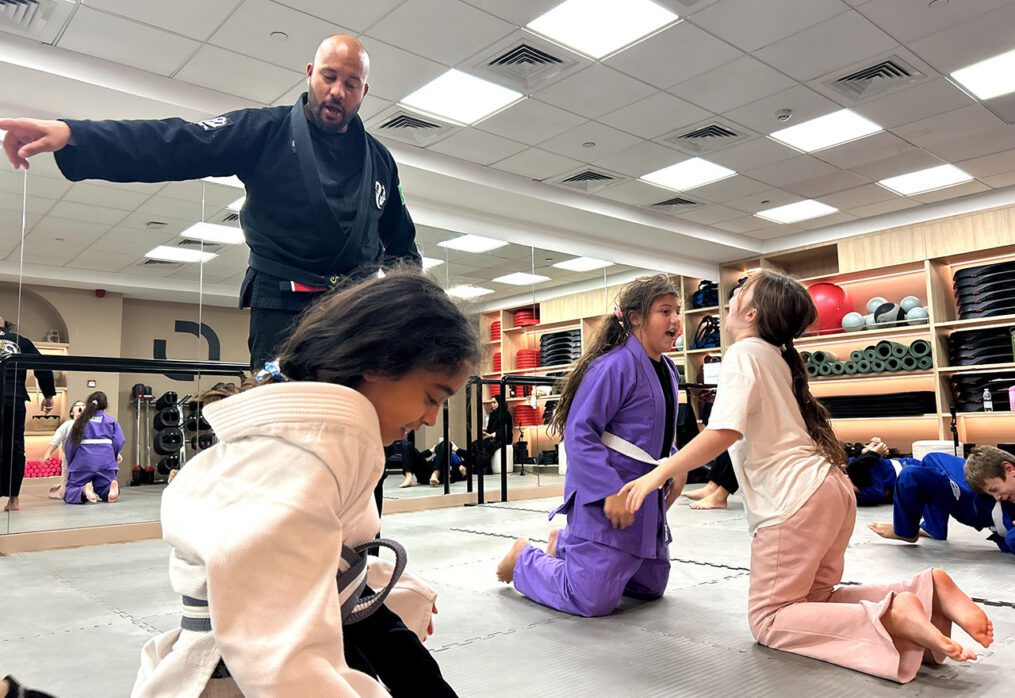
In his first week Sam stays near the wall during warm ups. In BJJ, though, children are paired up for drills, and the coach does the pairing. Sam does not have to find a partner. He just has to practise with whoever he is given. By week two he has worked with four different children. By week three one of them, Omar, asks to partner with him again.
Nothing dramatic happened. Sam was not told to be brave. He had a clear task, a partner who also had to take part, and a short, regular time to repeat it. After about six weeks he was laughing during a drill, and after eight he walked in with Omar. This is the pattern we see again and again. We think how to help child make friends is often a question about structure, not personality.
Many parents who ask us how to help child make friends want to see this first. If you are curious what a first session feels like for a child like Sam, we describe it step by step in our guide to what happens at a kids BJJ trial class in Dubai.
What You Can Do This Week
You do not need a plan for the whole year. Pick two or three of these and try them over the next seven days.
Ask the teacher one specific question, because teachers see how to help child make friends in real time. “Who does my child seem comfortable around?” gives you a name you can use for a play date. A general “How are they settling in?” usually gets a general answer.
Invite one child for one hour, with an activity. Keep the time short so nobody gets stuck.
Practise three opening lines in the car. Do it as a game, and take a turn being the shy one yourself.
Choose one weekly activity where the same children return. Look for small groups, a clear routine, and a coach who actively mixes children rather than letting them choose partners by habit.
Say less after school. Parents often over ask when they are unsure how to help child make friends. Ask about the best part of the day, and leave the friendship question for the weekend.
Write down what you see. A short note each evening, such as “talked to Layla at break”, shows progress you would otherwise miss. Slow progress is still progress, and it is easy to lose track of it when you are worried. Keeping notes on how to help child make friends in your own house, and what worked, makes the next step clearer.
How Friendship Looks at Different Ages
Advice on how to help child make friends should change with age, because the skills children need change too.
Between four and six, friendship is mostly about shared play. Children at this age need adults to set up the first meeting and give them a game. In our Penguins classes for ages 4 to 6, the games do most of the work.
Between seven and nine, children start to care who sits next to them. Falling outs begin. This is also the age when many children first say “nobody likes me”. Our Foxes class for ages 7 to 9 is where we see a lot of the early friendship skills form.
Between ten and twelve, groups matter more, and so does fitting in. Children can feel left out in a very sharp way. We wrote about this stage in our article on pre-teen development and confidence, and our Cranes programme is built around it.
From thirteen, friendships become more private, and parents are asked to stand further back. Even so, how to help child make friends is still a fair question at this age, and the answer is mostly to offer a place to belong. You can still help by offering an activity that gives your teenager a place to belong that is separate from school.
How The Origami Factory Approaches Friendship
We are a character development programme that uses BJJ as the way we teach it. Friendship is not a separate lesson for us, and we do not treat how to help child make friends as an add on. It sits inside the 3D Method, our approach of Discover, Develop and Demonstrate.
In Discover, a new child learns the room, the routine and a few faces. In Develop, they practise skills with partners who rotate, so they are not stuck with one person or left alone. In Demonstrate, they show what they have learned, often by helping a newer child. That last step matters. A child who has helped someone else tends to feel that they belong.
Our classes are grouped by cohort: Penguins at 4 to 6, Foxes at 7 to 9, Cranes at 10 to 12 and Dragons from 13. Children train with others their own age, which gives them a stable group to return to every week. We track character development as well as technique, so a coach can tell you whether your child is starting conversations, working with new partners and handling a loss calmly. You can read more about the whole programme structure on our site.
BJJ also helps for a plain reason. Children have to work with a partner to learn anything. They cannot practise alone, and they cannot hide. Our answer to how to help child make friends is simple, give children a reason to work together. They also learn to deal with winning and losing in front of each other, which is a social skill most children are never taught directly. If bullying is part of the worry, our article on how jiu jitsu prevents bullying covers that side of it.
When to Look for More Help
Most children settle in within a term or two. Sometimes it takes longer, and that can still be normal. Knowing how to help child make friends does not mean you can speed it up on demand. Look for more support if your child avoids school, if they are showing signs of low mood or worry that last for several weeks, or if they have been excluded or bullied. Talk to the school first, and consider the school counsellor or your paediatrician if the problem continues.
If your child is struggling more broadly, you may find it useful to read our article on what to do when a child has no friends and our guide to helping a child who struggles socially. Both go deeper than we can here on how to help child make friends when the problem is bigger than a new school.
Frequently Asked Questions
How long does it take a child to make friends after moving to Dubai?
It varies, and how to help child make friends quickly is a common worry. Many children find one or two friendly faces within four to eight weeks, and a settled group often takes a full term. If you are wondering how to help child make friends faster, focus on repeat contact with the same few children rather than more events.
Should I arrange play dates for my child?
Yes, but keep them short and give the children a task. One hour with a clear activity does more than a long afternoon with nothing planned. Part of how to help child make friends is choosing one child at a time.
My child says they do not want friends. What should I do?
Take it seriously, but do not panic. Some children are content with one close friend. Ask what happened, and ask whether they feel lonely or just prefer quiet. If it sounds like fear, practise small steps at home and in a small group activity.
Can sport help a shy child make friends?
It can, particularly sport that pairs children up and rotates partners. A regular class gives your child the same faces each week, which is what friendship needs. It is one of the simplest answers to how to help child make friends that we know of.
When should I speak to the school?
Speak to them early, ideally in the first few weeks. Teachers see the playground and can suggest children who might suit your child. If your child is being excluded or teased, contact the school straight away.
Is it too late if my child has already been in the same school for years?
No. Friendships shift at every age, and a new activity outside school can open a fresh group. The approach to how to help child make friends is the same whenever you start.
If you are still working out how to help child make friends, we built The Origami Factory for children who need a steady place to practise being brave with other people. You can look at our programmes for each age group, or book a free trial class and let your child try it for themselves.