

What Happens at a Kids BJJ Trial Class in Dubai
 Booking a kids BJJ trial class is one thing. Knowing what is actually going to happen when you and your child arrive is another. For most parents, this will be the first time you have ever walked into a Brazilian Jiu Jitsu academy. You will have questions. Your child will probably have nerves. There may be things you wish you had known before you got there.
This article walks you through exactly what to expect at a kids BJJ trial class at Origami Factory in Dubai, from the moment you arrive to the moment you leave. It is written for parents who have never set foot in a BJJ academy and want to feel prepared rather than thrown in at the deep end.
None of this is meant to be a script you have to memorise. We will guide you and your child through everything when you arrive. But knowing roughly what is coming usually helps both parent and child feel more settled, which makes the first session a better experience for everyone.
Before the Kids BJJ Trial Class
You will have booked your kids BJJ trial class either through our website or by speaking to us directly. Once the booking is confirmed, you will receive details of the class time, location, and what to bring. If you have not booked yet and want to, you can do so on our trial booking page.
The night before, the simplest preparation is the most useful. Your child does not need to know any BJJ moves. They do not need to be fit. They do not need to be confident. What they need is to have eaten a proper meal a couple of hours before the class, to be reasonably well rested, and to know that the trial is meant to be enjoyable, not a test.
For what to wear, comfortable sports clothes are perfectly fine for a kids BJJ trial class. Leggings or shorts and a t-shirt or rash guard work well. Avoid anything with zips, buttons, or pockets. Hair should be tied back. Fingernails and toenails should be trimmed. If your child has any specific medical condition or anxiety, let us know in advance so we can keep an eye out and tailor the session accordingly.
Arriving for Your Kids BJJ Trial Class
We recommend arriving about ten to fifteen minutes before the kids BJJ trial class is due to start. This gives you and your child time to settle in, meet the coach briefly, and get oriented to the space before things begin.
When you walk in, you will be greeted at reception. We will check you in, take a few details if we do not have them already, and show you where to put your child’s bag and shoes. Shoes come off before stepping onto the mat. Most children, even nervous ones, find this transition helpful. There is something about taking off your shoes and stepping onto a mat that feels like crossing a threshold. The space is calm, the lighting is right, and there is enough activity around to be interesting without being overwhelming.
While you are settling in, your child will be introduced to the coach who will be running the session. We make a deliberate effort to greet new children warmly but briefly. We are aware that some children find too much attention from strangers harder than too little. The coach will say hello, ask their name, perhaps make a small joke if it feels right, and then let them settle in without pressure.
You as the parent are welcome to stay and watch. In fact, we encourage it for a first session. There is a viewing area where you can sit comfortably. You do not need to engage with what is happening, you just need to be visible enough that your child knows you are there.
What Happens in the First Few Minutes of the Kids BJJ Trial Class
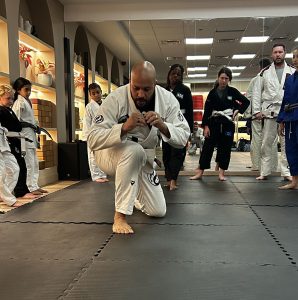
The class will usually begin with a quick gathering. Children sit in a line on the mat. The coach introduces the session, sometimes mentions anyone new (this can be skipped if your child has indicated they would rather not be singled out), and outlines what the class is going to cover.
This is followed by a warm-up. The warm-up serves two purposes. It gets bodies moving and ready for what comes next, and it lets the coach see how children move. For a child new to a kids BJJ trial class, this is usually a comfortable starting point. Warm-up exercises are simple, often game-like, and there is no right or wrong way to do them.
Typical warm-up activities include light jogging or skipping, hip escapes (a sideways shuffling movement on the back), forward and backward rolls (which are gentle and supervised), and some basic mobility drills. None of this requires prior experience. New children pick it up by watching the others. The coach keeps an eye on anyone who is struggling and offers quiet help where needed.
The Main Part of the Kids BJJ Trial Class
After the warm-up, the class moves into the technical part of the session. This is where the actual BJJ content is introduced. The structure of what comes next depends on the age group, and one of the things we always do for a kids BJJ trial class is place your child in the right group from the start.
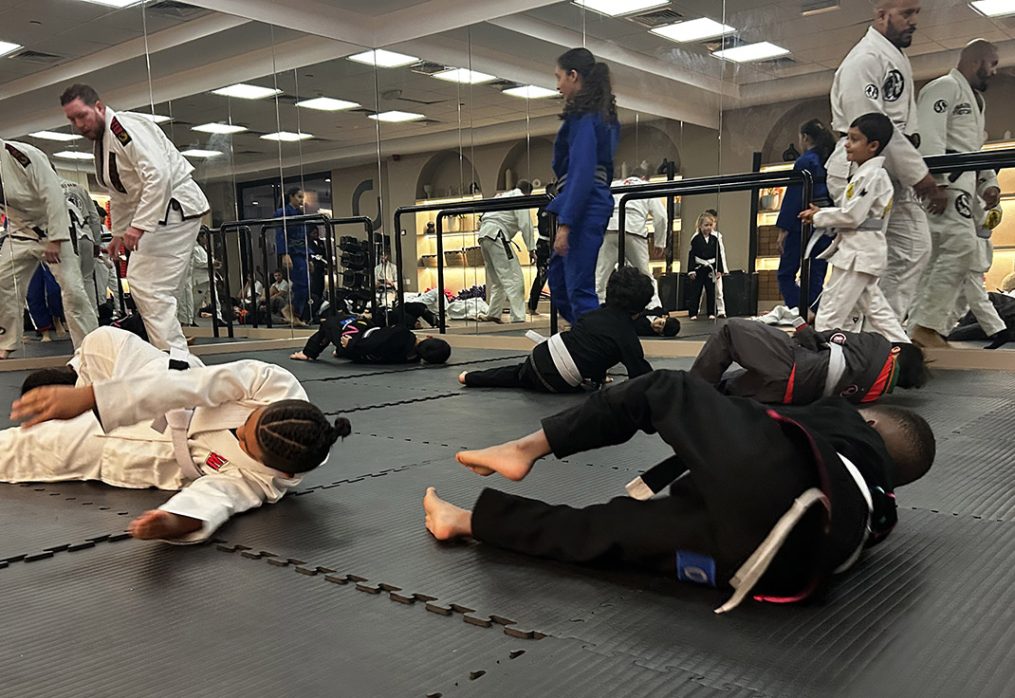
If your child is between 4 and 6, they will join our Penguins programme. At this age, the technical content is woven into games and movement challenges rather than presented as formal instruction. Children might play a tag-style game that secretly teaches them how to control their distance from another person. They might be asked to crawl, roll, and shuffle their way through obstacles. The learning happens, but it does not feel like learning.
If your child is between 7 and 9, they will join our Foxes programme. Here the structure starts to look more like a traditional BJJ class. Children are introduced to a specific position or movement, the coach demonstrates it clearly, and children pair up to practise it slowly with a training partner.
For 10 to 12 year olds, our Cranes programme goes deeper into technique, builds positional understanding, and starts to introduce light positional sparring. The Dragons programme for ages 13 and above operates at the highest intensity, closer to how adults train, though still with careful coaching attention.
In all groups, the teaching follows our 3D method: Discover, Develop, Demonstrate. Children are given a chance to explore a problem, then given structured coaching to develop technique, then given an opportunity to demonstrate what they have learned. A kids BJJ trial class typically shows all three stages, though in a compressed form, since the goal of the first session is exposure rather than complete mastery.
What About Sparring?
This is one of the most common questions parents ask before a kids BJJ trial class. Will my child have to spar with another child on their first day?
The short answer is no, not in any meaningful sense. New children are never put into open sparring on their first session. What may happen, depending on the age group, is some very light positional work with a partner where the coach has set up a specific situation and the children take it in turns to try a technique. This is closer to structured drilling than free sparring.
If your child seems happy and engaged, the coach may gradually introduce slightly more interactive elements towards the end of the session. If your child is hesitant, we keep things lower intensity. Nobody is pushed. Our priority in a kids BJJ trial class is for your child to leave wanting to come back, not for them to learn the most BJJ they can possibly absorb in one hour.
The culture around sparring at Origami Factory is also worth knowing. We talk to children about tapping from the very first session. Tapping is how you signal to your partner to stop, and we treat it as immediate and absolute. There is no pressure to push through pain. There is no rewarding of toughness over control. We cover this in detail in our article on how safe is jiu jitsu for children, which is useful background reading if you have any safety concerns before the trial.

The Last Few Minutes of the Kids BJJ Trial Class
The session typically wraps up with a short cool down, a moment of group acknowledgement, and a brief reflection. In some classes the coach asks children to share one thing they learned or found challenging. This is part of our 3D method’s Demonstrate stage, and it serves an important purpose: it gets children to articulate what they have taken away from the session rather than just leaving the mat passively.
For a first-time kids BJJ trial class, this part can be brief. We do not want to put pressure on a new child to perform in front of the group. But we do want them to leave with a clear sense of what they did, even if it was just one thing.
After class, the coach will usually take a moment to talk to you. They will share their initial impressions, mention how your child engaged, and answer any questions. This is a good moment for you to ask anything that came up while you were watching. If your child has had any kind of difficulty, the coach will let you know. If they did particularly well at something, we make a point of mentioning that too.
What to Watch For as a Parent During the Kids BJJ Trial Class
Watching your child in a new environment is informative. There are a few things worth paying attention to during the kids BJJ trial class, because they give you good signals about whether this is the right activity for them.
Watch how your child responds to the coach. Are they listening? Are they comfortable being directed? You do not need them to be eagerly enthusiastic from minute one. Some children warm up slowly, and that is fine. What you are looking for is a willingness to engage, even if it is tentative.
Watch how they handle moments of difficulty. There will probably be one or two moments where they cannot quite do something the way the coach is showing it. How do they respond? Do they keep trying? Do they shut down? Do they look for help? Their response tells you something about where they are emotionally, and it tells the coach how to work with them in the future.
Watch how they look at the end of the class. Tired but smiling is the ideal outcome. Tired and quiet is also fine. Distressed or angry is a sign to talk it through with the coach before deciding whether to continue. In most cases, even children who looked unsure during the session feel pretty positive once it is over.
You can also use the session as a way to evaluate the academy more broadly. Notice how the coaches interact with all the children, not just yours. Notice how the older children treat the younger ones. Notice the tone of the room. We have a separate article on how to choose a jiu jitsu academy in Dubai which covers what to look for in detail.
What If My Child Refuses to Participate?
It happens. A child arrives for their kids BJJ trial class full of intention and then, when the moment comes to step onto the mat, freezes. They will not go in. They cling to you. They might cry. This is genuinely common and it is not a sign that BJJ is not for them.
What we usually do in this situation is give the child time. They can sit at the edge of the mat with you and watch the whole session. They do not have to participate. Often, by the end of the class, they are watching with interest and asking small questions. Sometimes they ask if they can try one thing. Sometimes they say nothing and just want to come back another day.
Either is fine. The first session is not the moment to push. A child who watches one class and comes back the following week and joins in has done exactly the right thing. A child who is forced onto the mat against their wishes is likely to associate BJJ with that bad feeling for a long time. Our article on how to help a child who struggles socially covers more about how to handle a child who is hesitant in new environments, and the same principles apply here.
Common Worries Parents Have Before the Kids BJJ Trial Class
Most parents arrive with a small set of recurring concerns. Worth addressing them directly so you can come in feeling settled.
The first is whether BJJ will make their child more aggressive. The research is reassuring on this: well-run BJJ programmes consistently reduce aggression in children, not increase it. We cover this in detail in our article on does martial arts make kids aggressive.
The second is whether BJJ is safe. Compared to most other contact sports, it is. Injuries are typically minor, and the culture of the mat is built around partner safety rather than competitive force.
The third is whether the activity will suit their specific child. Children who are shy, who have anxiety, who get easily frustrated, or who have not stuck with other activities can all benefit enormously from BJJ in the right environment. The kids BJJ trial class is in part a chance for us to see your child and for them to see us, and to find out together whether the fit is right. If it is not, we will tell you so honestly.
For more context on the broader benefits we see in children who train consistently, our article on how jiu jitsu builds confidence in children and our piece on how jiu jitsu builds emotional intelligence are useful starting points.
After the Kids BJJ Trial Class
Once the session is over, give your child a little time before you start asking how it went. Children often need a few minutes to process. Once you are in the car or on the way home, ask open questions: what did you find hard? Did you learn anything new? What was your favourite bit?
Resist the urge to interpret too much from the first session. A child who says they did not like it might mean they did not like the warm-up but loved the rest. A child who says they loved it might be performing enthusiasm for you. Give it some time. If they ask when the next class is, that is your real signal.
If you want to come back for a second session, we will be happy to arrange it. If you have decided to join the programme, we will walk you through what comes next. If you have questions, you can always reach us on the contact page or check our class times on the schedule page.
Worth knowing too that the BJJ governing body, the International Brazilian Jiu-Jitsu Federation, publishes its own code of conduct for coaches and parents, which gives a useful sense of the wider culture and standards of the sport beyond any individual academy.
Getting Started
If you have read this far, you are probably ready to book. The programmes page has more detail on how we structure training across the different age groups, and the schedule page shows you when classes run.
When you are ready, book your child’s free kids BJJ trial class here. There is no commitment, no pressure, and you are welcome to ask any questions before you arrive.
Frequently Asked Questions: Kids BJJ Trial Class
How long is the kids BJJ trial class?
Classes typically run for 45 to 60 minutes depending on the age group. The Penguins (ages 4 to 6) train for slightly shorter sessions to suit their attention span. Older age groups train for longer.
How much does a kids BJJ trial class cost?
At Origami Factory, your child’s first kids BJJ trial class is free. There is no obligation to continue afterwards, and we never use high-pressure sales tactics. If you decide BJJ is not right for your child, we want you to leave with that information clearly.
Does my child need a gi for the trial?
No. Comfortable sports clothes are fine for the first session. If you decide to continue training, you will need to buy a gi for ongoing classes, but the trial does not require it.
Can I stay and watch the kids BJJ trial class?
Yes. We encourage parents to watch the first session. Some children need to know you are nearby in order to feel comfortable trying something new. There is a viewing area near the mat where you can sit comfortably and see the whole class.
What if my child has special needs or anxiety?
Tell us before the trial. We work with children with a wide range of needs and temperaments and we are happy to adapt how the first session is structured. The more we know in advance, the better the experience will be. You can reach us via the contact page to discuss your child’s specific situation.
What if my child has already tried other martial arts or activities and quit?
This is more common than you might think. Many of the children who train with us came after trying other things that did not stick. We have a whole article on this, why your child quits everything, which is worth reading if this is your situation. The kids BJJ trial class is a low-stakes way to see if our environment works for your child specifically.
What is the difference between BJJ and other martial arts for children?
BJJ is grappling-based, not striking-based, so children learn through control rather than impact. We compare BJJ with karate and taekwondo specifically in our article on kids martial arts in Dubai: BJJ vs karate vs taekwondo, which is helpful background reading.
How quickly will I see results in my child after they start training?
It depends on what you are looking for. Small changes in attitude and energy can appear within a few weeks. Meaningful improvements in focus, confidence, and behaviour usually take three to six months of consistent attendance. Our article on why consistent training helps children behave better at school explains the time frames in more detail.