

Confidence vs Self-Esteem in Children: Why the Difference Matters.
 Parents ask us this a lot, usually without realising they are asking two different questions at once. “How do I build my child’s confidence?” and “how do I help my child feel good about themselves?” sound like the same thing. They are not, and mixing them up is one of the most common reasons well-meaning parenting advice does not work.
We think the distinction matters enough to explain properly, because once you can tell the two apart, you stop wasting energy on the wrong fix. We going to cover confidence vs self-esteem in children and how you can help them to build both.
What Self-Esteem Actually Means
Self-esteem is a child’s overall sense of their own worth. It is broad and mostly stable, built up over years through relationships, attachment, and how consistently a child feels loved and accepted regardless of what they achieve. A child with healthy self-esteem generally believes, at a fairly deep level, that they are good, likeable, and worthy of care.
Self-esteem does not ask “can I do this specific thing.” It asks “am I okay as a person.” That is why it responds well to unconditional things: consistent affection, being listened to, feeling safe at home, knowing that love does not depend on performance.
What Confidence Actually Means
Confidence is narrower and much more specific. It is a child’s belief that they can handle a particular task, situation, or challenge, and that belief is built on evidence rather than reassurance. A child becomes confident at swimming by swimming, not by being told they are a great swimmer. A child becomes confident speaking in front of a class by doing it, stumbling, doing it again, and eventually managing it well.
This is why confidence is domain specific in a way self-esteem is not. A child can be a confident reader and a nervous swimmer. A child can walk into a maths test relaxed and freeze completely at a birthday party full of unfamiliar kids. Confidence is built one specific skill or situation at a time, through repetition and real feedback.
Why Parents Mix the Two Up
The language that parents us has a big impact on confidence vs self-esteem in children. Most parenting advice defaults to praise: “you’re so clever,” “you’re amazing at that,” “I’m so proud of you.” This kind of language is aimed at self-esteem. It tells a child they are valued. The trouble is, a lot of parents reach for it when what their child actually needs is confidence, which cannot be talked into existence. You cannot praise a child into being able to do a cartwheel or handle a difficult conversation with a friend. That only comes from doing the thing, badly at first, then less badly, then well.
We see this a lot with new students. A child arrives having been told constantly how brilliant and capable they are, and then freezes the first time a drill is genuinely hard, because nobody has given them practice at being bad at something and getting better. Their self-esteem is often fine. Their confidence in this specific, unfamiliar situation is not, and no amount of “you can do it” from the sidelines fixes that on its own.
A Quick Example From the Mat
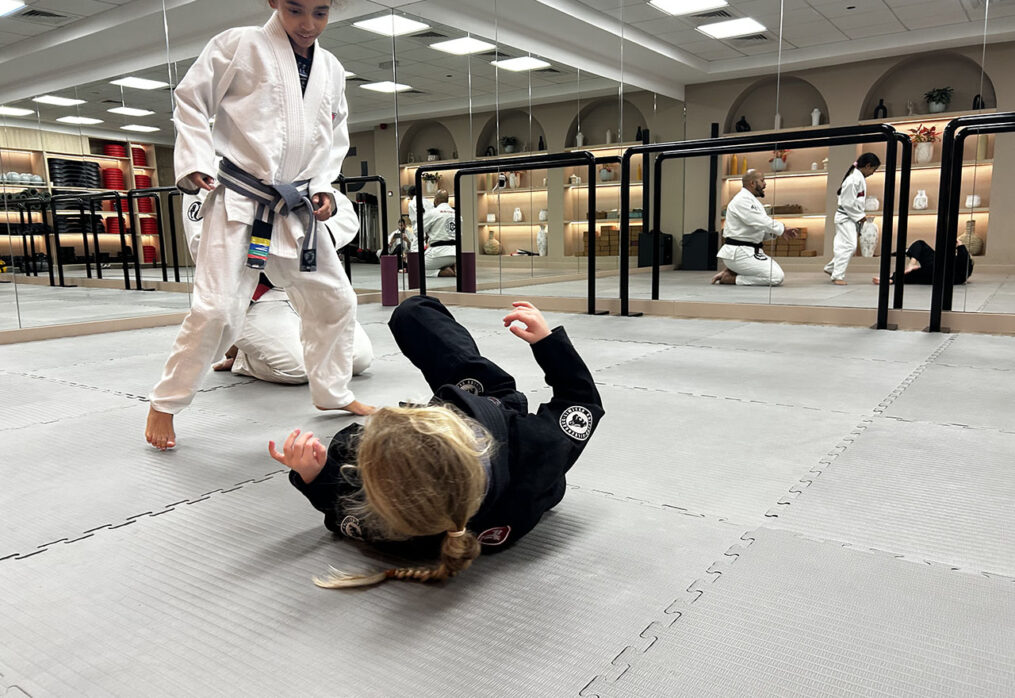
We saw this play out with a seven year old a few terms ago, and it is worth describing because it is fairly typical. On paper, nothing was wrong with her. She was chatty at home, close with her sister, quick to laugh with the other kids waiting outside before class. Self-esteem, by any normal measure, looked solid. But she would not step forward for partner drills. Not stubbornness exactly, more a quiet dread that only showed up in that one part of the session.
Her parents’ first instinct, understandably, was more praise. “You’re so good at this, you’ll be fine.” It did not help much, because she already half believed she was fine as a person, and the praise did not touch the actual problem, which was that she had almost no evidence she could handle that specific moment in front of the group. Now, compare what this does for confidence vs self-esteem in children.
What changed things was smaller and slower than anyone expected. We broke the drill into pieces she could manage: a partner exercise with no resistance, then a little resistance, then a short round with a coach who deliberately let her find success early. Each step was small enough to survive and real enough to count for something. After about six weeks, she was choosing to go first in her group. Nobody told her she was brave. She worked it out for herself.
How to Tell Which One Your Child Actually Needs
Listen to the language. A child low in self-esteem tends to speak in absolutes about themselves as a person: “I’m stupid,” “nobody likes me,” “I’m always the bad one.” A child low in confidence tends to be specific about a task or situation: “I can’t do this,” “I always mess this up,” “I don’t want to try because I’ll look silly.”
Also watch for pattern versus scope. A generally insecure child struggles across many unrelated areas: friendships, schoolwork, family life, hobbies. A child with a confidence gap is often fine everywhere except one specific area, which they avoid, get anxious about, or give up on quickly. If your child seems happy and secure day to day but goes quiet and reluctant only around, say, sport, or reading aloud, or a particular class, that is very likely a confidence issue rather than a self-esteem one, and it needs a different response.

What Actually Builds Confidence
Confidence is built through what psychologists sometimes call mastery experiences: attempting something genuinely difficult, in small enough steps that success is possible, with enough real challenge that the success actually means something. Skip the difficulty and you skip the confidence. A task that is too easy proves nothing to a child, no matter how much you praise them for finishing it.
This is the entire logic behind how we structure a class. We call it the 3D Method: Discover, Develop, Demonstrate. A child discovers a new skill through games and guided movement, develops it through repetition until it is genuinely theirs, then demonstrates it in front of the group. That last step matters more than people expect. The child is not told they are confident. They find out, in front of people who are watching, that they can actually do the thing. That is proof, not praise, and it is the only kind of evidence that sticks.
We track this properly rather than guessing. Our progress tracking system measures five things for every child, confidence among them, so we can see whether a specific skill area is actually improving rather than just assuming it is because the child seems happier in general.
What Actually Builds Self-Esteem
Self-esteem needs a different kind of input. It grows through consistent relationships, being genuinely listened to, and knowing that your worth is not on the line every time you try something new. This is background work, not foreground work. It rarely comes from a single class or a single conversation. It comes from a thousand small, boring, repeated moments of a child feeling safe and accepted.
Coaches and parents can support this by separating effort from outcome in how they talk to a child. Notice the trying, not just the winning. Notice the child, not just the performance. A child who loses a match and is met with warmth rather than analysis learns that they are still loved when they fail, which is a self-esteem lesson, not a confidence one.
Why We Track Both Separately
Most academies do not separate the two, which is part of the problem. A belt system alone measures technical progress. It says nothing about whether a child is more socially confident, more resilient after setbacks, or more willing to try things they are bad at. We built our system around five measurable dimensions, confidence, discipline, focus, resilience, and social development, precisely because lumping everything into “how is my child doing” leaves parents guessing. We help to build both aspects of confidence vs self-esteem in children.
You can read more about how that tracking actually works in how we measure character development, and about the wider framework in the 3D Method. If you are trying to work out what your own child specifically needs right now, our guide on how to build confidence in a child is a good place to start, and our piece on the signs of low confidence in children can help you work out whether you are dealing with a confidence gap or something broader.
What to Do This Week
Here’s how you can assess confidence vs self-esteem in children. If your child seems generally insecure across many areas of life, not just one, focus on connection at home before you focus on any specific skill. Consistency, warmth, and unconditional attention do more here than any activity will. If your child avoids a specific thing, a subject, a sport, a social situation, focus on small, repeatable practice in that exact area, with real feedback rather than blanket praise. Do not tell them they are brilliant at it. Help them get slightly better at it, notice out loud when they do, and let them draw their own conclusion.
The two problems can look identical from the outside, a quiet, reluctant child, and get treated with the same generic reassurance. They need different things. Confidence is earned in small doses through repeated, specific challenge. Self-esteem is grown slowly through consistent, unconditional relationship. Most children need some of both, in different measures, and it is worth working out which one is actually missing before you decide how to help. It is also worth saying that this is not a one time diagnosis. Children move between needing more of one or the other as they grow, change schools, or hit new social situations, so it is worth revisiting the question every so often rather than assuming what was true at five is still true at nine.
If your child struggles with friendships specifically, our article on what to do when your child has no friends goes into that in more depth, and if motivation rather than confidence seems to be the issue, what’s actually going on when a child has no motivation covers that separately. Children who withdraw socially rather than avoiding a specific skill are often dealing with something slightly different again, which we cover in how to help a child who struggles socially.
Frequently Asked Questions
Can a child have high self-esteem but low confidence?
Yes, and it is common. A child can feel fundamentally loved and secure while still lacking belief in their ability at a specific skill, like public speaking or a new sport, simply because they have not had enough practice or evidence in that area yet.
Does praise damage confidence?
General praise on its own does not build confidence, and overused praise that is not tied to real effort can actually undermine it, because children learn to distrust feedback that does not match their own sense of how they actually performed.
Which one should we work on first?
If your child is insecure across most areas of life, start with self-esteem, through consistency and connection at home. If the struggle is isolated to one specific activity or situation, start with confidence, through small, repeated, real challenges in that area.
How long does it take to build confidence in a specific area?
confidence vs self-esteem in children varies, but most parents notice a shift over a school term of consistent, structured practice, since confidence is cumulative and builds with each small success a child can point back to.
Is one activity better than another for building confidence?
Not really, any activity that puts a child through small, repeated, genuinely difficult challenges with real feedback can build confidence. What matters more than the activity itself is whether the difficulty is pitched correctly and whether the child gets honest evidence of their own progress rather than empty encouragement.
How does The Origami Factory build both?
We build confidence through the 3D Method inside every class, and we support self-esteem through a consistent, warm coaching culture where effort is noticed regardless of outcome. We track progress across five dimensions so parents can see which one their child actually needs more support with.
If you want to see how this works in practice, you can find out more about our programmes or book a trial class and watch how we build genuine, evidence based confidence in a real session.