

Why Consistent Training Helps Children Behave Better at School
 Most parents who bring their child to BJJ are thinking about confidence. Or fitness. Or maybe they have a child who is being bullied and they want to do something about it. School behaviour is rarely the first thing on the list.
But it comes up. Again and again, parents tell us that something shifted at school after their child started training. Teachers began commenting. Reports improved. A child who was constantly in trouble for talking back or losing focus started making different choices. Parents are sometimes surprised by this. We are not, because we have seen it enough times to understand what is happening underneath it.
This article explains why consistent training helps children behave better at school, what the research says about it, and what specifically happens on the mat that transfers into the classroom.
The Research Behind Why Children Behave Better at School After Martial Arts Training
This is not anecdotal. There is a reasonable body of research looking at the connection between structured martial arts training and classroom behaviour.
A study published in the Journal of Applied Developmental Psychology looked at a three-month martial arts intervention for elementary school children and found that the martial arts group showed greater improvements than the control group in cognitive self-regulation, prosocial behaviour, and classroom conduct. The researchers noted that the mechanism was not simply the physical activity itself. It was the specific demands of martial arts training, things like monitoring your own behaviour, responding to a partner, and practising self-control under pressure, that drove the improvement.
A separate study cited in research published on PubMed Central found that male sixth-grade students in the UAE showed significant improvements in classroom behaviour following a 12-week BJJ programme, with reductions in hyperactivity, inattention, and conduct difficulties compared to a standard physical education group. That study was conducted in the UAE specifically, which gives it particular relevance to what we see here in Dubai.
None of this is to say BJJ is a guaranteed fix for every child with behaviour challenges at school. But the evidence that consistent, structured training has a measurable positive effect on how children behave better at school is real, and it is growing.
Self-Regulation: The Skill That Makes Children Behave Better at School
If there is one concept that sits at the centre of this topic, it is self-regulation. It is the ability to manage your own impulses, emotions, and attention in response to what is happening around you. Children who struggle to behave better at school are almost always struggling with some aspect of self-regulation, whether that is controlling an emotional reaction, sitting still when they are bored, or stopping themselves from saying something they know they should not.
Self-regulation is not a fixed trait. It is a skill, and like any skill it can be trained. BJJ trains it constantly and in ways that children barely notice are happening.
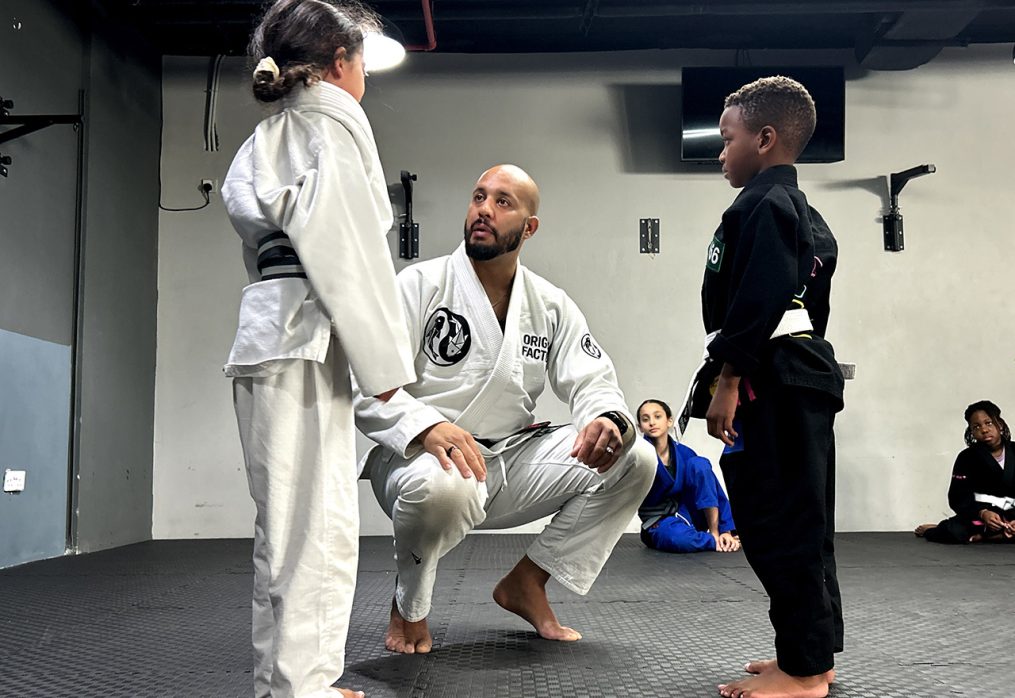
Think about what a child is doing in a sparring round. They are physically engaged with another person who is actively trying to put them in a difficult position. Their instinct might be to panic, to force something, to give up. Instead, they have to stay calm, read the situation, choose a response, and execute it under pressure. That is self-regulation in its most literal form. Do it twice a week for six months and you start to build a genuine capacity for it.
This is why jiu jitsu and focus are so closely linked. The ability to concentrate, to not be pulled off task by the noise in your own head or the distraction of the environment around you, is part of the same system. When a child builds it on the mat, they bring some of it into the classroom.
Consistency Is What Makes It Work
Here is the thing that parents sometimes miss. It is not training that helps children behave better at school. It is consistent training.
A child who attends six sessions and then stops has had a nice experience. A child who trains twice a week for a year has had their brain and nervous system genuinely changed by the process. The self-regulation skills that transfer into school behaviour are built through repetition, not exposure. They accumulate slowly and compound over time.
This is why we are so deliberate about how we structure our programmes. The 3D method we use, Discover, Develop, Demonstrate, is designed to keep children engaged across many months of training, not just the first few sessions. A child who is engaged keeps coming. A child who keeps coming keeps building.
It is also why we structure by age group rather than mixing everyone together. A 5-year-old and a 10-year-old have very different self-regulation capacities and very different reasons for struggling at school. Our Penguins programme for ages 4 to 6 is built around the specific developmental needs of young children, where impulse control is genuinely still forming. The Foxes programme for ages 7 to 9 goes deeper, and by the time children reach the Cranes programme for ages 10 to 12, the expectations around self-regulation mirror quite closely what their teachers are asking of them at school.
What Happens on the Mat That Transfers to the Classroom
It is worth being specific about the mechanisms here, because parents sometimes wonder why BJJ in particular seems to have this effect. The answer is in the specific demands the sport makes on children, not just the fact that it is physical activity.
Following instructions precisely
In a BJJ class, instructions matter. A child who is not paying attention when the coach explains a technique will not be able to do it. There is no hiding. The gap between listening and not listening is immediate and visible. Children learn quickly that attention pays off in a way that feels rewarding rather than punitive. They carry that association into school, even if they do not consciously make the connection.
Managing frustration without acting out
Every child gets put in a difficult position during training. Every child fails to execute a technique that looked simple when the coach demonstrated it. The mat is a continuous, low-stakes practice ground for handling frustration without blowing up. Children who train consistently get better at this. Teachers notice. This connects directly to our thinking on how jiu jitsu builds emotional intelligence, and why the emotional skills developed through training show up in places far beyond the academy.
Respecting structure and authority
BJJ has clear rules, clear expectations, and clear consequences. You tap or the hold continues. You show up and do the work or you do not improve. Children learn to operate within a structure that requires their respect, not because they are told to respect it, but because it becomes obvious that the structure is there for good reasons. That orientation, the one that says rules and authority exist for a reason and operating within them produces better outcomes, is exactly what struggling at school often breaks down around.
Physical outlet for energy and anxiety
A child who is restless, anxious, or carrying unspent physical energy into a classroom is going to find it harder to sit still and engage. Training gives children a genuine physical outlet twice a week. They arrive at school on the days after training having discharged something. This is not a complex mechanism, but it is a real one. The connection between physical activity and improved classroom readiness is one of the better-supported findings in child development research.

Screen Time, Behaviour, and What Training Offers Instead
There is another factor worth naming, particularly in Dubai where children often have access to screens from a very young age. Passive screen consumption, games, YouTube, social media, trains children’s brains to expect constant stimulation and immediate reward. School does not provide that. Sitting in a lesson that requires sustained attention and delayed gratification feels, to a child whose nervous system has been shaped by screens, genuinely difficult. Not because they are badly behaved, but because nothing has trained them to tolerate that kind of demand.
BJJ is the opposite of a screen in almost every important respect. It is slow. It requires patience. Progress comes in weeks and months, not minutes. The reward for effort is not immediate, but it is real and it is theirs. A child who trains consistently is building a tolerance for delayed gratification and sustained effort that directly improves their ability to function well in a classroom.
We cover this in more depth in our article on screen time vs martial arts. If you are concerned about how much time your child is spending on devices and what it might be doing to their capacity to concentrate and regulate themselves, that piece is worth reading alongside this one.
Bullying, Social Confidence, and School Behaviour
Not all behaviour problems at school are about impulse control or attention. Some children behave badly at school because they are frightened, or because they are being picked on and do not know how to handle it, or because they lack the social confidence to navigate the complexity of classroom relationships without either withdrawing or acting out.
Training addresses this in ways that are harder to measure but just as real. A child who knows they can handle physical difficulty, who has learned to stay calm under pressure and try again when something is not working, carries a different kind of social confidence into school. They are less reactive. Less easily destabilised. More able to walk away from a provocation or assert themselves without it escalating.
This is why the connection between jiu jitsu and preventing bullying is not just about self-defence. It is about the psychological shift that happens in a child who has trained consistently and knows, in a bone-deep way, that they are capable. That shift changes how they carry themselves at school, and it changes how other children treat them.
What Parents Can Do to Support the Transfer
Training twice a week does most of the work. But there are things parents can do at home to help the skills children are building in class transfer more fully into school behaviour.
The first is to ask good questions after class. Not just, how was it? But: what did you find hard today? What did you figure out? Did you feel like giving up at any point? What did you do when that happened? These questions reinforce the meta-skills of self-awareness and reflection that underpin good self-regulation.
The second is consistency at home around structure and expectations. A child who faces clear, consistent expectations at home and in training starts to build a coherent internal model of how the world works and what is required of them. That coherence is what makes children behave better at school, because they are no longer operating in a different register when they walk through the school gates.
Our article on building confidence at home covers the practical side of this in detail. The suggestions there are not complicated, but they work best when they are running alongside consistent training rather than in isolation.
A Note on Realistic Expectations
We want to be honest with you here. Consistent training is not going to make children behave better at school overnight, and it is not going to turn every situation around in a month. Some children see changes quickly. Others take longer. A child with significant behavioural challenges at school may need more than twice-weekly BJJ classes, and we would never suggest otherwise.
What training does is build the underlying capacity, the self-regulation, the frustration tolerance, the ability to focus and follow instruction, that makes better behaviour possible. Whether that capacity shows up at school depends on a lot of other factors too: the relationship with the teacher, what is happening at home, whether the child is sleeping well, whether there is something else going on socially that nobody has quite named yet.
What we can say, from what we have seen in class and from what parents report back to us, is that children who train consistently and who are supported well at home do tend to behave better at school over time. Not because BJJ is magic, but because it trains something real, and real things, trained consistently, show up in real life.
If you want to read more about the broader picture of what we are trying to build for children, the about page explains our thinking. And our article on how jiu jitsu builds confidence in children covers the confidence side of this in depth, which is closely linked to the behavioural improvements we are describing here.
Getting Started
If your child is struggling at school and you are looking for something structured, physically engaging, and genuinely good for their development, we would be glad to talk. You can check our current class times on the schedule page and reach us directly via the contact page.
The most useful thing you can do right now is come and watch a class. See how we run things, meet the coaches, and let your child try a session with no commitment attached. If it feels right, the consistency will follow naturally. And once the consistency is there, the rest tends to take care of itself.
Book your child’s free trial here.
Frequently Asked Questions
How quickly will I see my child behave better at school after starting BJJ?
It varies. Some parents notice small shifts within a few weeks, particularly around frustration tolerance and willingness to follow instructions. More significant changes in classroom behaviour typically emerge after two to three months of consistent training. The key word is consistent. Occasional sessions do not produce the same results as regular attendance.
My child already has behaviour support at school. Is BJJ still appropriate?
In most cases, yes. BJJ can run alongside other support without any conflict. If your child has a specific diagnosis or is working with a school psychologist, it is worth mentioning BJJ to them and asking if there are any considerations. We are also happy to have a conversation with you directly before your child’s first session. Reach us on the contact page.
Does it matter which age group my child is in?
Yes, and we take this seriously. Our programmes are structured by age specifically because the developmental needs are different at each stage. You can read about each group, the Penguins (4 to 6), the Foxes (7 to 9), the Cranes (10 to 12), and the Dragons (13 and above), on our programmes pages.
Is BJJ safe for children with anxiety or who are sensitive to physical contact?
We cover this in detail in our article on how safe jiu jitsu is for children. The short answer is yes, with the right academy and coaching approach. We introduce physical contact gradually and always within a structure that children understand and can control. If your child has specific concerns, talk to us before the trial and we will make sure their first session is well managed.
What if my child does not want to go consistently after the first few sessions?
This is normal. The novelty of the first few sessions fades and some children push back on going. Our experience is that children who push through this initial resistance almost always settle into a rhythm and start looking forward to class. The article on kids jiu jitsu in Dubai has a section on this, including practical ways to keep children motivated in the early weeks of training.