
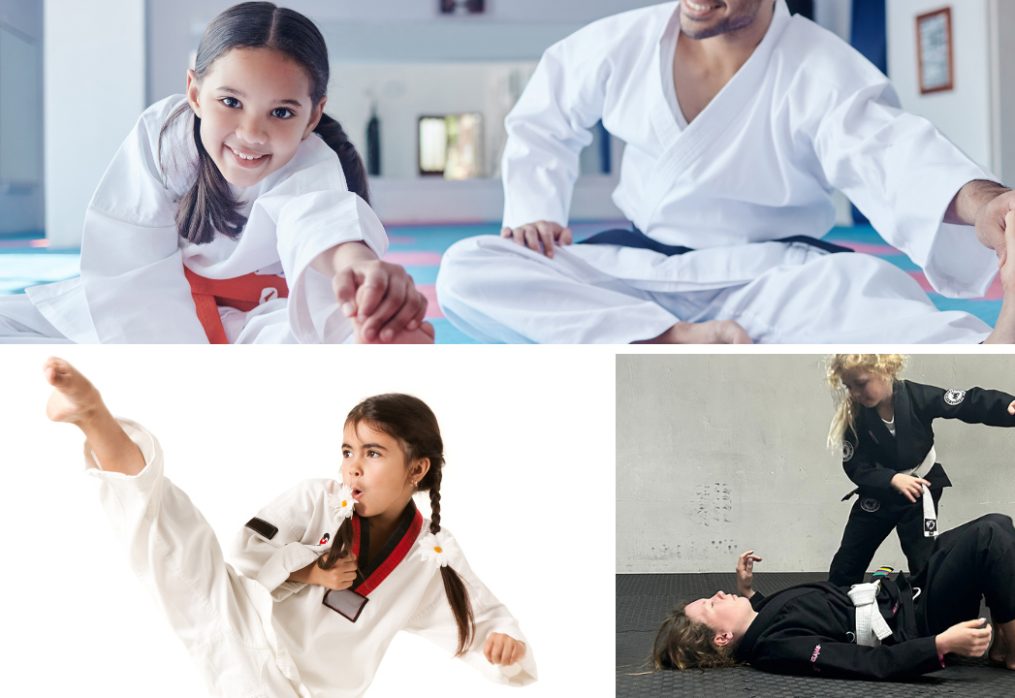

Kids Martial Arts in Dubai: BJJ vs Karate vs Taekwondo
 If you are looking at kids martial arts in Dubai, you will quickly realise there is no shortage of options. BJJ academies, karate dojos, taekwondo clubs, mixed martial arts gyms, and everything in between are scattered across the city. Each one will tell you their discipline is the best choice for your child. That does not help much when you are actually trying to make a decision.
This guide cuts through the noise. We cover what each of the three most popular kids martial arts in Dubai actually teaches, the differences that matter for children, the safety profile of each, and how to work out which one might suit your child best. We run a BJJ academy ourselves, so we have a point of view. But we have also tried to be honest about where karate and taekwondo have genuine strengths, because our goal is for your child to end up somewhere that suits them, even if that is not with us.
Kids Martial Arts in Dubai: The Three Most Common Options
Most parents looking at kids martial arts in Dubai end up comparing Brazilian Jiu Jitsu, karate, and taekwondo. They are the three most widely available disciplines in the emirate, and they represent three genuinely different approaches to martial arts.
At a high level, the distinction is simple. BJJ is a grappling art. Karate and taekwondo are striking arts. That single difference shapes almost everything about how each discipline is taught, how children progress, and what they take away from training. It also shapes the injury profile, the culture on the mat, and the kind of child who tends to thrive in each environment.
Let us look at each one individually before comparing them directly.
Brazilian Jiu Jitsu (BJJ)
BJJ is a grappling-based martial art that focuses on control, leverage, and submissions. There is no punching, kicking, or striking of any kind. Children learn to take their training partner to the ground, control them, and apply holds that would end a real confrontation without causing injury.
For kids martial arts in Dubai, BJJ has grown rapidly in popularity over the last decade, largely because its approach matches what modern parents actually want. It teaches self-defence without teaching violence. It builds physical confidence without rewarding aggression. Children learn how to stay calm when someone is physically dominating them, which is a skill with genuine real-world application in schoolyard situations where bullying often turns physical.
Progression in BJJ is slow. The belt system moves at a genuinely earned pace, and children do not collect belts simply for attending classes. We cover this in more detail in our article on how safe is jiu jitsu for children, which also addresses the most common questions parents have about BJJ safety specifically.
The training environment in a good BJJ academy is cooperative rather than competitive. Children work in pairs, help each other learn, and tap out to signal that they need their partner to stop. This culture of mutual care is one of the things that genuinely sets BJJ apart from most other kids martial arts in Dubai.
Karate
Karate originated in Okinawa and became globally popular in the 20th century. It is a striking art focused on punches, kicks, blocks, and forms. Students progress through coloured belts as they learn predetermined sequences called kata, which they perform both solo and under instruction.
Karate tends to appeal to parents who value traditional structure. Classes typically involve formal bowing, Japanese terminology, and clear lines of authority. Children who like order and ritual often respond well to this environment. The repetition of kata builds discipline and focus, and the emphasis on precision teaches attention to detail.
The limitations of karate for kids martial arts in Dubai are worth understanding. Traditional karate places heavy emphasis on air strikes, breaking boards, and performing forms. Live application against a resisting partner is less common than in BJJ. This means children can spend years in karate and be highly skilled at the discipline’s internal goals while having relatively little practical experience with resisting opponents. That is not a flaw in karate. It is a feature of how the discipline is taught. But it is worth knowing.
Injury rates in karate are moderate. Striking sports carry some risk of head impact, particularly in sparring. Good kids karate programmes use significant protective equipment and control the level of contact carefully. As with any discipline, the quality of the academy and the coach matters more than the discipline itself.
Taekwondo
Taekwondo is a Korean striking art that emphasises kicks, particularly high, fast kicks. It became an Olympic sport in 2000 and has a strong competitive structure. For children with high energy and flexibility, taekwondo can be an excellent fit.
The discipline is known for being athletic and dynamic. Children in taekwondo classes spend a lot of time on footwork, flexibility, and explosive movement. The belt system rewards progression regularly, which keeps motivation high in younger children. Board-breaking, spinning kicks, and the physical beauty of high-level taekwondo give the sport a certain spectacle that appeals to many children.
For kids martial arts in Dubai, taekwondo schools are widely available and well-established. Like karate, the classes tend to be structured and hierarchical, which suits children who respond well to clear rules and visible progression.
The considerations are similar to karate. Taekwondo is a striking art, which means that in a real confrontation, the techniques require distance and space to execute. Most real-world conflicts between children happen up close and end on the ground, where taekwondo technique has limited application. This is a common criticism of striking arts for practical self-defence, and it is one reason why BJJ has grown so quickly as a preferred option for kids martial arts in Dubai.
Comparing Kids Martial Arts in Dubai: The Factors That Matter
Once you get past the surface differences, a few deeper factors matter more than others when choosing between kids martial arts in Dubai. Here is how BJJ, karate, and taekwondo compare on each.
Safety
BJJ has one of the better safety profiles of any martial art for children, precisely because it removes striking entirely. Injuries in BJJ are typically minor sprains and bruises. Karate and taekwondo both involve striking, which introduces a higher baseline risk of head contact and joint strain from explosive movements. None of the three are unsafe when taught properly, but the mechanism of risk is different.
Practical self-defence
An independent comparison on FloGrappling makes the point cleanly: BJJ focuses on ground-based combat, which is where most physical confrontations between children actually end up. A child who is grabbed, pushed, or tackled at school is far more likely to need the skills BJJ teaches than those taught in striking arts. That is not to say karate and taekwondo cannot defend a child. They can. But the practical transfer is less direct.
Culture and aggression
BJJ training does not reward aggression. You cannot win a BJJ exchange by being more aggressive. You win by being more technical and more calm. Children who train in BJJ tend to become less reactive rather than more reactive. Striking arts have a more complex relationship with aggression. Good instructors in karate and taekwondo work hard to teach discipline and restraint, but the mechanism of the sport, generating power through striking, naturally teaches a different relationship with physical force.
Belt progression
This is a real difference. Karate and taekwondo belts progress relatively quickly for children, sometimes to the extent that a child can reach black belt in three to five years. BJJ belt progression is much slower, and a black belt typically takes a decade or more of consistent training. For some children and parents, the faster progression in striking arts is motivating. For others, the slower BJJ progression is meaningful precisely because each promotion is genuinely earned.
Character development
All three disciplines can build character. The question is how. Karate and taekwondo emphasise discipline through ritual, tradition, and repetition. BJJ builds character through the experience of regular, structured struggle with another person, and through the requirement to tap out and try again. Different children respond to different approaches. We write about the underlying principles of character development in our article on how to build confidence in a child, which is worth reading alongside this one if character development is your primary reason for considering kids martial arts in Dubai.

Which Kids Martial Art in Dubai Suits Which Child?
The answer is not as simple as BJJ is better, or karate is better for discipline. Different children thrive in different environments. Here is a rough guide.
A child who loves structure, ritual, and slow methodical progression may thrive in karate. The bowing, the terminology, the repetition of forms, these things are genuinely grounding for some children. A child who enjoys theatre, rehearsal, or chess often responds well to the karate environment.
A child who has enormous energy and loves big, dynamic movement may enjoy taekwondo. The spinning kicks, the flexibility work, the athletic spectacle of it, these suit children who want their physical activity to feel exciting and visible.
A child who is shy, who has been bullied, who lacks confidence, who quits things when they get hard, or who needs to learn how to manage difficult emotional experiences often does best in BJJ. The non-striking environment removes the fear of being hit. The one-on-one partner work builds social skills. The slow, earned progression gives meaningful evidence of capability. We have a detailed article on this in our piece on why your child quits everything, which explains why BJJ works particularly well for children who have already tried and stopped other activities.
A child who is highly sensitive, who struggles with emotional regulation, or who has difficulty with focus also tends to do well in BJJ. The structure is demanding but calm. There is no shouting. Coaches work closely with each child. We cover the connection between training and emotional regulation in our article on how jiu jitsu builds emotional intelligence.
The Environment Matters More Than the Discipline
Here is something worth saying clearly. The specific martial art you choose matters, but the quality of the academy matters more. A well-run karate club will be better for your child than a poorly-run BJJ academy. A thoughtful taekwondo instructor who genuinely understands children will do more for your child’s development than a decorated BJJ black belt who treats kids as miniature adults.
When you are looking at kids martial arts in Dubai, visit the academies. Watch a class. Notice how the coaches speak to the children. Watch how the older students treat the younger ones. Watch what happens when a child is struggling or emotional. The culture of an academy tells you more than the discipline’s theoretical advantages ever will.
We cover this in detail in our article on how to choose a jiu jitsu academy in Dubai, and the same principles apply across karate and taekwondo too. What you are looking for is consistency, warmth, genuine expertise with children, and a structure that rewards real development rather than just attendance.
The Role of Consistency Across Kids Martial Arts in Dubai
Whichever discipline you choose, consistency is the variable that most determines whether your child benefits. A child who attends once a week for three months and then stops has had a nice experience. A child who trains twice a week for two years has had something genuinely meaningful happen to them. The benefits of martial arts for children, improved focus, better behaviour at school, increased resilience, emotional regulation, are the compound effects of showing up repeatedly over time.
We cover this specifically in our article on why consistent training helps children behave better at school, which explains the mechanism by which training effects transfer into the classroom. The principle holds across BJJ, karate, and taekwondo. The specific effects will differ slightly depending on the discipline, but the importance of consistency does not.
This is why one of the questions worth asking when looking at kids martial arts in Dubai is simply: will my child want to keep coming? An academy with a slightly less ideal curriculum that your child loves will outperform an academy with a better curriculum that your child dreads. Find the one where they will stay.
Age Groups and Progression
Good kids martial arts programmes in Dubai separate children by age. Developmentally, a 5-year-old and a 10-year-old need different things from their training. Our own programme structures this explicitly. The Penguins for ages 4 to 6 focus on movement, coordination, and simple positional games. The Foxes for ages 7 to 9 start working with real technique. The Cranes for ages 10 to 12 go deeper, and the Dragons for ages 13 and above train at a level that approaches adult practice.
When you visit any academy, whether BJJ, karate, or taekwondo, ask how they group children by age. A club that puts all children together regardless of age is almost always prioritising convenience over child development. You want separation, age-appropriate curriculum, and coaches who are specifically experienced with the age group your child falls into.
Getting Started With Kids Martial Arts in Dubai
The best thing you can do is try before you decide. Most academies, ours included, offer a free trial class. Watching your child on the mat for the first time tells you more about whether an academy is the right fit than any amount of research ever will.
If you want to see how we run things at Origami Factory, you can check our current class times on the schedule page. For more detail on how we structure our programme, visit the programmes page. If you have specific questions about whether our approach is right for your child, you are always welcome to reach us on the contact page.
When you are ready, book your child’s free trial here. There is no commitment required, you are welcome to watch the full session, and if we are not the right fit, we will happily say so.
Frequently Asked Questions: Kids Martial Arts in Dubai
What age should my child start martial arts?
Most kids martial arts in Dubai accept children from age 4. At this age, classes are mostly games and basic coordination. Genuine technical learning typically begins around age 6 or 7, regardless of the discipline. If your child is younger than 4 and showing interest, many academies will let you visit and observe, but formal classes at that age can be difficult to structure well.
Is BJJ safer than karate or taekwondo?
Generally, yes. BJJ’s removal of striking means the injury profile is lower risk, particularly in terms of head impact. That said, all three disciplines can be taught safely when the academy is well-run and the coaches are experienced with children. Our article on how safe is jiu jitsu for children covers BJJ safety in detail.
How much do kids martial arts in Dubai cost?
Pricing varies widely. Monthly fees typically range from AED 500 to AED 1,500 depending on the academy, the frequency of training, and the location. Group classes in mixed-discipline MMA gyms tend to be cheaper. Specialist academies with smaller class sizes and more individual attention tend to cost more. The cheaper option is not always better value. What matters most is the quality of instruction and the consistency of attendance, not the monthly price tag.
How quickly will we see benefits?
Small shifts often appear within the first four to eight weeks of consistent attendance. More meaningful changes in focus, behaviour, confidence, and emotional regulation typically emerge over three to six months. The key word is consistent. Occasional training does not produce the same results as regular attendance.
Can my child train in more than one martial art?
Yes, though we would generally recommend starting with one and committing to it for at least a year before adding anything else. Children who split their attention across multiple disciplines tend to develop more slowly in each one, which can undermine the sense of mastery that makes martial arts so valuable for building confidence. Once a child has a solid foundation in one discipline, adding a complementary one can be rewarding.
What should I look for when visiting a kids martial arts academy in Dubai?
Watch how the coaches interact with children, particularly children who are struggling. Look at how older students treat younger ones. Notice whether the classes are structured by age. Ask about the coach’s background and experience specifically with children. Check the facility is clean and the equipment is in good condition. Trust your instinct. If the environment feels right, it probably is. If something feels off, look elsewhere.
My child is very sensitive or anxious. Would BJJ still suit them?
In most cases, yes, but the academy matters enormously. Sensitive or anxious children thrive in environments where coaches are patient and attentive, where classes are calm rather than loud, and where they are given time to adjust before being pushed. Our article on building confidence at home has useful context on this, and we are always happy to have a conversation before your child’s trial to make sure the first session is well managed.