

What Age Should My Child Start BJJ? A Guide for Parents in Dubai
 It is one of the first questions parents ask us. What age should my child start BJJ? Is four too young? Is eight too late? Should I wait until they show interest, or push them into it now?
The honest answer is that there is no single perfect age, and any academy that gives you a fixed number is oversimplifying. Different children are ready at different ages, and readiness is only partly about numbers on a calendar. That said, there are useful patterns worth understanding, and there are clear guidelines from developmental research that can help you make the right decision for your specific child.
This article walks through what the research says about when a child should start BJJ, the readiness signals worth watching for, what to expect at each age, and how to know whether now is the right time or whether you should wait. It is aimed at parents in Dubai specifically, because the local context, the climate, the school schedules, and the wider activity culture, matters when thinking about when to start.
The Short Answer: When Should a Child Start BJJ?
For most children, ages 4 to 7 form the sweet spot for when to start BJJ. Formal academies typically accept children from age 4, and by age 6 or 7 most children have the physical coordination, attention span, and social readiness to engage properly with the training.
But we would push back gently on the idea that these ages are prescriptive. Some children are ready at 4. Some are not ready until 6. Some 8-year-olds arrive with no prior training and quickly overtake the 6-year-olds who have been training for two years. The right age for a specific child depends more on their individual development than on any calendar rule.
The American Academy of Pediatrics writes that sports readiness is about three specific things: physical, mental, and social readiness. A child who has all three at age 4 can start BJJ. A child who is missing one or more may benefit from waiting a little longer. That is the framework worth thinking in, rather than fixating on a specific age.
The Three Readiness Signals That Matter More Than Age
Before you decide when your child should start BJJ, spend a few weeks quietly observing them against three developmental readiness signals. These will tell you more than any birthday will.
Physical readiness
Can your child hop on one foot, balance for a few seconds, run without falling regularly? Can they follow a physical sequence like touch your toes, touch your head, touch your toes? These small motor benchmarks tell you whether they have the basic coordination that BJJ requires. Most children have this by age 4, though some develop faster than others.
Mental readiness
Can your child listen to instructions from an adult who is not their parent for at least 5 to 10 minutes? Can they follow a sequence of three steps? Can they wait their turn? These are the mental skills that make a structured class possible. A child who cannot yet sit through a short storytime is probably not ready for a structured BJJ class.
Social readiness
Can your child be in a room with other children without needing you present the whole time? Can they share a small space with another child without becoming distressed? Can they cope with not always being first? These social skills are what will let your child engage with the partner-based nature of BJJ.
If your child has all three signals broadly in place, they are probably ready to start BJJ. If they are missing one or more, waiting three or six months and reassessing is often the wisest move.
Age 4 to 6: The Penguins Stage
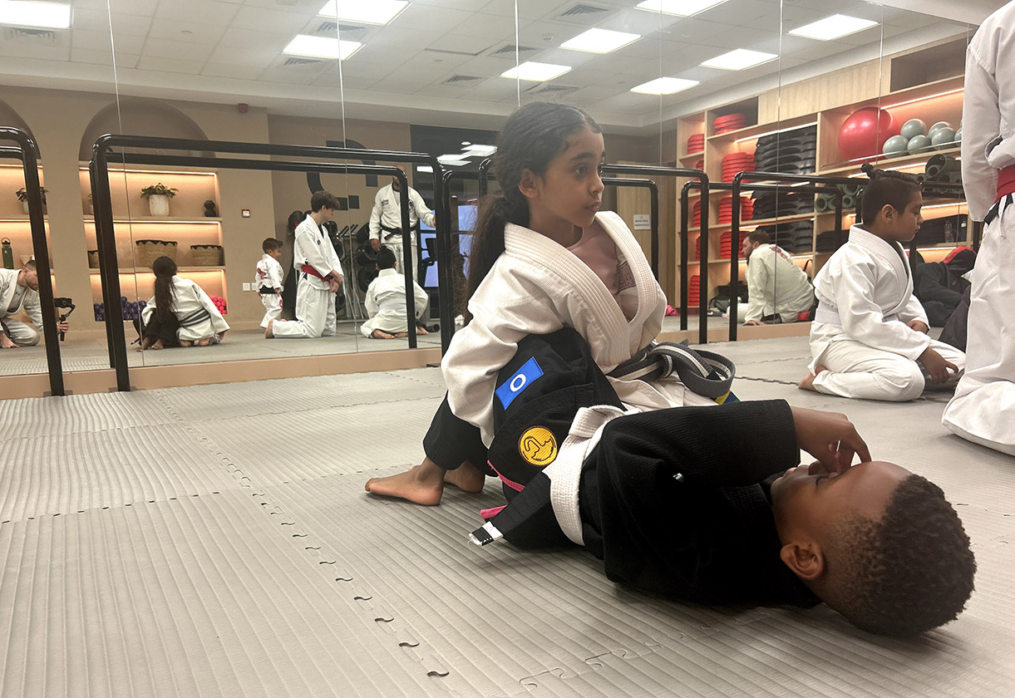
At Origami Factory, we have a dedicated programme for the youngest age group. Our Penguins programme for ages 4 to 6 is designed with a very specific philosophy: at this age, BJJ is more about movement, coordination, and playful engagement than about technique.
Should your child start BJJ at 4? It can be a wonderful time to begin, but only if the programme is right. At this age, formal drilling is not developmentally appropriate. What is appropriate is games that build body awareness, animal walks that develop coordination, simple positional puzzles that introduce basic BJJ movements without labelling them as such. A good class for a 4-year-old should look more like structured play than a mini-adult class.
Benefits at this age include early development of coordination and physical confidence, gentle introduction to the culture of a martial arts environment (bowing, respect, listening to a coach), and the social benefit of being in a small group of children with a shared activity. Children who start BJJ at 4 or 5 often develop a genuine sense of belonging to the academy that carries through their whole childhood.
Cautions at this age are also worth naming. A 4-year-old who is not developmentally ready will find the class frustrating rather than fun, and pushing them into it can produce the opposite of what you were hoping for. If your child is not ready, wait. Six months at this age is a lot of development, and the class that felt impossible in January is often manageable by July.
Age 7 to 9: The Foxes Stage
This is often the ideal window to start BJJ for children who did not begin earlier. By age 7, most children have the attention span, coordination, and social skills to engage properly with structured technique. They can follow multi-step drills. They can work with a partner without becoming overwhelmed. They can sit through a longer explanation and apply it.
Our Foxes programme for ages 7 to 9 is where genuine technical BJJ begins. Children are introduced to positions, learn to control a training partner in specific ways, and start earning stripes and belts on the basis of real technical development rather than participation.
This is also the age where the character development benefits of BJJ start to become visible. Children this age are old enough to notice their own progress, to compare themselves to how they used to be, and to draw connections between what they do on the mat and what they do at school. Our article on why consistent training helps children behave better at school covers this transfer effect in detail.
For parents wondering whether it is too late to start BJJ at 7 or 8, the answer is definitely not. Many of our strongest students started in this window. What matters is starting well and staying consistent.

Age 10 to 12: The Cranes Stage
Children who start BJJ between 10 and 12 are entering at a genuinely interesting developmental moment. They are old enough to make sense of the technical content in real depth, but not so old that the pre-adolescent self-consciousness has fully taken hold. This is often a strong age to begin.
Our Cranes programme for ages 10 to 12 introduces more advanced technique, positional sparring, and the beginnings of independent problem-solving on the mat. Children this age can start to think tactically about their training rather than just executing what they are shown.
Parents sometimes hesitate to have their child start BJJ at this age because they worry it is too late, or because their child has already tried other activities and drifted from them. Our article on why your child quits everything covers the specific dynamics of children who have started and stopped several activities, and BJJ is often unusually well suited to these children because the structure is calmer and the progression is personal rather than competitive.
If your child is 10, 11, or 12 and you are still thinking about whether they should start BJJ, do not overthink it. Book the trial, see how they respond, and decide from there.
Age 13 and Above: The Dragons Stage
Some parents worry that 13 or 14 is too old to start BJJ. It absolutely is not. Adolescence is, in fact, a genuinely powerful time to begin. Teenagers who start BJJ often find that it gives them something that few other activities can: a physical, social, and psychological outlet that is neither school nor screens, and that produces real, visible growth in confidence, focus, and self-regulation.
Our Dragons programme for teenagers 13 and above operates closer to the way an adult class runs, though still with careful coaching attention to the developmental needs of teens. Progression is genuine. Sparring is properly introduced. Character development happens at a level of sophistication that younger children cannot yet reach.
For teens who are struggling socially, who are drifting into problematic screen habits, who are showing signs of low motivation or low confidence, starting BJJ at 13 or later can be transformative. Our article on my child has no motivation and our article on 10 signs of low confidence in children cover the underlying dynamics that BJJ tends to address in this age group.
The one caveat with starting BJJ as a teenager is patience. A 13-year-old who starts training will be on the mat with 6-year-olds who have been training for years. This can be humbling at first. But it can also be one of the most valuable experiences a teenager can have: learning from those younger than them, experiencing being a beginner in an environment that does not judge, and developing the humility that will serve them for the rest of their life.
Signs Your Child Is Ready to Start BJJ Now
Beyond the three broad readiness signals, there are some specific behavioural signs that suggest your child is ready to start BJJ this term rather than waiting.
They are physically restless in a way that structured activity would help with. They are asking about martial arts, wrestling, or fighting (usually because they have seen it somewhere and are curious). They struggle with confidence in ways that a structured, achievement-based activity might help address. They are quitting other activities, which may indicate they need a different structure rather than more of the same. They have difficulty focusing at school, and would benefit from an activity that trains attention. Our article on screen time and your child’s attention span covers the connection between physical activity and attention.
None of these signs are absolute. But if you recognise several of them in your child, the timing is probably right to have them start BJJ.
Signs Your Child Might Not Be Ready
On the other hand, some signs suggest your child would benefit from waiting a few months before starting BJJ.
They still have significant difficulty being away from you in a group setting. They have not yet developed enough attention span to sit through a short structured activity like a class. They are consistently overwhelmed in group settings and need one-to-one attention to function. They are dealing with a significant transition in their life (new school, house move, new sibling) that is absorbing their emotional energy.
In these cases, the answer is usually not never, it is just not yet. Give it three or six months, watch for the readiness signals to develop, and reconsider. Our article on how to help a child who struggles socially covers what to do in the meantime.
What About Dubai Specifically?
The Dubai context matters when thinking about when to have your child start BJJ. Three factors are worth thinking about specifically.
The climate. Outdoor sport for six months of the year is genuinely difficult here, particularly for younger children. BJJ, being indoor and temperature-controlled, is one of the few activities that a Dubai-based child can pursue consistently year-round without the summer months disrupting their routine. This makes it easier to build the consistency that produces real development.
The school schedule. Dubai schools tend to have long summer holidays, which can be a challenge for keeping children engaged in structured activities. Starting BJJ in the school year and continuing through the summer often works better than starting in the summer and hoping the interest carries into term time.
The wider activity culture. Dubai is a city where children are often signed up for many activities. This can be positive, but it can also lead to shallow engagement across multiple things rather than depth in one. If you are asking when your child should start BJJ, it is worth also asking whether they have room in their life to commit to it properly. Consistency matters more than variety. Our article on how to build confidence in a child covers why depth in one activity produces more benefit than skimming multiple.
Common Concerns About When a Child Should Start BJJ
A few concerns come up repeatedly when parents are weighing when their child should start BJJ. Worth addressing them directly.
What if my child is too small or physically weak?
Not a concern. BJJ is specifically designed around leverage and technique rather than size and strength. A smaller child can absolutely thrive. In fact, smaller children often become highly technical because they cannot rely on strength.
What if my child is aggressive?
Also not a concern in the way you might think. Research consistently shows that well-run BJJ programmes reduce aggression in children rather than amplify it. Our article on does martial arts make kids aggressive covers the evidence in detail.
What if my child has never done martial arts before?
The vast majority of children who start BJJ have never done any martial art before. This is completely normal and not a barrier. Beginners are welcome and the class structure assumes no prior knowledge.
What if my child does not want to start?
Worth taking seriously. A child who is genuinely reluctant to try something new is often reluctant for a reason, and forcing them can produce lasting negative associations. That said, mild reluctance about trying anything new is normal and often disappears once they have been to one session. The trial class is designed for exactly this situation. Our article on what happens at a kids BJJ trial class in Dubai walks through what to expect.
What to Do When You Have Decided
Once you have decided your child should start BJJ, the process is straightforward. Book a trial class. Come and watch. Talk to the coach afterwards. Sign up if it feels right. Do not sign up if it does not.
The trial is genuinely low-pressure. We do not use aggressive sales tactics. We do not push you into a decision. Our view is that the wrong child in the wrong programme is bad for everyone, and if BJJ is not right for your child, we would rather tell you honestly than sign you up and have you leave three months later disappointed.
If you want to explore whether BJJ vs another activity is the right fit, our article on BJJ vs football for building confidence in children and our article on kids martial arts in Dubai: BJJ vs karate vs taekwondo compare BJJ with other options for children.
You can see how we structure our programmes across the age groups on our programmes page, check current class times on the schedule page, and reach us with specific questions on the contact page.
When you are ready, book your child’s free trial here.
Frequently Asked Questions: When Should My Child Start BJJ?
What is the minimum age a child can start BJJ?
At Origami Factory, our youngest programme is the Penguins for ages 4 to 6. Some academies accept children as young as 3, though at that age the class is generally more play-focused than skill-focused. If your child is under 4, it may be worth waiting until they are a little older, or looking for a specifically designed pre-school martial arts programme rather than a formal BJJ class.
Is my child too old to start BJJ?
Almost certainly not. Children can and do start BJJ well into their teens and beyond. The question is not whether they are too old, but whether they are willing to be a beginner in an environment that includes younger children who may have more experience. Most teens adapt to this quickly.
How can I tell if my child is developmentally ready?
Watch for the three readiness signals: physical (basic coordination and balance), mental (can follow instructions for 5 to 10 minutes), and social (comfortable in a group setting without you present). If your child has all three broadly in place, they are ready.
My child is shy. Should they wait to start BJJ?
Not necessarily. Shy children often thrive in BJJ because the environment is calmer and more structured than most group activities, and because they get one-on-one work with training partners rather than the pressure of larger group settings. Our article on how to help a child who struggles socially covers this in more depth.
Does my child need to be athletic to start BJJ?
No. BJJ builds athleticism rather than requiring it. Some of our best students started as unathletic children and developed real coordination and physical confidence over time. If anything, unathletic children often benefit most from BJJ because they are building capacities they did not have before.
How often should my child train once they start BJJ?
Twice a week is our recommended minimum for real progression and character development. Once a week is fine as a starting point but produces slower results. Three times a week is ideal for children who have taken to the training and want to progress faster. Our article on how we measure character development covers the pace at which development typically happens.
What if my child starts and does not enjoy it?
This happens sometimes, and it is nothing to worry about. Most children who initially say they do not enjoy BJJ change their view after four to six sessions. If, after two months of genuine trying, your child still does not want to go, it may not be the right fit for them right now. That is fine. You can revisit in six months or explore other activities.