

How to Help a Shy Child Come Out of Their Shell.
You watch her stand at the edge of the birthday party, back against the wall, waiting for it to be over. Or maybe it’s him, the one who goes quiet the second a new adult walks into the room, who won’t order his own food at a restaurant, who has stood at the edge of the football pitch for three weeks running and never once asked to join in. You’ve told yourself it’s just a phase. You’ve also lain awake wondering if it’s something more, and whether the thing you’re doing to help is actually making it worse.
Shyness in children is one of the most misread traits in parenting. It gets treated as a problem to solve, a switch to flip, or worse, a character flaw to correct with enough gentle pushing. None of that is true, and most of it backfires. This article is about what shyness actually is, where parents go wrong trying to fix it, and how to help a shy child come out of their shell, in their own time and on their own terms.
What “Shy” Actually Means (and What It Doesn’t)
Shyness is a temperament trait, not a diagnosis and not a defect. Research on childhood temperament, going back to the work of psychologists like Jerome Kagan at Harvard, shows that somewhere between 15 and 20 percent of children are born with a more reactive nervous system. They notice more, process more, and take longer to feel safe in new situations. That’s not the same as social anxiety, and it’s not the same as being antisocial. A shy child often wants connection just as much as an outgoing one. They simply need more time and more safety to get there. Understanding this distinction is often the real starting point for how to help a shy child, because it changes what kind of support actually helps.
The distinction matters because it changes what “helping” should look like. If you treat ordinary shyness like a disorder, you send the message that there is something wrong with your child that needs fixing. If you dismiss it as nothing at all, you miss the real discomfort your child is feeling and the skills they genuinely could use support building. Our guide to spotting low confidence in children is a useful place to check whether what you’re seeing is temperament, or something that’s tipped into a bigger confidence problem. That single check is often the fastest way into how to help a shy child, because it tells you where to actually focus.
The Misconceptions That Keep Parents Stuck
The most common mistake is over-narrating it. “She’s shy, she’ll warm up,” said in front of the child, at the child, repeatedly, in front of every new person you meet. It feels like you’re smoothing the moment over for them. What it actually does is hand your child a label they didn’t choose and cement it as part of their identity before they’ve had a chance to prove otherwise to themselves.
The second mistake is the opposite instinct: pushing too hard. Forcing a hug with a relative, insisting they say hello to the whole room, signing them up for the loudest, most socially demanding activity you can find because you’ve decided confidence comes from throwing them in the deep end. For a temperamentally cautious child, that kind of pressure usually increases withdrawal rather than reducing it. The nervous system reads forced exposure as a threat, not a growth opportunity, and the child learns to associate social situations with panic rather than pleasure.
The third, quieter mistake is avoidance. Letting a child skip every party, every group activity, every situation that makes them uncomfortable, because it’s easier for everyone in the short term. Comfort has its place, but a child who never practises tolerating mild social discomfort doesn’t get more comfortable with time. They get more entrenched. Avoiding all three of these traps is a practical way to think about how to help a shy child without swinging too far in any direction.
A Story From the Mat
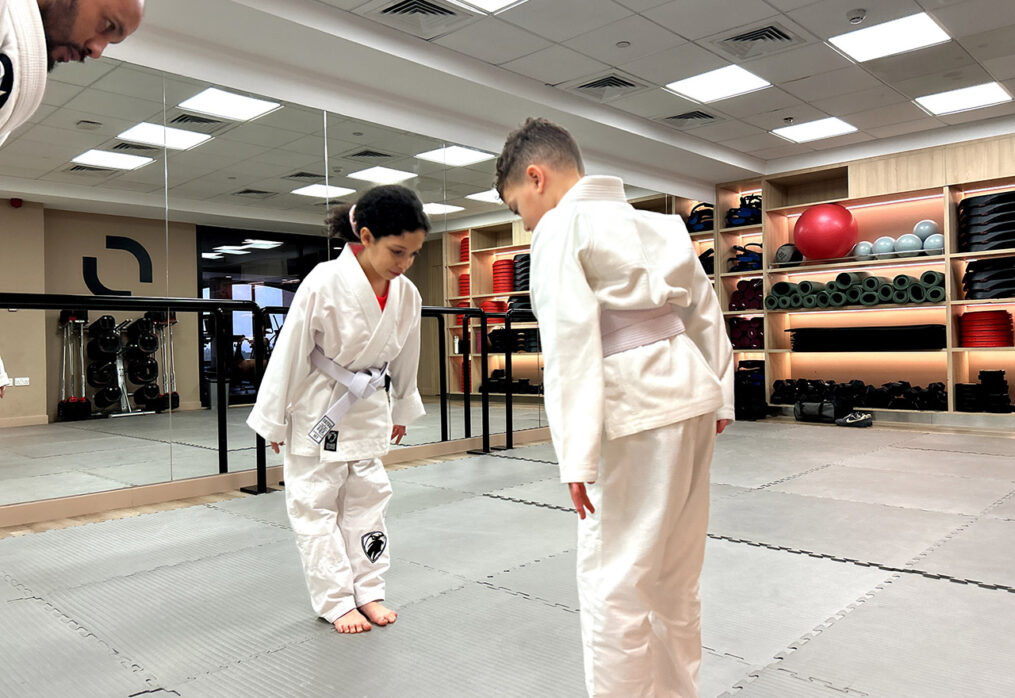
A few terms ago, we had a six year old join the Penguins group, we’ll call her Amara, who wouldn’t step onto the mat without her mother standing at the edge of the room. For the first two sessions, she sat out entirely and just watched. Our coaches didn’t coax her onto the mat or make a fuss about it. They kept including her from a distance: a wave during warm-up, her name called out during a game, an invitation that expected nothing back. Small gestures like these are often the clearest version of how to help a shy child feel included without singling them out.
By the third week, she was doing the warm-up from the sideline, mimicking the movements without joining the group. By the fifth week, she stepped in for one drill, paired with a coach rather than another child, low pressure and predictable. By week eight, she was asking her mother if she could stay for the whole class without her watching. Nothing dramatic happened in any single session. What changed was that she was given repeated, low-stakes chances to test the water, and nobody made her feel watched or judged for how long that took. Watching Amara’s coaches work, it was clear this was how to help a shy child in practice, not just in theory.
That pattern, small steps, repeated often, in a structured and predictable environment, is at the heart of how to help a shy child build tolerance for new social situations. It’s also exactly what most birthday parties, school assemblies, and family gatherings don’t offer.

How to Help a Shy Child: What You Can Do This Week
Start by dropping the narration. If someone asks why your child isn’t saying hello, you can simply say “we’re taking our time today” and move the conversation along, without labelling your child in front of them.
Next, give your child a script rather than an instruction. “Say hello” is vague and puts them on the spot. “You can just wave if you want” gives them a concrete, low-effort action they can succeed at, which builds a small win rather than a small failure. Swapping instructions for scripts like this is a small but real part of how to help a shy child feel capable rather than caught out.
Rehearse specific situations before they happen, not as a lecture but as a two-minute chat in the car. If you’re heading to a party, ask what they think they might say when they arrive, and let them come up with their own answer rather than handing them yours. This kind of light preparation is a genuinely useful answer to how to help a shy child before a specific event, not just in general.
Praise the attempt, not the outcome. If your child manages a wave, a single sentence, five extra minutes in the room before wanting to leave, that is the win. Chasing the version where they’re suddenly chatty and easy-going sets a bar most shy children will never clear, and they’ll feel it as failure every time. Small, consistent moments like these are the practical answer to how to help a shy child day to day.
Finally, look for structured, repeatable environments rather than one-off high-pressure ones. A single big party is a hard place to build social confidence. A weekly class with the same faces, the same coach, and the same routine is a much easier place to practise, because the newness wears off fast and what’s left is just repetition, which is where confidence actually gets built.
How BJJ Helps Without Forcing a Child to Perform
One practical answer to how to help a shy child is to change the environment they are asked to perform in, not the child. Brazilian jiu-jitsu is an unusual environment for a shy child, in a good way. There’s no audience. Nobody has to speak in front of the group, answer a question out loud, or perform socially to take part. The interaction is physical and paired, one training partner at a time, which is a far gentler entry point than a group conversation or a team sport where the whole class is watching one child take a shot. That gentler entry point is at the center of how to help a shy child engage without dreading it.
It’s also highly structured. Every class follows the same shape: warm-up, technique, drilling, light rolling. That predictability matters enormously for a child whose nervous system is on alert in unfamiliar situations. When the format never changes, the only new variable each week is a small increase in skill or a new training partner, which is a manageable amount of newness rather than an overwhelming amount. That balance of structure and small challenge is central to how to help a shy child build confidence without overwhelming them.
We’ve written before about the emotional side of this in more depth in how jiu-jitsu builds emotional intelligence, and it’s worth addressing the concern we hear from almost every parent of a shy child before they’ve watched a class: no, it doesn’t make children more aggressive or forceful. If anything, we see the opposite; children who feel physically capable tend to become calmer and less reactive, not more. We go into this in detail in does martial arts make kids aggressive if that’s a worry you’re sitting with. None of this works, though, without a clear plan for how to help a shy child, which is exactly what the 3D Method gives us.
The 3D Method: Discover, Develop, Demonstrate
Everything we do at The Origami Factory runs through what we call the 3D Method: Discover, Develop, Demonstrate. It’s a framework, not a script, and it’s especially suited to shy children because it never asks a child to perform before they’re ready. In many ways, the 3D Method is our answer to how to help a shy child move forward without ever feeling rushed.
In the Discover phase, a shy child isn’t pushed to join in immediately. Coaches watch, learn what makes that specific child comfortable, and find the smallest possible entry point, sometimes that’s a drill with a coach instead of a peer, sometimes it’s simply being allowed to watch for a class or two, the way Amara did.
In the Develop phase, we build skill and comfort together, gradually increasing the social demand as competence grows. A child who can do a technique confidently finds it much easier to also talk to the partner they’re doing it with. Confidence in the skill tends to precede confidence in the social interaction, not the other way around, which is why we don’t lead with conversation. This sequencing is one of the clearest examples of how to help a shy child build confidence in the right order.
Demonstrate is the payoff, but it looks different for every child. For some it’s a stripe ceremony in front of the class. For a shy child, we might set a much smaller, private goal first: leading warm-up for their own small group, or teaching a younger student one movement. We track this progress properly, not just belts, which you can read about in how we measure character development, so you as a parent can actually see the shift happening in specific, concrete terms rather than guessing at it. Tracking progress this way is part of how to help a shy child see their own growth, even when it’s quiet.
Why the Right Environment Matters More Than the Right Activity
Parents often ask us how to help a shy child specifically through BJJ, versus any structured activity. Honestly, the format matters more than the sport. What a shy child needs is small groups, predictable routine, low social pressure, and adults who don’t force performance. Our Penguins classes for 4 to 6 year olds are built around exactly that, short, structured sessions with a huge amount of repetition and very little unstructured social demand, which is often the easiest starting point for a younger shy child. This is really the crux of how to help a shy child settle into any new environment, not just BJJ.
If shyness is bound up with a broader struggle to make friends, it’s worth reading alongside this article. We’ve written specifically about what to do when your child has no friends, and about the wider picture of what actually works when you’re trying to build real confidence in a child, since shyness and confidence are related but not identical problems, and it helps to know which one you’re actually dealing with. If the social piece feels like the bigger issue than the shyness itself, our article on helping a child who struggles socially goes further into that. Either way, the goal is the same: how to help a shy child feel more at ease, not less like themselves.
Some of this work happens outside class time too. Small, repeatable moments at home add up. We’ve put together practical ideas in how to build confidence at home that pair well with whatever structured activity you choose. Home is often where how to help a shy child gets tested in the smallest, most ordinary moments.
Frequently Asked Questions
Here are some of the questions we hear most often from parents working out how to help a shy child settle into something new.
Is my child shy, or could this be social anxiety?
Shyness is discomfort in new situations that eases with familiarity. If your child avoids social situations altogether, experiences physical symptoms like nausea or panic beforehand, or the avoidance is getting worse rather than better with time, it’s worth speaking to your paediatrician or a child psychologist to rule out an anxiety disorder. Ordinary shyness responds to patience and repetition; clinical anxiety usually needs more targeted support. Either way, knowing the difference is the first step in how to help a shy child appropriately.
Will my child grow out of being shy?
Some children do become less reticent as they mature, particularly with supportive experiences along the way. But shyness as a temperament trait often persists in some form into adulthood, and that’s alright. The goal isn’t to turn a shy child into an outgoing one. It’s to make sure shyness doesn’t stop them from doing the things they actually want to do. That reframing is at the core of how to help a shy child long term, not just in the moment.
Should I force my child to say hello or hug relatives?
We’d avoid it. Forced physical or verbal greetings teach a child that their discomfort doesn’t matter and that their body isn’t fully their own to manage. A wave, a nod, or simply “hi from over here” achieves the same social politeness without the distress, and it’s a habit you can build on rather than a battle you have to win every visit. Choices like this are small but real examples of how to help a shy child without adding pressure.
How long does it usually take for a shy child to settle into a new activity?
It varies enormously by child, but four to eight sessions is a realistic window for a shy child to go from watching on the sidelines to participating comfortably, provided the environment is calm and consistent. Some children take longer, and that’s fine. What matters is the trend, not the timeline. That patience is, honestly, most of how to help a shy child settle into something new.
Is a one-on-one activity better than a group one for a shy child?
Not necessarily. One-on-one removes social pressure but also removes the practice of being around other children, which is usually the actual goal. A small, structured group with a predictable routine, like our classes, often works better because it offers gentle, repeated exposure to peers without the intensity of a large or unstructured group. It’s a detail worth considering carefully if you’re thinking through how to help a shy child choose the right activity.
What age should I start looking for activities to help with this?
Earlier is generally easier, simply because younger children have had less time to build avoidance habits, but there’s no cut-off. We work with children from four through their teenage years, and the approach adjusts to the child’s age and stage rather than assuming a six year old and a twelve year old need the same thing. There’s no single right age to start thinking about how to help a shy child; the right time is whenever you’re ready to start.
Learning how to help a shy child come out of their shell starts with patience, not pressure. Every child does it differently, and on their own timeline. Our job is to build the kind of environment where that’s allowed to happen at the pace that actually works for your child, not the pace that’s convenient for us or comfortable for other adults in the room. If you’d like to see how that looks in practice, take a look at our programmes for children aged 4 to 13, or book a trial class and let your child watch from the side for as long as they need to before they’re ready to step in.