

How to Build Resilience in Children: A Practical Guide for Parents.
 Your child fell off their bike last week and refused to get back on. Or they walked off the football pitch after one mistake and said they were never playing again. Or homework that used to take twenty minutes now ends in tears after five. If any of this sounds familiar, you have probably already started searching for how to build resilience in children, because you can see the problem clearly: it is not talent your child is short on, it is the ability to keep going when things get hard.
You are not alone in this, and it is not a sign you have done anything wrong. Resilience is not something children are born with in fixed amounts. It is built, gradually, through specific experiences and specific relationships. That is genuinely good news, because it means there is a lot you can do. This guide walks through what resilience actually is, what commonly gets in the way of it, and the practical, age-appropriate steps you can start using this week. If you have been searching for how to build resilience in children and mostly finding vague advice, this is meant to be the practical version.
What Resilience Really Means for Children
Resilience gets thrown around as a buzzword, so it helps to be precise. Resilience is not the absence of struggle. It is not a child who never cries, never gets frustrated, or never fails. A resilient child still feels disappointment, still gets knocked down, and still has bad days. The difference is what happens next: whether they can regulate the feeling, ask for help when needed, and try again without deciding the whole exercise, or themselves, is a failure. That distinction is the real starting point for how to build resilience in children, and it is worth sitting with before moving on to tactics.
Psychologists sometimes describe it as a balance scale. On one side sits adversity: a lost match, a hard exam, a friendship that fell apart. On the other side sit protective factors: skills, relationships, and coping strategies. When those protective factors outweigh the adversity, a child bends without breaking. When they do not, even small setbacks can feel enormous. Understanding how to build resilience in children starts with understanding that you are not trying to remove adversity from your child’s life. You are trying to build up the other side of the scale.
This matters because a lot of well-meaning parenting accidentally does the opposite. Removing every obstacle, smoothing every social conflict, and stepping in before your child has a chance to struggle all feel protective in the moment. Over time, though, they can leave a child under-practised in the very skill you are trying to build. Recognising that pattern in your own home is often the fastest way into how to build resilience in children in practice, rather than in theory.
Why “Just Toughen Up” Doesn’t Work
There is a version of resilience advice that boils down to toughening a child up: less comfort, more pressure, “the world is hard, get used to it.” We hear this from well-intentioned parents fairly often asking how to build resilience in children, and we understand the instinct. But this is not how to build resilience in children, and in our experience it usually makes things worse, not better.
Toughness without support teaches a child to hide distress rather than manage it. A child who is told to stop crying and get on with it learns to suppress the feeling, not process it. That might look like resilience from the outside, a stoic kid who does not complain, but underneath it is often just avoidance. The feelings do not disappear. They tend to resurface later, sometimes as anxiety, sometimes as anger, sometimes as a sudden refusal to try new things at all.
Real resilience needs the opposite combination: high warmth and high expectation, together. A child needs to know that you love them regardless of the outcome, and that you still expect them to try, to sit with discomfort, and to have another go. Take away either half of that and the whole thing falls apart. Take away the warmth and you get anxiety or rebellion. Take away the expectation and you get a child who never develops the skill in the first place. That balance, warmth plus expectation, is the clearest single answer we can give to how to build resilience in children, more useful than any single trick or tip.
What the Research Says About How to Build Resilience in Children
This is not just parenting folklore. The Center on the Developing Child at Harvard University has spent years studying how resilience actually develops, and their findings are consistent: children are not born resilient. Resilience is produced through the interaction between a child’s biology and protective factors in their environment, and the single biggest protective factor researchers keep finding is a stable, committed relationship with at least one supportive adult.
That is not a small requirement, but it is also not an impossible one. It does not need to be a parent every time. It can be a coach, a teacher, a grandparent, an instructor at a weekend activity, anyone who shows up consistently and believes in the child even when the child is struggling. This is one of the clearer, more useful findings in how to build resilience in children research, because it tells you exactly where to put your energy: not into removing every hard moment, but into making sure your child has steady adults around them who they trust.
The research also points to something we see constantly at the academy: resilience is skill-based, not trait-based. Children can be taught to identify what they are feeling, taught language for it, taught to break a big scary task into smaller manageable ones, and taught to self-soothe. These are learnable skills, in the same way that reading or maths are learnable skills. Nobody expects a child to read fluently without practice. Resilience works the same way. Treating it as a practice-based skill, rather than a fixed trait, changes how to build resilience in children from a mystery into a plan.

A Real Example From the Mat
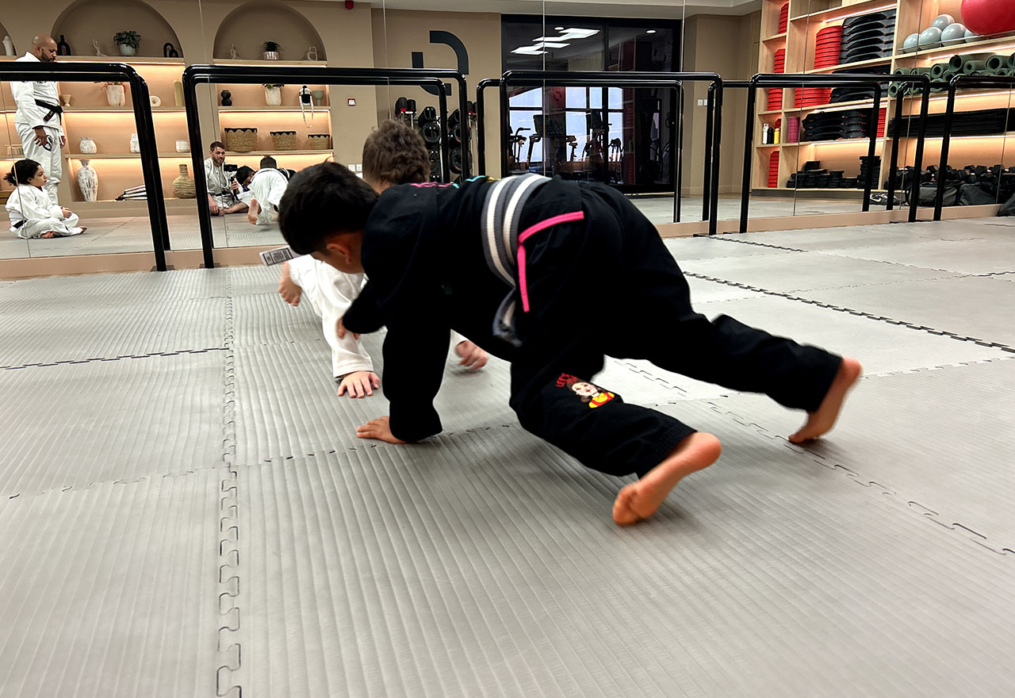
A few terms ago, we had a seven-year-old join us, a bright, sociable child whose parents were worried because he would not attempt anything he could not already do well. New techniques, unfamiliar drills, sparring against someone bigger: he would shut down, arms crossed, refusing to participate rather than risk getting it wrong in front of the class. His coach did not push him into it directly. Instead, over a few weeks, he was given small, private wins first: a technique broken into three tiny steps, practised one on one before he ever had to try it with a partner watching. Each small success was named specifically, not with generic praise but with “you adjusted your grip there, that’s exactly the fix,” so he could see the connection between effort and improvement. It is a small, unglamorous example of how to build resilience in children in real time, not a dramatic turnaround. By his third month, he was volunteering to demonstrate in front of the group, something that would have been unthinkable at the start. Nothing about his talent changed. What changed was his tolerance for the gap between trying and succeeding. That gap, and a child’s ability to sit inside it without quitting, is really the whole story of how to build resilience in children.
Practical Ways to Build Resilience in Children This Week
You do not need a training programme to start. Small, consistent changes at home make a genuine difference, and most of them cost nothing but attention.
Let your child struggle a little before you step in. When homework gets frustrating or a puzzle will not click, resist the urge to solve it for them within thirty seconds. Give it a minute. Ask “what have you tried so far” before you offer an answer, a small habit that quietly answers how to build resilience in children every single day. This single habit, more than almost anything else, is a practical, everyday example of how to build resilience in children, because it hands the struggle back to them in small, safe doses.
Name the feeling before you fix the problem. “You look really frustrated that this isn’t working” lands very differently to “just try again.” Naming the emotion helps a child recognise and eventually self-manage it, which is the actual skill you are building. Small as it sounds, this is a genuinely practical piece of how to build resilience in children advice that costs nothing and takes ten seconds.
Praise the process, not just the outcome. “You kept adjusting your approach even when it wasn’t working” teaches something completely different to “you’re so clever.” Outcome praise makes children fear the next failure, because failure threatens the identity you have praised. Process praise survives failure, because the effort is still true even when the result is not. This one shift in language is one of the most reliable levers we know for how to build resilience in children over time.
Let them fail at low-stakes things now. A missed goal in a friendly match, a wrong answer in a low-pressure quiz, a wobble on a bike with a helmet on: these are cheap, safe opportunities to practise recovering. Children who are protected from every small failure often meet their first real one later, at a much higher cost, with none of the practice they needed. This is one of the harder pieces of how to build resilience in children advice to actually follow, because it runs against every protective instinct you have. Have a simple recovery script ready. Something like “that didn’t work, what’s one thing I could try differently” gives your child language for getting back up, rather than leaving them to sit in the feeling with no route out of it. Scripts like this are often the missing piece parents ask us about when they ask how to build resilience in children at home, not big interventions.
How The Origami Factory Builds Resilience Through the 3D Method
We built The Origami Factory around a simple idea: Brazilian Jiu-Jitsu is an unusually good delivery vehicle for character development, and resilience is one of the outcomes we track most closely, because BJJ puts children in a controlled version of exactly the situation resilience requires. A child gets into a bad position on the mat, has to stay calm, has to problem-solve their way out, and either escapes or taps and resets. Then they do it again a minute later.
Nobody quits after one bad round, because everybody is in a bad round eventually, including the coaches. Our approach mirrors what the research recommends, and it shows up in how consistent training changes behaviour beyond the mat, built on our 3D Method: Discover, Develop, Demonstrate. In the Discover phase, a coach identifies where a child currently sits with frustration tolerance, whether they shut down, act out, or quietly disengage when something is hard. In the Develop phase, that child gets deliberately paired with drills and partners calibrated to stretch them without overwhelming them, the same “small private win first” approach we described above. In the Demonstrate phase, they get to show that growth, first to a coach, then to the class, then eventually to themselves, which is usually the moment it actually sticks.
That structure is deliberately built around how to build resilience in children specifically, not around producing better athletes. If you want a longer look at how we structure this, our full breakdown of the 3D Method covers each phase in more depth, and our piece on how we measure character development explains how we actually track things like resilience rather than just belt progress. This is deliberately not generic martial arts messaging. It is how to build resilience in children applied specifically, session by session, to your child.
Resilience at Different Ages: Penguins to Dragons
What resilience looks like, and what helps build it, changes a lot as children get older, which is why we run age-specific cohorts rather than one blended approach. Our Penguins, ages four to six, are mostly building basic emotional regulation: recognising big feelings and learning that a wobble is not the end of the world. At this age, how to build resilience in children mostly means short, achievable challenges and a lot of specific praise for trying. Our Foxes, ages seven to nine, start facing more social comparison. This is the age where “I’m bad at this” starts to appear as a fixed belief rather than a passing complaint, so we focus heavily on process praise and normalising mistakes openly in class.
This is a pivotal moment for how to build resilience in children, because beliefs formed here tend to stick. Our Cranes, ages ten to twelve, are dealing with pre-teen pressure and a sharper awareness of how they look to peers. Resilience here often means learning to take a loss in front of others without it becoming a story about their worth. How to build resilience in children at this stage means protecting their sense of worth while still letting the loss stand. Our Dragons, thirteen and up, are old enough to build genuine internal motivation rather than relying purely on external praise, so our coaching leans more on reflection: asking them what they noticed about their own response to difficulty, rather than telling them. By this stage, how to build resilience in children looks less like coaching and more like guided reflection. If you are not sure which stage fits your child, our programmes page breaks down each age group and what a typical class looks like.
Common Mistakes Parents Make Without Realising It
Rescuing too fast is the most common one. If you consistently step in the moment your child shows the first sign of frustration, you remove the exact rep they need to build the skill. It comes from love, but it slows the process down. Slowing that instinct down is one of the simplest, hardest parts of how to build resilience in children as a parent. Comparing siblings or classmates is another. “Your brother didn’t cry about this” or “look how well she’s doing” might be intended as motivation, but it usually reads to a child as a threat to belonging, which makes them more fragile, not less.
Removing comparison from the room is a quieter but equally important part of how to build resilience in children well. Over-scheduling recovery time away is a subtler one. Some parents, worried about pressure, remove all challenge from a child’s week. Ironically, this can starve a child of the small, manageable adversity they need to practise on, leaving them under-prepared for the bigger version when it eventually arrives, which it always does.
Finally, treating one bad day as a pattern. A child who melts down once is having a hard afternoon. A child who melts down consistently might need support. Confusing the two, either by overreacting to a single bad day or ignoring a genuine pattern, gets in the way of an accurate read on what your child actually needs, and it is a mistake that can quietly undo everything else you know about how to build resilience in children. Our piece on how Jiu-Jitsu builds emotional intelligence is a useful companion read here too. Our piece on what’s going on when a child has no motivation digs into this distinction in more detail, and it is a useful companion to how to build resilience in children, because low motivation and low resilience often travel together.
Frequently Asked Questions
What age should I start actively working on resilience with my child?
Earlier than most parents think. Even a four or five year old can start learning to name feelings and try again after a small setback. The specific tools change with age, but the core idea behind how to build resilience in children, small manageable struggle plus a supportive adult, applies from early childhood right through the teenage years.
Is resilience the same thing as confidence?
They are related but not identical. Confidence is belief in your ability to succeed. Resilience is the capacity to keep functioning when you don’t succeed. A child can be confident and still crumble at the first setback if resilience hasn’t been built alongside it. Our article on how to build confidence in a child looks at the confidence side specifically, and the two guides work well read together. Working on both is a practical way to approach how to build resilience in children without treating the two as separate projects.
My child seems to have given up on trying new things. Is it too late?
No. Resilience is a skill, not a fixed trait, which means it can be built at any age with the right conditions: small achievable challenges, process-focused praise, and a consistent supportive adult. It may take longer to rebuild a child’s willingness to try if they have had repeated bad experiences, but “too late” is very rarely the accurate description. It is more often a case of needing a gentler on-ramp. This is one of the most common versions of the how to build resilience in children question we get, and the honest answer is almost always no.
How is BJJ specifically useful for resilience compared to other activities?
Most sports involve failure, but BJJ puts a child in a physically safe, low-stakes bad position every single round, over and over, in a way few other activities replicate that consistently. Because it is one-on-one rather than team-based, a child cannot hide behind teammates, and because sessions are frequent, the reps needed to build genuine resilience come around often. That said, plenty of activities can build resilience if the coaching approach is right; the activity is the vehicle, not the whole answer. It is a concrete, repeatable answer to how to build resilience in children through sport specifically.
My child has low confidence too. Do I work on that first, or on resilience first?
You can work on both at once, because they reinforce each other. A small win builds a sliver of confidence, and surviving a small failure without falling apart builds a sliver of resilience, and each makes the other slightly easier next time. If you are looking for early warning signs beyond low resilience, our guide to signs your child lacks confidence is a useful place to check where things currently stand. That overlap is exactly why how to build resilience in children and building confidence tend to get asked about together.
What if my child cries or gets angry every time they fail at something?
That is a normal starting point for a lot of children, not a red flag on its own. The goal early on is not to stop the reaction but to shorten the recovery time and add a next step afterwards (“okay, you’re upset, what’s one thing we could try differently”). Over time, with practice, the intensity and duration of the reaction tends to shrink. If it isn’t shrinking at all after consistent effort over a few months, that is worth a proper conversation with a teacher, coach, or paediatrician. That pattern, more than any single outburst, is what we watch for when parents ask how to build resilience in children who react strongly to failure.
Every parent asking how to build resilience in children is really asking one thing: how do I help my child keep going when things get hard, without me being the one who has to make it easy. The honest answer is that it takes time, consistency, and the right kind of support, not toughness and not rescue. That is exactly what we focus on at The Origami Factory, using BJJ as the vehicle and the 3D Method as the structure behind it. If you would like to see it in action, our programmes page has the full breakdown by age group, or you can go straight ahead and book a AED 99 trial class to see how your child responds on the mat.