

Why Your Child Can’t Focus: How to Improve a Child’s Attention Span.
If homework takes two hours because your child stops every four minutes to fiddle with a pencil, stare at the wall, or ask what’s for dinner, you already know the frustration. Teachers mention it at parent evenings. You notice it yourself during dinner, during reading time, during anything that isn’t a screen. Working out how to improve a child’s attention span is one of the most common questions we hear from parents walking through our doors in Dubai, and it rarely has a single, simple cause.
The good news is that attention is trainable. It isn’t a fixed trait some children are born with and others aren’t. Before we get into what actually helps, it’s worth understanding why focus breaks down in the first place, because the fix depends on the cause, not just the symptom. That understanding is the real starting point for how to improve a child’s attention span, rather than jumping straight to a checklist of tricks.
Why Attention Span Looks Different at Every Age
Attention span isn’t one single skill. It’s a cluster of related skills: sustained attention, which is staying with one task; selective attention, which is ignoring distraction; and shifting attention, which is moving between tasks without losing the thread. All three develop at different rates, and all three look different depending on the age of the child in front of you. Any honest answer to how to improve a child’s attention span has to account for all three, not just the one that’s most visible at the dinner table.
At Penguins age (4 to 6), short bursts of focus are normal. A five-year-old genuinely struggling to sit through a ten-minute story isn’t unusual, and it isn’t a red flag on its own. By Foxes age (7 to 9), most children can hold attention for a full class period if the material engages them, though distraction from noise or movement in the room is still common. Cranes (10 to 12) can generally sustain attention for longer stretches, but this is also the age where screen habits start working against natural focus in a noticeable way. Dragons (13+) have close to adult-level attention capacity on paper, but motivation and interest play an outsized role in whether that capacity actually gets used.
Knowing where your child sits developmentally matters, because how to improve a child’s attention span at age five looks completely different to how you’d approach it with a thirteen-year-old. A parent expecting six-year-old focus from a four-year-old is setting everyone up for frustration, and a parent still using five-year-old strategies on a twelve-year-old is missing what that child actually needs.
The Screen Time Connection Nobody Warned You About
We wrote a longer piece on this over on our screen time and your child’s attention span research page, but the short version matters here too. Fast-cutting video content, the kind built into most children’s apps and short-form video platforms, trains the brain to expect a new stimulus every few seconds. Sit that same brain down in front of a maths worksheet, which offers no new stimulus for minutes at a stretch, and it struggles. Not because the child is lazy or incapable, but because the environment that shaped their expectations doesn’t match the task in front of them.
This is one of the most overlooked pieces in how to improve a child’s attention span. Parents often focus on the classroom or the homework table, when the real intervention needs to happen earlier in the day, in how screen time is structured. We go into practical detail on this in our guide to reducing your child’s screen time without a daily battle, and in a separate comparison of screen time versus martial arts as competing claims on a child’s free time.
To be clear, this isn’t an argument for zero screens. It’s an argument for noticing the pattern. If your child melts down or can’t settle for twenty minutes after switching off a screen, that transition difficulty is data, not defiance, and it’s a useful clue in working out how to improve a child’s attention span for that specific child.
How to Improve a Child’s Attention Span at Home This Week
Here is where most articles get vague. We’d rather be specific. If you’re looking for how to improve a child’s attention span starting this week, these are the changes that tend to move the needle fastest, in rough order of impact.
Start with sleep. A tired child cannot focus, no matter how good the strategy is, and no conversation about how to improve a child’s attention span is complete without it. Most children aged 6 to 12 need 9 to 12 hours; teenagers still need 8 to 10, even though school and social life conspire against it. If bedtime has crept later over the past year, that alone could explain a chunk of the focus problem.
Next, build in movement before anything that demands concentration. A ten-minute walk, a scooter ride, or twenty minutes on the mat before homework changes how a child’s brain performs for the following hour, and it’s often the fastest way into how to improve a child’s attention span on a day that’s already gone sideways. We’ll come back to why in the next section.
Third, shrink the task, which is another piece of how to improve a child’s attention span that’s easy to skip. Don’t ask a seven-year-old to “do your homework.” Ask them to do the first three maths problems, then check back in. Short, defined blocks with a clear end point are far easier for a developing attention system to hold onto than an open-ended instruction.
Fourth, remove the phone from the room, not just from the desk. Even a silenced phone sitting face-down nearby measurably reduces available attention, because part of the brain is still monitoring for it.
Fifth, and this is the one most parents skip: praise the process, not just the result. “You stuck with that for the whole ten minutes without getting up” builds the specific skill you’re trying to strengthen. “Good job” doesn’t tell a child what worked.

What We See on the Mat: A Practical Example
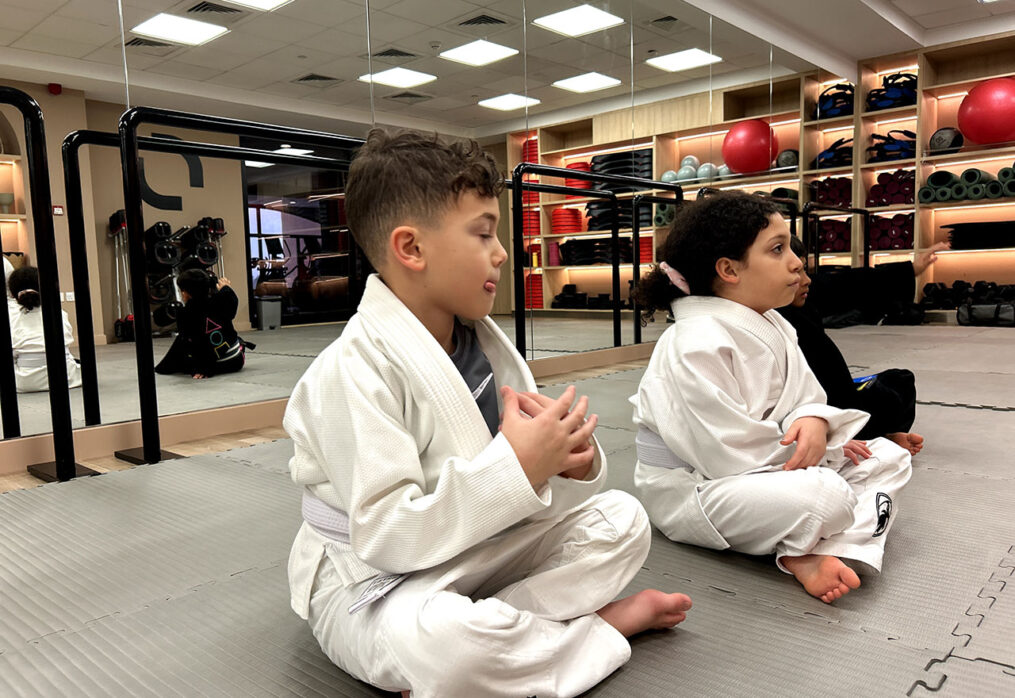
A few terms ago, we had a Fox in class, seven years old, whose mother described him as “unable to sit still for thirty seconds” at home or at school. She’d tried most of the standard advice on how to improve a child’s attention span already, with limited success. On the mat, in his first few weeks, that was true here too. He’d drift mid-drill, wander off during instruction, and need constant redirection.
What changed wasn’t a single trick. It was structure repeated consistently: a clear routine at the start of every class, short instructional segments rarely longer than ninety seconds, and immediate physical feedback (a partner drill, a live roll, a specific correction) rather than abstract praise. Within two months, his coaches were noting longer stretches of sustained focus during drilling. Within a term, his mother reported the same shift showing up at the dinner table and during homework.
We share this not because BJJ is magic, but because it’s a useful, real example of how to improve a child’s attention span through structure and immediate feedback rather than through willpower alone, which is what most parents are quietly trying (and failing) to instil.
The Role of Physical Activity in Focus and Attention
This isn’t just anecdote. Clinicians who work directly with children on attention difficulties point out that inattention has more than one cause and needs to be understood before it can be addressed. As the Child Mind Institute explains, attention problems in children are frequently mistaken for a single diagnosis when anxiety, stress, learning differences, or simple developmental variation can all produce the same surface behaviour. That distinction matters for parents asking how to improve a child’s attention span, because the right intervention depends on which of those is actually driving the distraction.
Physical activity is one of the few interventions that helps broadly, regardless of the underlying cause. Structured movement increases blood flow to the parts of the brain responsible for planning, inhibition, and sustained focus. It’s part of why we see attention improvements in students who train consistently, even students who arrived with no diagnosed attention difficulty at all. A twenty-minute session of focused physical activity, done regularly rather than as a one-off, tends to outperform a single long homework session for building the underlying capacity to concentrate. For parents short on time, this is often the single highest-leverage answer to how to improve a child’s attention span available to them.
This is also why we’re cautious about framing focus as purely a discipline problem. Telling a child to “just concentrate harder” rarely works, because attention is a skill built through repetition and the right kind of practice, not a switch a child can flip through effort alone. That’s a practical example of how to improve a child’s attention span through the body first, and the mind follows.
Common Mistakes Parents Make When Trying to Fix Focus
The first mistake is treating attention as a character flaw. A child who can’t focus isn’t being difficult on purpose, and framing it that way tends to add shame on top of an already frustrating experience, which makes the underlying problem worse, not better. It also makes any real progress on how to improve a child’s attention span slower, because a child who feels judged tends to disengage further rather than try harder.
The second mistake is removing all stimulation and expecting focus to appear in the resulting vacuum. Total silence and a bare desk sound sensible, but for many children, particularly younger ones, some low-level structured stimulation (fidget tools, background instrumental music, a defined physical space) supports focus rather than undermining it.
The third mistake is inconsistency. If how to improve a child’s attention span were a single conversation, every parent would have solved it by now. It’s a set of habits, repeated daily, that compound over months. One good week rarely produces a lasting change; a school term of consistent structure usually does.
We also see parents confuse attention problems with motivation problems, which are related but not identical. If your child seems to have given up on trying altogether, that’s worth reading alongside our piece on what’s actually going on when a child has no motivation, since the two often travel together but need slightly different responses, even though both sit under the same broad question of how to improve a child’s attention span and follow-through together.
How The Origami Factory Builds Attention Through the 3D Method
Everything we’ve described so far, structure, short instructional blocks, physical activity, immediate feedback, consistency, is built directly into how we run classes. We call it the 3D Method: Discover, Develop, Demonstrate.
In the Discover phase, coaches identify where a child’s focus currently sits: how long they sustain attention unprompted, what breaks it, and what re-engages them. In the Develop phase, we build focus deliberately through structured drilling, short attention windows that lengthen gradually over weeks, and consistent routine. In the Demonstrate phase, children show what they’ve built, on the mat and, just as importantly, off it. Coaches use this same three-stage approach as their working answer to how to improve a child’s attention span with every student who walks in the door.
We don’t just track belts. We track how character development, including focus and attention, changes over a term, because that’s the outcome parents actually came to us for. Many parents first notice the shift not in class but in ordinary life: homework finishing faster, fewer reminders needed at the dinner table, teachers commenting that their child settles better at school.
If your child is the sort who starts BJJ, gymnastics, or football with enthusiasm and drifts away within weeks, it’s also worth reading how this connects to persistence more broadly. We’ve written separately about why some children quit everything, because attention and follow-through are closely linked; a child who can’t sustain focus on a task often can’t sustain interest in an activity either, and the fixes overlap more than people expect.
Programmes are grouped by age (Penguins, Foxes, Cranes, and Dragons) precisely because how to improve a child’s attention span differs so much by developmental stage, and a one-size approach fails most children. You can see how each age group is structured on our programmes page.
Frequently Asked Questions
At what age should I be concerned about my child’s attention span?
Some variation is normal at every age, and a Penguin who can’t sit still for ten minutes usually isn’t cause for concern on its own. What matters more is whether attention is improving over time as your child gets older, or staying flat, or getting worse. If a seven or eight-year-old’s focus looks identical to how it looked at age four, or if attention difficulties are affecting friendships and schoolwork significantly, it’s worth a conversation with a paediatrician or child psychologist rather than waiting it out. That said, most parents asking how to improve a child’s attention span are dealing with ordinary developmental variation rather than anything clinical.
Can screen time actually shorten a child’s attention span?
The evidence points to a real effect, particularly with fast-paced content and heavy daily use. It’s not that screens are inherently harmful, but that certain formats train the brain to expect constant stimulus change, which makes slower-paced tasks like reading or homework feel unbearably dull by comparison. Reducing volume and being selective about format both help, and it’s usually one of the first places we point parents when they ask us how to improve a child’s attention span.
How to improve a child’s attention span without turning it into a battle?
Small, consistent changes work better than dramatic overhauls. Better sleep, a short burst of movement before focused tasks, and shrinking big assignments into smaller defined chunks all help without requiring a confrontation. Praise for sticking with a task, rather than only praising the finished result, reinforces the specific behaviour you’re after.
Does BJJ or martial arts training genuinely help with focus?
Structured physical activity that requires a child to listen, follow multi-step instructions, and respond to a live partner engages attention in a way that passive activities don’t. We see it consistently in our own students, and it lines up with the wider research on physical activity and executive function. It isn’t a substitute for addressing other causes of inattention, but it’s a genuinely useful part of the picture, and one of the more enjoyable answers to how to improve a child’s attention span that we’ve come across.
What’s the difference between a focus problem and ADHD?
Not every attention difficulty is ADHD, and clinicians caution against assuming it is without a proper evaluation, which matters because how to improve a child’s attention span differs depending on which one you’re actually dealing with. Anxiety, sleep problems, learning differences, and ordinary developmental variation can all produce behaviour that looks similar from the outside. If you’re concerned, a paediatrician or child psychologist is the right first step rather than self-diagnosing based on a checklist.
How long does it take to see improvement in a child’s attention span?
With consistent structure, most parents notice some change within four to six weeks, though the underlying skill keeps building for months afterward, which is fairly typical for how to improve a child’s attention span in a lasting way rather than a quick fix. It isn’t instant, and progress usually isn’t perfectly linear either; expect some weeks to look like a step backward before the next improvement shows up.
If you’re still working out how to improve a child’s attention span for your own family, the fastest way to see what consistent structure looks like in practice is to watch it in action. You’re welcome to see what happens at one of our trial classes before deciding whether it’s the right fit. We run a AED 99 trial across all four age groups, and you can book a kids BJJ trial class in Dubai to see how the 3D Method works with your own child on the mat.