

How to Discipline a Child Without Yelling.
It is 6:40 on a school morning. Shoes are missing, your child is lying on the hallway floor, and you hear your own voice go up two notches. Then you feel the guilt. If that sounds familiar, you are probably searching for how to discipline a child without yelling, and you are not alone. Most parents we meet at the academy have raised their voice this week. Most of them wish they had not.
This article explains how to discipline a child without yelling, why shouting rarely works, and what to do instead. We write it as coaches who spend several hours a week with children aged 4 to 13 on the mat. We see what helps and what does not. You will get a short answer first, then the detail, then a plan you can start this week.
The short answer: how to discipline a child without yelling starts before the problem
Here is the answer in under 200 words. How to discipline a child without yelling by doing four things. First, decide your rules and consequences when you are calm, not in the middle of a meltdown. Second, tell your child the rule in plain words before it matters. Third, follow through the same way every time, quietly. Fourth, repair the moment afterwards with a short, warm conversation.
Yelling feels like action, but it is usually a sign that the plan is missing. When the plan exists, your voice can stay low. A child who knows exactly what happens if they hit their sister or ignore the third request to put shoes on does not need volume. They need you to be predictable. That is the core of how to discipline a child without yelling: calm structure, repeated daily.
The American Academy of Pediatrics says that harsh verbal discipline, including shouting and shaming, does not work well and can lead to more behaviour problems and emotional difficulties over time. You can read their guidance on disciplining your child. They recommend clear rules, consistent consequences and praise for good behaviour instead.
Why yelling feels necessary and why it stops working
You do not yell because you are a bad parent. You yell because you are tired, late, and out of ideas, and because it works for about four seconds. Your child freezes. The noise stops. Your brain registers a result and wants to repeat it.
The trouble is what happens next. Children get used to volume quickly. By the second week you need to be louder to get the same pause. Meanwhile your child is learning that the loudest person wins, which is the opposite of what you want. If you are looking for how to discipline a child without yelling, this is the first thing to accept: the quick result is the trap.
At the academy we see the same pattern on the mat. A coach who raises their voice gets a quiet class for a minute and a restless class for the rest of the session. A coach who stands still, lowers their voice and waits gets attention that lasts. Children read tone before they read words. If your tone says panic, they match it.
Three misconceptions about discipline we hear from parents
Misconception one: calm means weak
Many parents think that learning how to discipline a child without yelling means becoming soft. It does not. A calm parent can hold a firm line. In fact, calm is what makes the line believable. Children test limits to find out whether the limit is real. Shouting tells them the limit is wobbly. A steady voice and a consistent result tells them it is solid.
Misconception two: discipline and punishment are the same thing
They are not. Punishment aims to make a child feel bad. Discipline aims to teach a skill. We wrote about this difference in our post on discipline versus punishment. The short version: ask yourself what you want your child to do next time. If the consequence does not teach that, change it.
Misconception three: you must win every moment
You do not. Part of how to discipline a child without yelling is picking the three or four rules that matter most and letting small things go. Shoes on the right feet is not a battle worth your voice. Hitting, rudeness to adults and ignoring safety are. Parents who try to control everything end up shouting about everything.
What is actually happening in your child’s head
Before you try any technique, it helps to know what a seven-year-old brain can do when you are shouting at it. Not much. The part responsible for planning and self-control is still developing, and it works worst when a child feels threatened or ashamed. A raised voice moves your child into defence mode. They stop listening and start protecting themselves.
That is why a calm approach is not just kinder; it is more effective. When you are working out how to discipline a child without yelling, you are really working out how to keep your child’s thinking brain switched on. Short sentences, a low voice, and a clear next step do that. Long speeches and threats do the opposite.
Threats cause a second problem. If you say you will cancel the weekend and then do not, your child learns that your words are negotiable. If you do cancel it, the punishment is often so large that you feel guilty and give in later. Both outcomes teach inconsistency. Keep consequences small, related and doable. Ten minutes without the tablet is better than a month you will never enforce.
A realistic example from the mat
We will call him Sami, though he is a composite of several children we have coached. Sami was seven. He hated losing a round in class and would shout, throw his belt and refuse to rejoin. At home, his mum told us, the same thing happened with homework. She shouted, he shouted, and homework took ninety minutes.
Our coach did not shout. He used the same three steps every time. He named what he saw in one sentence: you are angry because you lost. He gave one choice: take a minute at the edge of the mat, or sit with me for a minute. Then he waited. When Sami returned, the coach said nothing about the outburst and simply started the next round.
It took about five weeks. Sami’s outbursts went from every class to once a fortnight. His mum copied the approach at home: one sentence, one choice, one wait. She told us later that learning how to discipline a child without yelling turned out to be mostly learning to say less. Homework dropped to thirty-five minutes.
We are not saying the mat is magic. We are saying that clear structure, repeated, changes behaviour, and that is the whole idea behind how to discipline a child without yelling. Children at the academy also know what comes next in every session. That predictability is the same thing you can build at home.

Practical steps for this week
Here is a plan for how to discipline a child without yelling that you can start on Monday. Keep it small. Pick one step per day if that is easier.
Step 1: write down three non-negotiable rules
Choose three. For example: we keep our hands to ourselves, we speak respectfully to adults, we come when called for safety. Write them on paper. Tell your child, at a calm time, what they are and what happens if they are broken. This is the foundation of how to discipline a child without yelling, and it takes ten minutes.
Step 2: pick a small, related consequence for each
If your child throws a toy, the toy goes away for the day. If they ignore a request to get ready, they lose the five minutes of screen time they would have had. Related consequences make sense to children. Random ones feel like punishment.
Step 3: use the one-sentence rule
When a rule is broken, say one sentence in a low voice, then act. For example: “Toys are for playing, not throwing, so that one goes on the shelf.” No lecture. No repeated warnings. Parents who ask us how to discipline a child without yelling usually find this step the hardest and the most useful.
Step 4: pause before you respond
Take three slow breaths before you speak. It sounds small. It breaks the reflex, and it is the most immediate tool for how to discipline a child without yelling. If you cannot be calm, say so: “I am too cross to talk. I will come back in five minutes.” That models the exact self-control you want your child to learn.
Step 5: repair afterwards
When everyone is calm, spend two minutes talking. Ask what happened and what your child could do next time. If you shouted, apologise briefly. Children do not lose respect for a parent who says sorry. They gain it.
Step 6: notice the good behaviour
Aim for five noticed good moments for every correction. Say what you saw: “You put your shoes on without being asked, thank you.” Praise that names the action works better than general praise, a point we cover in does praise help or hurt children. This step is easy to skip, and it is half of how to discipline a child without yelling.
Routine does more of the work than you think
A surprising amount of shouting comes from unclear routines. When mornings are different every day, every task becomes a negotiation. When the sequence is the same, children follow it with less prompting. We explain why in our article on why structure and routine matter.
Try a visual checklist by the door: shoes, bag, water bottle. Let your child tick items off. Then your job changes from nagging to checking. That one change removes a large share of the shouting in many households, and it is one of the simplest answers to how to discipline a child without yelling.
Bedtime works the same way. Same order, same time, same last five minutes. Children who know the sequence resist less because there is less to resist, and how to discipline a child without yelling gets easier when there is less to argue about.
When your child pushes back while you learn how to discipline a child without yelling
Even with a good plan, some days will go badly. Your child will test you, especially in the first two weeks, and the behaviour may get worse before it improves. That is normal. It means they are checking whether the new rules are real. Keep going. Part of how to discipline a child without yelling is accepting that progress is uneven.
If a tantrum is in full flow, do not try to reason. Keep your child safe, stay close, say very little, and wait. Teach afterwards. If the same problem keeps appearing for months, or it comes with big mood changes, talk to your child’s teacher or paediatrician. Some children need extra support, and asking for it is a strength.
For motivation problems, which often look like defiance, see our post on what is actually going on when a child has no motivation. Not every refusal is disobedience.
How martial arts training supports calm discipline
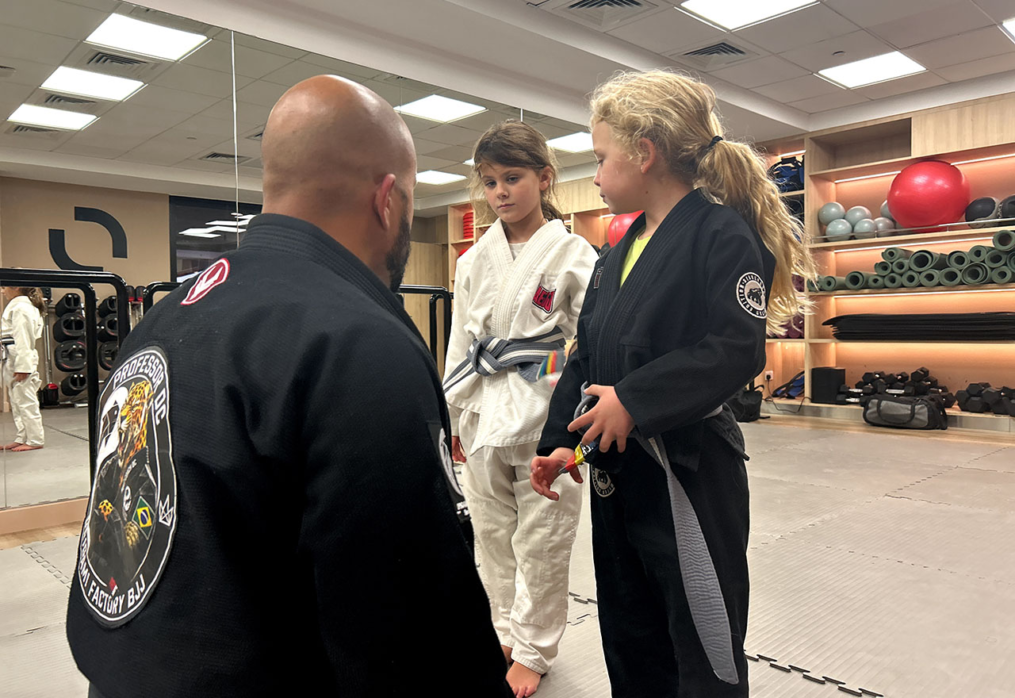
We should be honest about where we come from. The Origami Factory is a character development programme that uses Brazilian Jiu-Jitsu as the way we teach it. Children learn self-control because the class demands it: wait your turn, bow in, listen to the instruction, accept a loss, try again. None of that is shouted at them. It is built into the structure.
Our 3D Method has three stages: Discover, Develop, Demonstrate. A child first discovers a skill, then develops it through repetition, then demonstrates it. You can read the details in our post on the 3D Method. The same pattern applies at home. Teach the expectation, practise it, then notice when your child shows it. That is a practical way to think about how to discipline a child without yelling.
We track character, not just belts. Parents can see how we do it in how we measure character development. Many parents tell us that self-control on the mat shows up at the dinner table within a couple of months. One class a week will not transform a household; consistency at home matters more. But a good class gives your child a second place where calm, firm adults set the same standard.
Parents also tell us that school behaviour improves. We looked at this in why consistent training helps children behave better at school.
Matching your approach to your child’s age
Our academy groups children as Penguins (4 to 6), Foxes (7 to 9), Cranes (10 to 12) and Dragons (13 and over). The principles of how to discipline a child without yelling stay the same across all four, but the delivery changes.
For younger children, how to discipline a child without yelling means short instructions and quick, calm follow-through. With Penguins, keep instructions to one step and use a visual cue. Expect to repeat yourself. With Foxes, give choices and let them help choose consequences. With Cranes, explain the reason behind rules and listen to their view; they push back harder because they are starting to think independently. With Dragons, move toward agreements, not orders. Teenagers respond to respect, and they will not cooperate with a shouting parent for long.
If you are not sure which stage fits your child, our guide on what age a child should start BJJ explains how we place children.
What to do when you do yell
You will. Everyone does. Knowing how to discipline a child without yelling does not make you perfect; it makes you quicker to recover. When you shout, wait until the moment passes, then say: “I raised my voice and that was not okay. I am sorry. Here is what I will do next time.” Keep it short.
Children learn from repair as much as from rules. They see that adults make mistakes and fix them. Our post on teaching a child to handle failure covers the same idea: the response to a mistake matters more than the mistake. That applies to parents too.
Frequently Asked Questions
Is it ever okay to raise my voice? Does how to discipline a child without yelling mean never?
It is fine to raise your voice to warn of danger, such as a child running toward a road. That is safety, not discipline. The aim of how to discipline a child without yelling is to stop using volume as your main tool for everyday behaviour, not to stay silent in an emergency.
What age can I start using these methods?
From around age two or three, in a simple form. By four, children can understand a short rule and a clear consequence. The principles of how to discipline a child without yelling apply at every age; only the language and the size of the consequence change.
My partner and I disagree on discipline. What should we do?
Agree on the three non-negotiables and the consequences privately, away from the children. You do not need identical styles, but you do need the same rules. Children notice differences instantly. Sharing a plan for how to discipline a child without yelling is easier than arguing about it in the moment.
How long before I see a change?
Most parents notice something in two to three weeks and a clearer shift by six to eight. Behaviour often gets a little worse in the first week as your child tests the new approach. Stay consistent. If nothing changes after two months, review whether the rules are clear and whether both adults follow them.
Does time-out work?
Short time-outs, a minute or two for younger children, can work when used calmly and consistently as a pause, not a punishment. The AAP guidance linked above supports brief time-outs as part of positive discipline. Pair them with a repair conversation afterwards.
Can an activity like BJJ really help with how to discipline a child without yelling?
It can support it. Class gives children practice in self-control, listening and handling frustration with calm adults around. It does not replace what you do at home. If you want to see how it works, a trial class is the quickest way to judge for yourself.
At The Origami Factory we want your child to leave class calmer and more capable, and we want you to feel less worn down at home. If you would like to see what our approach looks like, take a look at our programmes for each age group, or book a trial class for AED 99. We will answer any question you have about how to discipline a child without yelling or anything else.