

Teaching Kids Teamwork Skills.
If your child comes off the mat every week talking about who won and who lost, it is worth stepping back and asking what they are actually learning. Teaching kids teamwork skills is not the flashy part of any kids’ activity. It rarely gets photographed for the results wall. But it is, in our experience running a martial arts academy in Dubai, the single thing that carries furthest into adult life. Long after your child has forgotten a scoreline, they will remember how to listen to a partner, how to lose without falling apart, and how to make someone else’s effort count. That is what this article is about: what teamwork actually looks like at different ages, why winning gets more attention than it deserves, and how you can start teaching kids teamwork skills at home this week, not just in a classroom or on a mat.
What Teamwork Actually Looks Like at Five, Eight, and Eleven
Parents often picture teamwork as something that starts around age eight or nine, once children can follow multi-step instructions and hold a strategy in their head. In practice, teaching kids teamwork skills starts much earlier than that, just in a different shape.
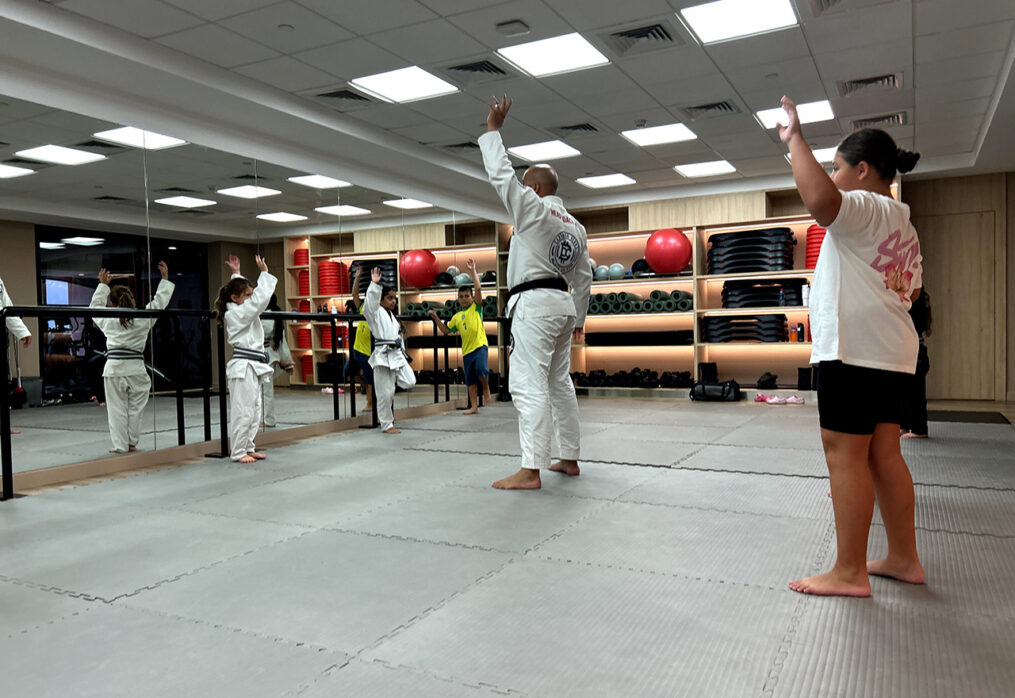
A four or five year old in our Penguins group is not coordinating a game plan. Teamwork at that age looks like waiting for a turn, copying a partner’s movement without shoving them out of the way, or noticing that a training partner is smaller and adjusting how hard to grip. It is small, physical, and immediate. By seven to nine, in our Foxes group, children can start to read another person’s intention: they notice when a partner is frustrated, and they can hold back or adapt without an adult prompting them every time. Ten to twelve year olds, our Cranes, are ready for something closer to what adults mean by teamwork: taking a role, communicating a plan out loud, and holding themselves accountable when the group does not perform well. Teenagers, our Dragons, are capable of mentoring younger students, which is teamwork in its most demanding form because it asks them to put someone else’s progress ahead of their own.
The mistake we see most often is treating teamwork as one fixed skill that a child either has or does not have. It is not. Teaching kids teamwork skills is a layered process, and each age group needs a different entry point.
The Trophy Problem: Why Winning Gets All the Attention
Here is a common misconception: that a child who wins consistently is automatically learning more than one who does not. Winning is loud. It shows up in medals, certificates, and the stories children tell each other in the car park after class. Cooperation is quiet. Nobody hands out a trophy for the child who helped a nervous training partner relax before their first sparring round.
That imbalance shapes what children pay attention to, and it shapes what many parents praise without meaning to. If every conversation after class is “did you win,” a child quickly learns that winning is the metric that matters. If some of those conversations are instead “who did you help today” or “what did your partner need from you,” a child starts to notice cooperation as something worth doing for its own sake. This is one of the simplest, lowest-cost ways of teaching kids teamwork skills: changing the question you ask on the car ride home.
We are not against competition. Healthy competition teaches children to handle pressure and to keep trying after a setback, which is exactly why sport can build genuine confidence in children when it is structured well. The issue is not competition itself. It is a culture where winning is the only thing that gets noticed, because that culture actively works against teaching kids teamwork skills rather than alongside it. A coach or parent who is serious about teaching kids teamwork skills has to be willing to praise the quiet, unglamorous moments just as loudly as the medal moments.
What the Research Says About Working With Others
This is not just a parenting preference. There is a solid body of research behind it. A well known longitudinal study from Pennsylvania State University, led by researchers Damon Jones, Mark Greenberg and Max Crowley, followed children from kindergarten into their mid-twenties and found that early social competence, the ability to cooperate, share, and resolve conflict with peers, predicted outcomes like college graduation and full-time employment nearly two decades later, independent of academic ability. In other words, teaching kids teamwork skills early is not a soft add-on to a child’s development. It is one of the strongest predictors we have of how they will do later in life.
That finding matches what we see on the mat. Children who learn to work with a partner, adjust to someone stronger or weaker than them, and recover from a bad round without blaming their partner tend to carry that composure into school, friendships, and eventually work. Teaching kids teamwork skills is, in a very real sense, one of the most worthwhile things you can spend a child’s time on, precisely because the benefits show up in places that have nothing to do with sport.

A Story From the Mat
A few terms ago, one of our coaches worked with a nine year old, we will call him Sami, who was technically one of the strongest students in his Foxes group but was becoming a difficult partner for the others, and his case is a good illustration of what teaching kids teamwork skills actually requires in practice. He would get frustrated when a partner could not keep up, and he would go too hard in drills that were meant to be light and cooperative. His parents were proud of his ability but worried about the pattern.
Rather than benching him or lecturing him about being “nice,” his coach paired him deliberately with newer, less confident students for several weeks and gave him a specific job: help this partner get one technique slightly better by the end of class. The goal was not winning the round. It was measurable improvement in someone else. Within a month, Sami’s whole posture in class changed. He started checking in with partners before drilling hard. He noticed, unprompted, when someone was struggling. That is teaching kids teamwork skills through structure rather than through a lecture, and it is a good example of why the method matters as much as the intention.
How We Build This Into Every Class
Our whole approach runs on what we call the 3D Method: Discover, Develop, Demonstrate. Teamwork sits inside all three stages, not bolted on as an extra.
In the Discover stage, coaches watch how a child naturally behaves with a partner, whether they dominate, hang back, or genuinely collaborate, before setting any goals. In the Develop stage, we build drills that cannot be completed alone: partner escapes, cooperative positional sparring, and roles where one student is explicitly responsible for their partner’s safety and progress. In the Demonstrate stage, children show what they have built, often by helping a newer student through the same drill they once struggled with themselves. This is deliberate. Teaching kids teamwork skills works best when children get to practise being the helper, not only the one being helped.
You can read more about how this looks in practice on our programmes page, and if you are weighing this up against other options for your child, it is worth knowing what to look for before you enrol a child in any BJJ academy, because not every class is structured with cooperation in mind.
Practical Things You Can Try This Week
You do not need a mat or a coach to start teaching kids teamwork skills at home. A few things work consistently well with the families we speak to.
First, give your child a two-person job around the house, something that genuinely cannot be finished alone, like carrying a large item with a sibling or cooking one part of dinner together. Second, change your post-activity questions. Instead of only asking who won, ask who they helped or who helped them. Third, let siblings or friends resolve small disagreements themselves before you step in, since conflict resolution is one of the more advanced parts of teaching kids teamwork skills and children only get better at it with practice, not with rescue. Fourth, praise the process of cooperating out loud and specifically: “I noticed you slowed down so your brother could keep up” lands far better than a generic “good sharing.”
Finally, watch for how your child handles losing in a group setting, not just individually. A child who can lose a team game without turning on their teammates is further along than a child who wins individually every time. If losing well is a struggle in your house, our piece on how to build resilience in children covers the groundwork that usually needs to come first, since teaching kids teamwork skills without first teaching them to lose well tends to fall apart under pressure.
Signs Your Child Might Be Struggling With Teamwork
Teamwork trouble is often one part of a wider pattern, and our broader guide on how to help a child who struggles socially is worth reading alongside this one if group settings in general feel hard for your child. Not every child arrives at cooperation easily, and that is normal rather than alarming. A few patterns are worth watching for. A child who consistently wants to play alone rather than with a group, even when invited, may be avoiding teamwork because it feels unsafe rather than because they simply prefer solitude, and it is worth reading our guide on what to do if your child has no friends if that pattern has been going on for a while. A child who blames teammates immediately after any loss is often struggling with the emotional side of cooperation rather than the practical side. And a child who goes quiet or withdraws entirely in group settings, rather than simply being reserved, may need the kind of gentle, structured push covered in our article on how to help a shy child come out of their shell.
It is also worth ruling out whether a child is being excluded rather than choosing to exclude themselves. If group settings consistently end badly for your child through no fault of their own, that is a different problem, and our guide on what to do if your child is being bullied is a better starting point than any teamwork exercise. Teaching kids teamwork skills only works once a child feels safe enough in the group to try, so safety always comes before skill-building.
If you notice several of these signs together with low confidence more generally, our article on the ten signs your child lacks confidence is a useful companion piece, since confidence and cooperation tend to move together in young children.
Teaching Kids Teamwork Skills by Age: How the Conversation Changes
Teaching kids teamwork skills at five looks nothing like teaching kids teamwork skills at fourteen, and treating them the same is one of the more common mistakes we see from well-meaning parents.
With Penguins, aged four to six, keep it physical and immediate: turn-taking games, simple partner tasks, and lots of specific praise. With Foxes, aged seven to nine, start naming emotions explicitly: “your partner looked frustrated, what do you think was going on for them.” With Cranes, aged ten to twelve, hand over more responsibility: let them set the plan for a group task and only step in if it genuinely breaks down. With Dragons, our teenagers, teamwork often means mentoring, and it is worth noting that disengagement at this age is rarely about laziness. If your teenager has stopped showing up for group commitments the way they used to, our piece on what to do when a teenager has no motivation digs into why that happens and how cooperative responsibility, like mentoring a younger student, can actually pull a disengaged teenager back in.
Frequently Asked Questions
At what age should I start teaching kids teamwork skills?
Earlier than most parents expect. Even a four year old can practise basic turn-taking and simple shared tasks. Teaching kids teamwork skills does not require a child to be old enough for strategy games; it starts with much smaller, physical forms of cooperation.
My child is naturally competitive. Is that a problem?
No, not on its own. Competitiveness and cooperation are not opposites, and plenty of children hold both at once. The goal of teaching kids teamwork skills is not to remove a child’s drive to win, but to make sure that drive does not come at the expense of the people around them. In fact, some of the most driven children respond best to teaching kids teamwork skills once they see cooperation as another way to win, not the opposite of winning.
Does an individual sport like BJJ actually teach teamwork?
Yes, often more directly than team sports do. Because BJJ training relies on a partner for almost every drill, a child cannot progress without genuinely cooperating with someone else, which makes it one of the more effective settings for teaching kids teamwork skills, even though it looks like an individual activity from the outside.
What if my child refuses to work with certain training partners?
This is common and usually solvable. Coaches can rotate partners deliberately and give children a specific, small job with a partner they are avoiding, which is exactly the kind of structured approach that underpins teaching kids teamwork skills in our own classes. Refusal is often about discomfort rather than genuine dislike.
How do I know if teamwork training is actually working?
Look for unprompted behaviour rather than compliance. A child who checks in with a partner without being told to, or who mentions helping someone else without being asked about it, is showing that teaching kids teamwork skills has actually taken root rather than just being followed as an instruction.
Can teamwork be taught, or do some children just have it naturally?
Some children pick it up faster, the same way some children pick up reading faster, but it is a skill, not a fixed trait. Teaching kids teamwork skills works with structure and repetition even for children who start off finding cooperation difficult.
Teamwork is not a side effect of a good childhood activity. It is one of the outcomes worth designing for directly, and it is a large part of why we built our programmes the way we did. If you want to see what teaching kids teamwork skills looks like in one of our classes, you can find the right age group on our programmes page, or come and see it for yourself with a trial class for AED 99.