
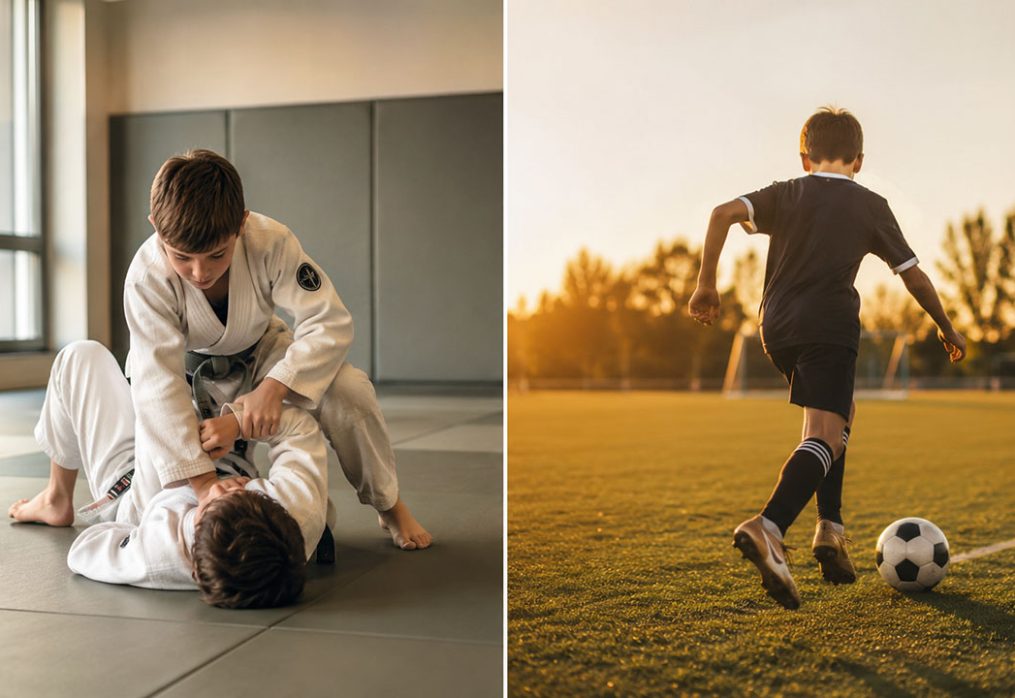

BJJ vs Football for Building Confidence in Children
If you are trying to build confidence in your child through sport, the choice between BJJ vs football is one you may already be weighing up. Football is the default. Almost every child in Dubai has played it in some form. It is easy to sign up for, widely available, and familiar to most parents. BJJ is the newer option, less well-known, but growing rapidly in popularity precisely because parents are noticing what it does for children in ways other activities do not.
Both can build confidence. The question is not which one is objectively better, but which one is likely to build confidence in your specific child, given who they are and what they need. This article compares BJJ vs football on the specific dimensions that actually matter for confidence, and helps you work out which is likely to be the better fit.
We run a BJJ academy, so we have a point of view. But we have tried to be fair to football throughout, because it genuinely has strengths that BJJ does not have. The goal here is to help you make a good decision for your child, not to sell you on our discipline over another.
Why the Choice Matters
Confidence in children is not built by any activity in the abstract. It is built by the specific mechanisms an activity uses to give a child accumulated experiences of struggle, mastery, and belonging. Different sports do this differently. When you are weighing BJJ vs football for your child, you are really weighing two different confidence-building mechanisms. Both work. But they work in different ways, and they suit different children.
Getting this wrong is not catastrophic. A child in the wrong sport will still get some benefits. But getting it right can transform the whole picture. A child who was struggling to build confidence in one setting can flourish in another, and the trajectory of their childhood shifts because of it.
What the Research Says About BJJ vs Football
Before we get into the specifics, it is worth knowing what the research actually shows about team sports versus individual sports for children’s confidence. The picture is more nuanced than either camp usually admits.
Team sports like football have well-documented benefits for what researchers call collective self-esteem, the sense of belonging to a group, of contributing to something bigger than yourself, of being part of a shared identity. A 2024 study found that children who played team sports showed better executive function and interpersonal awareness than children who played only individual sports.
But the picture flips when you look at personal self-esteem measures. A longitudinal study published on ScienceDirect tracking nearly 3,000 children in the Netherlands from age 10 to 13 found that individual sport participants scored higher on personal self-esteem measures than team sport participants. Another study using the Rosenberg Self-Esteem Scale found individual athletes scored significantly higher on personal self-esteem than team athletes.
The take-away is not that one is better than the other. It is that they build different kinds of confidence. Team sports like football build the confidence that comes from belonging. Individual sports like BJJ build the confidence that comes from personal mastery. Neither is universally superior. The right choice depends on which kind of confidence your child needs most.
How Football Builds Confidence in Children
Football has real strengths for children’s confidence, and it is worth being clear about them.
Belonging to a team
Being part of a team gives children an identity. They are the goalkeeper. They are the striker. They belong to something. For a child who feels isolated or uncertain about their place in the world, being on a team provides a ready-made sense of belonging that is genuinely valuable.
Shared achievement
Winning a match as a team, or losing one together, produces bonding experiences that children rarely get elsewhere. The shared emotional highs and lows of team sport build friendships and social confidence in ways individual activities can struggle to match.
Physical exercise and coordination
Football develops general athleticism, cardiovascular fitness, and coordination. Children who play regularly become physically capable in ways that carry into other parts of life.
Widely available and social
Football is easy to find in Dubai. There are clubs, school teams, and social matches. A child who plays football has ready-made social opportunities in a way that is harder to arrange for less mainstream activities.
Where Football Can Struggle to Build Confidence
Football also has some structural features that can work against confidence-building, particularly for certain children. This is where BJJ vs football starts to look different, depending on who the child is.
The bench problem
In most football teams, some children play more than others. Children who are less skilled, less physically developed, or less naturally coordinated often find themselves on the sidelines watching. This is one of the most direct ways an activity can undermine confidence rather than build it. A child who is repeatedly told, in effect, that they are not good enough to be on the pitch does not build confidence. They build the opposite.
Public performance
Football is played in front of an audience. Parents watch. Other children watch. Mistakes are visible. A child who is anxious about being seen to fail often finds this environment excruciating. The very act of participating exposes them to the risk they fear most. Some children thrive on this. Others shrink.
Comparison to peers
In team sport, children are constantly measured against one another. Who scores the goals. Who plays the most matches. Who makes the A team. The comparison is unavoidable, and it can produce sharp inequalities of confidence within the same squad. A child who is genuinely good at football builds confidence quickly. A child who is not can lose it just as quickly.
Skill ceiling
Some children discover early that football is not their sport. Their coordination is different. Their physicality is different. Their brain works differently in fast-moving group situations. For these children, no amount of training seems to close the gap with more naturally talented peers, and the persistent gap becomes evidence of inadequacy rather than a spur to improvement.
How BJJ Builds Confidence in Children
BJJ builds confidence through a different mechanism, and understanding it is central to the BJJ vs football question.
Everyone trains, every session
There is no bench in a BJJ class. There is no first team and reserve team. Every child who turns up trains. This one structural feature matters enormously for children whose confidence has been undermined by being sidelined elsewhere.
Progression is personal, not comparative
Children in BJJ progress through stripes and belts based on their own development. They are not measured against the fastest child in the room. They are measured against where they were three months ago. This creates a very different psychology. Each child’s confidence is built by evidence of their own improvement, not by their standing in a competitive hierarchy.
Failure is private and normal
When a BJJ technique does not work, only the training partner sees it. There is no audience. There is no scoreline. Every child in the class fails multiple times every session, and that failure is understood by everyone as part of the process rather than as an exception to it. Our article on does martial arts make kids aggressive touches on the culture of the mat and how it shapes what children internalise about failure and effort.
Individual coaching attention
In a good BJJ class, the coach knows every child by name and works with them individually within the group. The child is seen. In contrast, a football team of 22 children rarely allows any one child to be the focus of the coach’s attention on any given day. For children who need to feel seen to feel confident, this is a meaningful difference.
Physical confidence without hitting
BJJ builds real physical confidence, the felt sense that you can look after yourself in a difficult situation, without teaching children to hit anyone. This particular form of physical confidence has a way of settling children internally in a way that carrying a football around a pitch does not. Our article on how jiu jitsu builds confidence in children covers the mechanism in more depth.

BJJ vs Football: Which Suits Which Child?
The BJJ vs football question rarely has a universal answer. Here is a rough guide to which suits which child.
Football tends to suit children who
Are physically well-coordinated for their age and enjoy fast-moving team play. Thrive on shared emotional experience and group identity. Are relatively confident and enjoy being watched. Naturally cope with being compared to peers. Already have a solid friendship group who play together.
BJJ tends to suit children who
Are shy, sensitive, or anxious in busy group settings. Have low confidence that has been eroded by previous experiences of exclusion. Struggle to keep up with fast-moving group sport. Prefer smaller, calmer environments where they can be seen individually. Have been bullied or feel physically insecure. Are quirky, thoughtful, or introverted rather than boisterous. Need to build genuine, earned confidence rather than performative confidence.
A useful test: does your child come alive in a large, loud, competitive group, or do they retreat? Children who retreat often build confidence more effectively through BJJ. Children who come alive often build confidence more effectively through football. Neither response makes them better or worse. They are simply differently wired.
Our article on how to help a child who struggles socially covers this dynamic in more depth, particularly for children whose social confidence has been affected by group settings.
What About Children Who Have Already Tried Football?
Many parents come to us in the BJJ vs football decision having already tried football. Their child did it for a season, maybe two, and something did not stick. They stopped enjoying it, or asked to quit, or drifted away.
This is worth paying attention to. It does not necessarily mean football was wrong for them. Sometimes children quit sports for reasons that have nothing to do with the sport itself. But if the pattern is repeated, if your child has quit football and other team activities, it may be telling you something about which environments they need. Our article on why your child quits everything covers this in detail, and it is worth reading if you are considering BJJ vs football specifically because football did not stick.
What we have seen in these cases is that children who did not thrive in football often flourish in BJJ, precisely because BJJ offers the opposite of what did not work. Small groups instead of large. Individual attention instead of collective attention. Personal progression instead of comparison. No bench. No audience. No public failure.
The Long-Term View: BJJ vs Football Over Years
Both BJJ and football can be pursued for years, but the shape of that long-term commitment differs considerably.
Football tends to become more competitive as children get older. The teams stratify. The children who show promise are pushed into higher levels. The children who do not, drift away. By adolescence, only a fraction of the children who started football at age 6 are still playing regularly. For those still playing, the experience becomes intensely social and competitive. For those who have drifted away, the sport is often a source of low-grade regret or a memory of not making the grade.
BJJ has a very different long-term structure. Because progression is personal and there is no cut, children who start young often continue for many years. The transition from child to adolescent to adult happens seamlessly on the mat. A child who starts BJJ at 6 often finds themselves training at 16, having built a decade of accumulated skill, self-knowledge, and confidence in a single, consistent setting. Our article on why consistent training helps children behave better at school covers the compounding benefits of long-term consistent training.
This long-term consistency is one of the underrated features of BJJ vs football. A child who trains BJJ for eight years is building something considerably more substantial than a child who plays football for two years and drifts away.
What About Doing Both?
The BJJ vs football question is often presented as either-or, but many children do both. Football two or three times a week and BJJ once or twice a week is entirely doable, and there are children in our academy who do exactly that.
The benefits complement each other. Football builds the collective side of confidence: belonging, shared experience, team identity. BJJ builds the personal side: individual mastery, self-regulation, physical self-assurance. A child who does both often gets the best of both.
The caveat is that consistency matters. A child who spreads themselves too thinly across too many activities does not build depth in any of them. Our article on how to build confidence in a child covers the importance of consistency for genuine confidence-building. If you are going to do both BJJ and football, commit to both properly rather than dabbling in each.
BJJ vs Football on Practical Considerations
A few practical points worth being aware of when weighing BJJ vs football for your child.
Safety
Both are safe when well-run. Football carries injury risk from collisions, twisted ankles, and occasional serious impacts. BJJ carries injury risk from joint pressure and awkward falls. Neither is unsafe. The academy or club matters more than the sport.
Cost
Both are broadly comparable in Dubai. Football club fees and BJJ academy fees sit within a similar range. Kit costs are higher for football initially (boots, shin pads) but the ongoing costs are similar.
Time commitment
Football often involves weekend matches, which are a significant time commitment for families. BJJ classes are shorter, more consistent, and do not usually require weekend travel unless your child competes.
Weather
This matters in Dubai. Football is often played in high heat unless it is indoor or evening. BJJ is always indoor and always temperature-controlled. For children who suffer in the heat, BJJ is easier on the body.
How We Structure BJJ for Different Ages
If BJJ starts to look like the better fit in your BJJ vs football consideration, it is worth knowing how we structure the training. Our programmes are grouped by age. The Penguins for ages 4 to 6 use movement games and simple positional play. The Foxes for ages 7 to 9 introduce genuine technique and partner work. The Cranes for ages 10 to 12 go deeper technically and start to introduce controlled sparring. The Dragons for ages 13 and above train at the highest intensity within our children’s programme.
Our teaching approach follows the 3D method, Discover, Develop, Demonstrate, which is specifically designed to build the kind of confidence that BJJ is well suited to producing. If you want to see how a first session works before deciding between BJJ vs football, our article on what happens at a kids BJJ trial class in Dubai walks through it in detail.
Getting Started
If BJJ vs football is a decision you are trying to make and you would like to try BJJ first before committing, the best way is to come and watch a class. See how we run things, meet the coaches, and let your child try a session with no obligation attached.
You can see how we run our programme on the programmes page, check class times on the schedule page, and reach us via the contact page with any specific questions.
When you are ready, book your child’s free trial here. If BJJ is not the right fit after the trial, we will tell you so honestly.
Frequently Asked Questions: BJJ vs Football for Building Confidence
Which is better for building confidence, BJJ or football?
Neither is universally better. They build different kinds of confidence. Football builds the confidence that comes from belonging and shared achievement. BJJ builds the confidence that comes from personal mastery and self-regulation. The right choice depends on your specific child.
My child is shy. Which is better?
For most shy children, BJJ tends to be a better fit. The environment is calmer, the coaching is more individual, and there is no audience to perform in front of. Football can work for shy children too, but the busy, competitive nature of team play often reinforces rather than reduces shyness.
My child loves football but is not making the team. Should I switch them to BJJ?
Not necessarily. If your child genuinely loves football, do not take that away from them. But you could add BJJ alongside football, particularly if being left off the team is starting to affect their confidence. A child who trains BJJ builds an internal source of confidence that is not dependent on making a team.
Can BJJ replace team sport for social development?
Partly. BJJ builds social skills through consistent partner work and long-term relationships within the academy, but it does not build the specific team-based social skills that football does. If your child needs strong team-based social development, adding one team activity alongside BJJ can be worthwhile.
What if my child has already tried football and quit?
This is one of the more common reasons parents look at BJJ. Children who have not thrived in football often flourish in BJJ, because BJJ offers the opposite of what did not work: small groups, individual attention, personal progression, no bench. Our article on why your child quits everything covers this pattern in detail.
How quickly will I see confidence improvements?
Small shifts often appear within four to eight weeks of consistent training in either BJJ or football. More meaningful and durable confidence-building typically takes three to six months. In both cases, consistency matters more than intensity.